In January 2022, Adam Winnick had a problem that would be familiar to anyone who has ever organized a dinner: too many people, too few places. Medici LA had 130 spots. Fifty were being offered first to participants in the previous program. That left 80, and a small arithmetic exercise with unusually large financial implications.
Winnick published his reasoning. He wanted three crypto participants for every two from traditional finance. Within the crypto contingent, he wanted two protocols for every fund manager. The point was to get people building networks into conversation with people capable of funding them. A conference organizer might count badges. Winnick was counting relationships.
His final test was a question: “Can you help us on our mission?” It gave the invitation a job to do. A seat was an opportunity to contribute something useful. For a business built around the promise of networks, the arrangement was pleasantly literal: start by making a useful network of people.
Before tokens, there were bonds
The instinct had a family history. Winnick’s father worked at Drexel and helped develop the high-yield bond market. When Adam introduced the first Medici gathering in 2018, he joked that using the old, less flattering name for those bonds would make his father angry. Financial vocabulary can be a surprisingly delicate family heirloom.
Winnick began his own career in high yield in 1997, originating securities and later investing through a collateralized debt obligation. He knew the distance between an unfamiliar financial instrument and one an institution will hold. By the time he founded Medici, that distance had become the subject of his work.
The inaugural gathering took place in Beverly Hills during the Milken Global Conference. It was intimate and off the record, with an exception for SEC commissioner Hester Peirce’s remarks. Winnick’s interest was personal as well as professional: he had watched an earlier market acquire institutional acceptance. Digital assets offered another version of that difficult transition.
A detour through the shopping list
His route to blockchain included a business with a very different vocabulary. In 2013, Winnick, Kevin Stone, and YouTube creator Elle Walker launched Subblime, a platform connecting creators, their audiences, and lists of favorite products. Its inspiration came from Oprah’s famous recommendations. A shopping list could become a business relationship.
At a lunch at Swinger’s in Santa Monica, Winnick explained his interest in the combination of authenticity, relatability, and trust. He wanted creators to understand their audiences and build businesses around those relationships. Subblime’s ambitions extended beyond attaching a purchase link to a video.
That June, he was also discussing the model at the TV of Tomorrow show in San Francisco. The problem was practical: how could creators connect more directly with advertisers and earn from the audiences they had assembled? The people making the content had built something valuable. Winnick was working on a way for them to receive more of its commercial benefit.
The room came before the fund
Winnick’s investing experience stretched beyond consumer platforms. He co-founded ITU Ventures, working on the commercialization of university technology, and co-founded iCrete in construction materials. In 2016, he founded Caravan Growth to provide equity, debt, and combinations of the two to technology companies. Economics at Tufts and an MBA at Stanford sat alongside experience operating businesses.
Medici began in 2018. Finality Capital Partners followed in 2021, established with Kamal Mokeddem. That sequence matters. The community existed before the investment vehicle, and Winnick publicly worried about what the new business might do to the old one.
He wanted Finality to grow without turning Medici into a sprawling gathering for a fund’s investors. “I hope to grow Finality, but not at the expense of Medici,” he said. The concern was concrete: a community with its own purpose could become an accessory to someone’s fundraising. He was putting that tension on the table while the venture was still new.
- Subblime launches
- Caravan Growth begins
- Medici’s first gathering
- Finality is established
Changing the company you keep
Winnick changed the room as the industry changed. By 2021, he had increased the presence of protocol founders and reduced that of crypto fund managers. He wanted institutions to hear directly from the people building the systems. He also distinguished between an institution investing in cryptocurrency and an institution actually owning tokens.
In Singapore in 2023, he gave Medici’s next expansion a different emphasis. Los Angeles had promoted institutional adoption; Singapore would encourage enterprise adoption. The inaugural Asian gathering took place at Raffles. His opening remarks borrowed examples from Singapore’s history to argue for ownership, planning, and connections beyond one’s immediate community.
He even compared Medici’s bridging role to Singapore’s use of English alongside mother tongues. A specialist community needed a way to communicate outside itself. For an investor, translation was becoming part of the work: between founders and allocators, between finance and technology, and between people who used the same words to mean rather different things.
The eighth-grade test
In December 2024, Winnick took his argument to his eldest son’s eighth-grade “Money Matters” class. It was an audience without an investment committee, which removed at least one layer of ceremony. The subject was why crypto mattered. He later wrote that the presentation had become useful in conversations with endowments and sovereign wealth funds.
His explanation moved through money as a technology, the creation of trust, and networks that people could participate in. He used wheels, carts, motors, and highways to explain layers of blockchain infrastructure. The metaphors gave an abstract system something a student could picture.
He also acknowledged that he preferred the terms blockchain or digital assets to crypto. His central phrase was “private property on the Internet.” It captures his ambition in language considerably shorter than a fund presentation. Whether addressing students or institutions, he was asking listeners to imagine themselves possessing part of the digital environments they already helped make valuable.
“Private property on the Internet.”
ADAM WINNICK / HIS EXPLANATION FOR EIGHTH GRADERS, 2025
An alliance for the unglamorous parts
Ownership, in Winnick’s account, requires machinery. In July 2024, he introduced himself as president and co-founder of the Shared Security Alliance, which he said had attracted more than 40 members in its first two months. Its participants included restaking platforms, node operators, service providers, and application developers.
He drew on earlier experience as an SAP integration partner to explain why applications need supporting services. Decentralized applications would also need middleware, the software that lets different pieces work together. Shared security was part of his proposed answer to the cost of securing all those pieces separately.
The alliance’s agenda included questions that rarely make glamorous conference posters: which platform to choose, what to charge, which distribution channels to use, and when to issue a token. Sometimes, whether to issue one at all. The ambition had returned to operating details. An appealing idea about ownership still needed developers, customers, and a service someone would use.
Taking your data with you
By his 2024 Singapore keynote, Winnick was discussing how blockchain applications might compete for users of established internet services. He focused on ways for people to verify information from existing accounts and bring it elsewhere. In his argument, better technology could make token incentives more precise and applications more useful.
His October 2025 Singapore remarks carried that interest into the emerging world of AI agents. He asked what would let a person move prompt history or an online reputation between services. The underlying concern was the power of platforms that hold valuable information about their users while making departure difficult.
These were proposals about how the internet could develop. They also connected to the older problem he had encountered with creators: a person helps generate an audience, a reputation, or useful data, then depends on a platform for access to it. Winnick’s investment argument increasingly concerned the tools that might give that person greater control over the relationship.
Privacy enters the room
In February 2026, Winnick added another requirement to his account of adoption: programmable privacy. He argued that everyday users would hesitate to transact if doing so exposed their wider financial history. Institutions, meanwhile, needed ways to establish facts without making everything public.
His presentation reached for the Infinity Gauntlet from the Avengers films, treating privacy as a missing piece that would let other capabilities work together. His talks can move from financial history to cinema without much warning. The references serve a consistent purpose: making technical systems recognizable before asking an audience to care about them.
For Winnick, privacy belongs within the infrastructure needed for participation. The proposition links a product concern with his ownership ambitions. People would need to prove enough to use a service while retaining control over information they did not want to disclose. His case for broader adoption had acquired another practical condition.
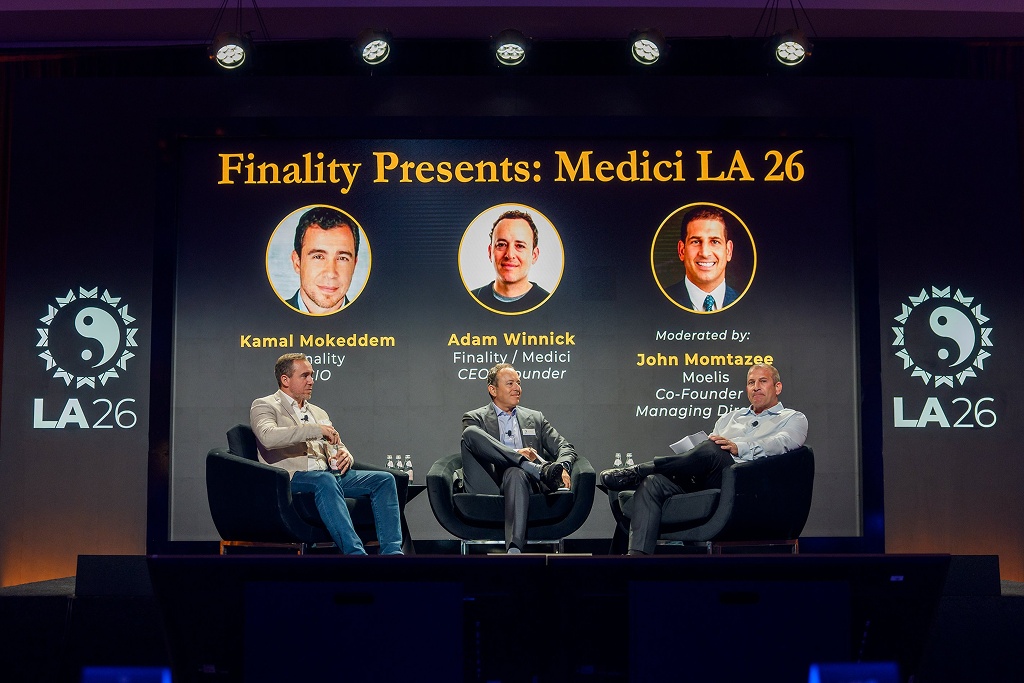
The chairs are still arranged for a conversation
At Medici LA 26, Winnick joined Mokeddem and moderator John Momtazee of Moelis for a discussion of stablecoins, tokenized markets, and the financial tools AI agents might require. The network’s published material now stretches from the first small Beverly Hills gatherings to conversations about deployment across financial institutions.
Finality’s current venture practice backs founders from pre-seed through Series A across blockchain, AI, and finance. Winnick serves as founding partner and CEO. The firm and Medici give him two ways to pursue related aims: invest in what gets built, and bring together people who might help it find a place in the world.
The 130-seat plan remains a useful way to understand him. It shows a founder treating the composition of a room as consequential work. Someone has to decide who should meet whom, what each might contribute, and why either should return. For Winnick, a guest list has been one way to begin answering a much larger question about participation.