A hotel room has an awkward relationship with time. Leave it unsold tonight and tomorrow you cannot put it in a sale bin beside yesterday’s croissants. The bed remains, the lamps remain, the opportunity has gone. Patrick Bosworth built a business around helping people make a better decision before that happened.
His route to that problem ran through government, business school and the casino floor. At Wynn Las Vegas, he became director of yielding and business strategy, responsible for revenue management at both Wynn and Encore. The job concerned prices, certainly, but also the behavior of the people paying them. A resort can sell the same accommodation through several channels, to guests with very different reasons for arriving.
That makes the apparently simple question at the front desk - how much for a room? - a rather crowded meeting. Marketing has an opinion. Sales has commitments. Tomorrow’s demand might bear little resemblance to today’s. Bosworth’s eventual answer was to help build Duetto, a software company whose origins were considerably less glamorous than its Las Vegas surroundings: consulting work, spreadsheets and a stubborn operational problem.
Before the software, the spreadsheet
Bosworth studied political science at the University of San Diego and earned an MBA at Harvard Business School. His earlier work at the U.S. Department of Labor involved modernizing financial reporting standards that had gone largely unchanged since the 1950s. Before he was asking hotels to reconsider their systems, he had worked on changing an established reporting regime in Washington.
The hospitality experience gave his next venture a specific starting point. In 2010, Bosworth and Marco Benvenuti launched Duetto Consulting. They worked with hotels on improving profits, developing tools in Excel. Their ambition extended beyond improving results for a single employer: they wanted ideas developed in operations to be useful across the industry.
The pair initially explored working with existing technology businesses. When that route failed to produce what they needed, their own tools became the starting material. The spreadsheet had done its useful work. Turning it into something many hotels could use required another kind of expertise.
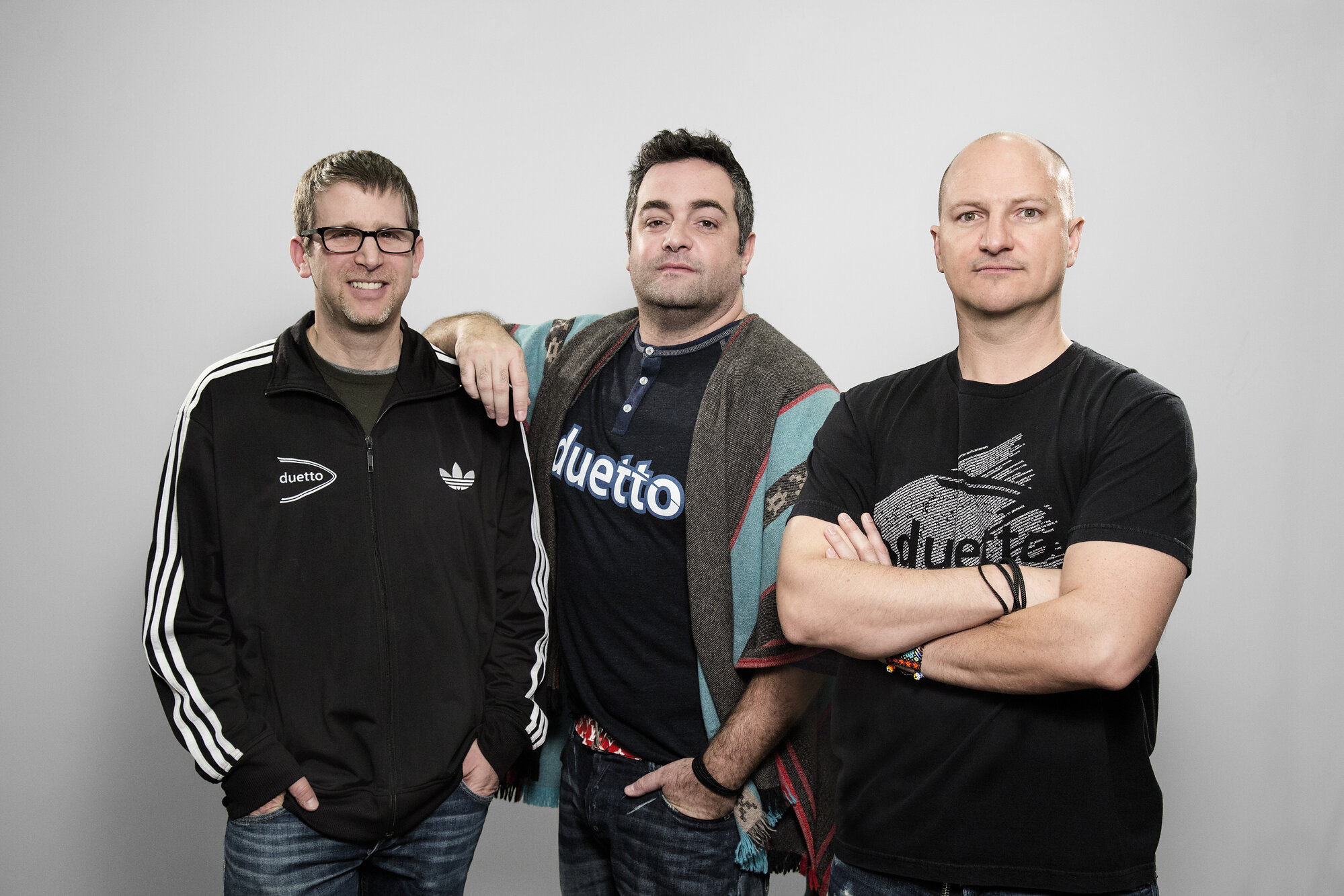
Craig Weissman, previously Salesforce’s chief technology officer, joined as the third co-founder. He brought experience building cloud software that could serve many customers. Duetto’s software business dates to 2012. The combination mattered: two founders knew the hotel’s problems from inside the building; the third knew how to make software travel beyond it.
An origin story without the lightning bolt
Bosworth did not dress this up as a sudden revelation. In an early interview, he described a gradual recognition that hotels needed new technology to respond to changing demand and use new sources of data. The founders were learning from customers as they built. There was no conveniently cinematic moment when a room key hit the floor and the future became obvious.
Even the name carried an emphasis on partnership. Duetto suggested working together, including with customers. By January 2013, the young business had paying users and pilots across several kinds of accommodation, from economy hotels to resorts and casinos. It had also closed a $10 million Series A round the previous month.
An early practical difficulty was deciding which opportunities to decline. A small company can see more possibilities than it has people to pursue. Bosworth identified hiring and the pace of taking on customers as constraints. The idea might be ambitious; the diary and payroll still imposed their own opinions.
“There was no specific ‘aha’ moment.”Patrick Bosworth · 2013
A room rate with room to move
Duetto introduced GameChanger and its Open Pricing approach in 2014. The principle was to let hotels price different channels, customer segments and room types independently. A change in one rate did not have to drag all the others along behind it. That gave the people running the property more scope to respond to the demand in front of them.
The distinction becomes particularly interesting in a casino. In 2019, Bosworth described the rigidity of older categories: a guest might qualify for a complimentary room, a casino rate or the regular cash price. Yet the value of offering that guest a room could change from one date to another. A fixed category could get in the way of a sensible offer.
He argued for letting a property offer a complimentary stay when circumstances justified it, while charging on other dates. The point was to match the decision to the day. Automation could handle recurring patterns, leaving staff to examine exceptional circumstances and exercise judgment. The computer would have plenty to do without receiving a complimentary suite of its own.
The product still needed a sales conversation
Understanding hotels did not automatically equip the founders to sell software at scale. Early sales depended on Bosworth and other executives. They could win business, but a growing company needed a process that new people could learn and repeat.
Their work with sales consultancy Skaled exposed a familiar founder’s temptation: expecting a strong product to do the persuading. Together they worked on how to present Duetto’s value, organize the sales operation and make better use of Salesforce. A useful tool still needed a clear explanation and a dependable way to reach the next customer.
It is an instructive detail in a business founded partly on technical capability. The company had recruited a former Salesforce CTO; it still had work to do in how it used sales technology itself. Expertise comes with a job description, and the job description keeps changing.
The CEO job kept changing underneath him
By 2015, Bosworth was describing a role that changed substantially every six months. Raising the first money, recruiting early employees, getting a product out and finding its first buyer gave way to the demands of running a growing organization. Skills that helped a founder get started needed company of their own.
Lee Pillsbury became an important guide. Thayer Ventures had invested early, and Pillsbury subsequently invested personally and joined Duetto’s board. Bosworth said they spoke at least weekly. Their conversations helped him become more comfortable leading as CEO, rather than carrying so much of the work himself.
He valued a mentor who could disagree forcefully while keeping attention on the outcome. Someone who had experienced business cycles could also bring calm. By the end of 2015, Duetto was serving nearly 1,000 hotels in more than 50 countries. Bosworth was learning the management job while the size of that job continued to grow.
Eighty million dollars, and a simpler promise
In February 2018, Duetto announced an $80 million Series D financing led by funds affiliated with Warburg Pincus. At the time, its software served more than 2,500 hotels and casinos across over 60 countries. Investors were backing a company with an established international customer base, alongside plans for more products and expansion.
Bosworth’s explanation of the work grew increasingly concerned with making customers’ lives easier. By 2019, he was pushing back against his own profession’s tendency to make revenue management sound forbiddingly arcane. Hoteliers had reasons to distrust another elaborate technology pitch. They had bought things before that failed to deliver.
He argued that revenue professionals bore some responsibility for the slow adoption of their tools. The language and the process needed to become simpler. Owners and operators needed to see practical value quickly: less manual work, better decisions and more control over daily operations. A hotelier already has enough complications without buying a subscription to several more.
There was an organizational argument, too. Bosworth urged sales, marketing, revenue and operations to coordinate their decisions, and pressed hotels to examine which mix of business actually produced profit. More occupied rooms alone would not resolve rising costs. His interest lay in what each booking contributed and how a hotel made the decision to accept it.
Funding led by Warburg Pincus affiliates.
At the time: 2,500+ properties in 60+ countries.
Knowing when to give someone else the keys
The company’s next transition involved its founder. In autumn 2019, Bosworth moved from CEO to executive chairman. David Woolenberg, who had joined as chief revenue officer, became president and chief operating officer with responsibility for leading the business. Woolenberg was named CEO in January 2020.
The handover came during growth. Duetto reported a 40 percent increase in revenue and headcount in its 2019 leadership announcement. The arrangement gave Woolenberg responsibility for daily execution while Bosworth could work on vision, customers and the executive team. Founding a company and being the person who should run every subsequent stage are separate questions. Duetto’s leadership change addressed the second one.
By 2021, Bosworth was sharing his experience as an entrepreneur in residence with Cornell’s Pillsbury Institute for Hospitality Entrepreneurship. His listed areas of expertise were SaaS, hotel revenue, fundraising and global scaling. He had also moved into work at Royalton Investment and advised businesses outside hospitality software. The sequence reads like a widening of his working life after years spent building one company.
The hotel problem keeps finding him
Duetto continued beyond its founding chapter. GrowthCurve Capital acquired the company in June 2024, when it reported more than 6,000 hotel and casino resort properties using its applications. The transaction’s financial terms were not disclosed. Those figures describe the business’s later development; they belong after Bosworth’s CEO tenure in the story.
Bosworth, meanwhile, remains connected to hotel technology. Katapult’s current client material identifies him as founder of Vacant.com, where his comments concern progressing an iOS product while managing spending. Vacant offers independent hotels software for reservations, payments, guest communication, check-in and distribution. The scale of the operator may change; the need to make daily work manageable remains recognizable.
A recurring quality in Bosworth’s public comments is his willingness to question his own assumptions. Asked what founding Duetto had taught him, he emphasized the danger of becoming too certain of one’s opinions. That sits comfortably beside a venture that began without a single revelation, learned through consulting and eventually changed its leadership.
A hotel sells a particular night once. Building the systems behind that sale takes years of revision: a spreadsheet becomes a product, a founder becomes a manager, a manager makes room for a successor. Bosworth’s story is full of those adjustments. The room may look the same tomorrow. The decision behind its price has had quite a journey.