A guest checking into Balfour Miami Beach encounters a hotel with a history stretching back to 1940. There are 82 rooms, an Art Deco pedigree, an Eastern Mediterranean restaurant and a neighborhood café. The name on the building is Balfour. Wyndham supplies the Registry Collection affiliation. In January 2026, Evolution Hospitality took over management. Three identities, one stay. The interesting business is the one the guest may never notice.
- Hotel owners hire Evolution to run properties, build demand and improve operating performance.
- Its in-house specialists connect hotel operations, digital marketing and restaurant development.
- A disclosed hotel contract shows the economics: revenue-based fees, plus a profit incentive.
Evolution occupies that space between a property's identity and its daily execution. It manages independent, boutique, luxury and soft-brand hotels, with services reaching from new openings to rebranding. Its paying customers are owners and investors. Guests experience the result through rooms, restaurants and service. An owner buys the ability to coordinate all of those moving parts without building an entire management organization.
01 / A new name. An existing engine.
Evolution began in January 2011, when the management division of Tarsadia Hotels emerged from a restructuring of that business. Founder John Murphy had already led the division. This was a launch with operating experience behind it: nine assets at the start, according to his later biography. The company inherited an owner's concern with property value alongside the hotelier's concern with service.
In 2017, executive Matt Raine described the origin neatly: “a new name but not a new platform.” That distinction matters. A hotel operator's useful assets include recruiting systems, revenue expertise and people who know what happens when a restaurant opening slips. Those capabilities take time to assemble. Evolution could sell the accumulated knowledge under a fresh identity.
Aimbridge acquired Evolution in 2015. Murphy's biography records more than 100 assets by the end of 2019, including 75 open and 25 in development. Treat those as separate categories: a hotel on a drawing board cannot welcome a guest. Today, Evolution's own culture page describes a portfolio of over 90 hotels. The historical counts show expansion; they do not establish a continuous growth curve.
02 / The agency behind the room key
Consider the independent hotel's marketing problem. A recognizable chain name supplies a ready-made shorthand. A distinctive property has to explain itself: why this neighborhood, why this restaurant, why this room at this rate? Evolution keeps part of that explanation inside the company through Second Wave, its agency spanning e-commerce, marketing and creative services.
The work includes brand development, content, graphic design and websites for hotels, restaurants, bars and spas. Second Wave describes a dedicated account manager coordinating website builds with the hotel's marketing manager. That is an unglamorous detail with practical consequences. A beautiful site still needs someone accountable for getting it delivered and making it fit the property's commercial objectives.

Soft brands make this arrangement particularly relevant. Evolution lists relationships with collections including Marriott's Autograph, Hyatt's Unbound and Hilton's Curio. A property can keep an individual identity while participating in a larger brand system. Evolution supplies operating and creative expertise around that arrangement. Its proposition is the combination: a recognizable distribution relationship, a locally legible hotel and a team charged with making the business function.
03 / The restaurant has to add up
The same coordination problem appears downstairs. Taste & Theory, Evolution's culinary team, works on restaurant concepts, design, programming and operations. Its stated process begins with feasibility research and competitive comparisons. It extends to equipment consultation, procurement, hiring and training. A dining room has to survive contact with purchasing orders and payroll.
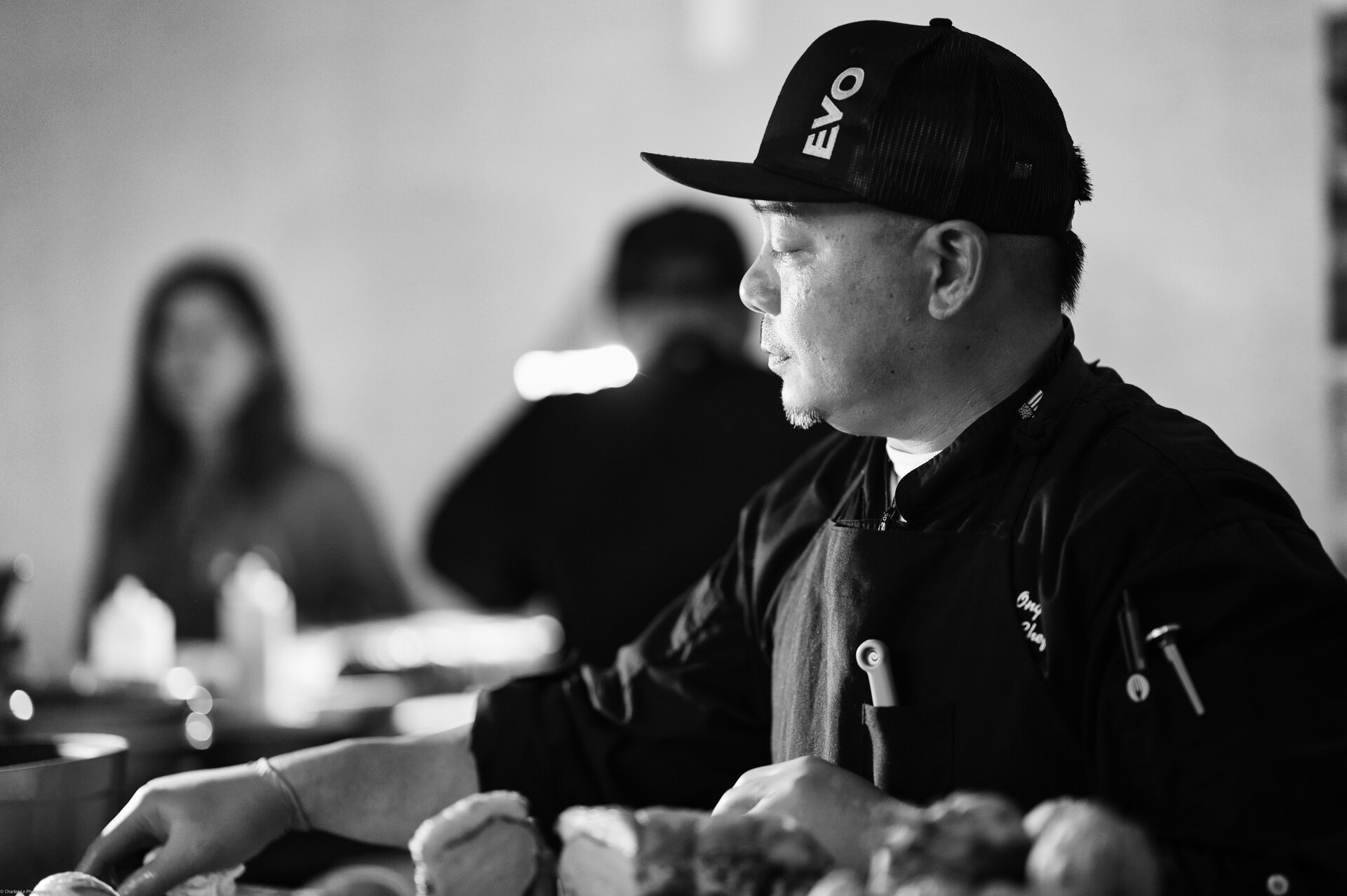
Financial forecasting is part of the offering, too: the team describes preparing a pro forma and return analysis. The useful idea for an owner is to examine a restaurant's appeal and operating demands together. A menu, a service model and a kitchen layout belong in the same discussion. Otherwise, the guest-facing promise can become expensive to deliver.
04 / What the owner actually pays
A public filing makes the business model unusually tangible. When DiamondRock acquired the 218-room Bourbon Orleans Hotel in July 2021, it signed a five-year management agreement with Evolution. The disclosed base fee was 2.5% of gross revenue in year one and 2% thereafter. An incentive fee paid 15% of operating profit above a defined owner's priority, capped at 1% of annual gross revenue.
Percentage of gross revenue. Separate profit incentive capped at 1% of gross revenue annually. Historical property agreement; terms vary.
These are historical terms for one property. They reveal the incentives more clearly than a slogan could. Revenue generates a base fee; exceeding a specified profit threshold can generate additional compensation. For an owner comparing operators, the questions follow naturally: which expenses sit outside the fee, how is profit defined, and what performance is required before an incentive becomes payable?
05 / Scale still has to earn its keep
Evolution's parent provides a useful caution. In early 2025, Aimbridge announced a restructuring converting more than $1.1 billion of debt into equity and providing $100 million in new capital. S&P subsequently confirmed the debt reduction. This was a parent-company balance-sheet event, distinct from Evolution's hotel contracts.
The operating lesson was sharper. In January 2025, Aimbridge CEO Craig Smith acknowledged that the group had overextended itself and reported losing roughly 23% of its hotels over two and a half years. Management introduced scorecards tracking guest satisfaction, market share and operating margins. Owner dissatisfaction and financial pressure forced a closer examination of what scale was delivering.
“Make it better than it was before.”Evolution Hospitality guiding principle
Evolution's culture makes improvement explicit, alongside direct feedback, humility and staff wellness. Those intentions need property-level evidence. Rival operators, including Davidson's Pivot and Sage Hotel Management, also combine lifestyle expertise with commercial discipline. An owner should compare the actual team, property fit and contract economics. The approach suits hotels whose individual identity can attract demand and support its operating costs. Where that demand is weak, extra creative complexity can consume the margin it was meant to create.
The transferable idea is simple: put the people who promise an experience close to the people who must deliver it. Evolution gives that idea an organizational home. The daily test happens at each hotel, in the distance between the photograph a guest books and the stay that follows.