Jonathan Friedman had the stock, the location and a friend to help. He had spotted inexpensive RC Cola in an Israeli supermarket and decided to resell it to drivers at the busy intersection below his family’s home. There was one difficulty with this otherwise promising teenage enterprise: the cans were warm. In the Israeli summer, this was a fairly comprehensive objection.
The next day, the boys returned with ice and a cooler. Sales improved. Years later, Friedman still told the story of that small correction. He had discovered the pleasure of making his own money, along with an inconvenient truth about customers: they buy the thing as they experience it. Your splendid reasoning about the price will not chill their drink.
That memory offers a useful way into his career. Friedman has built businesses, helped develop a payments product inside another startup and co-founded Demostack, a company concerned with what happens when software finally meets its prospective buyer. Again and again, the interesting work sits in the space between having something useful and helping another person see its use.
It is a space with plenty of room for embarrassment. A demonstration can contain an excellent product and still make an unconvincing case for buying it. The screen is empty. The example belongs to the wrong industry. Someone must explain away the data. Friedman eventually made that awkward interval the subject of an entire company.
A demo worth arguing about
His route into software passed through the Netherlands, where he studied business and finance at Rotterdam School of Management, Erasmus University. He also worked on businesses while studying, including Print-Center.nl and StudentEvents. Building something was already part of his education, rather than a reward to be collected once the studying was finished.
Reactful brought him into website conversion optimization and into a working relationship with Aaron Hakim. Their later partnership at Demostack had a useful piece of history behind it: they had already disagreed about a demo. Hakim wanted to invest in a particularly good one. Friedman was less certain that the investment made sense.
They went ahead. In a later recollection, Friedman said people remembered the demonstration years afterward. The detail is appealing because the future founder of a demo company had once needed persuading. He arrived at his eventual conviction by watching what happened when his colleague’s argument won.
A memorable demonstration can become part of how a company is remembered. Features are difficult to carry around in conversation. An experience is easier to describe to somebody else. Reactful gave the two founders a shared example of that difference, as well as a relationship they could bring to another business.
Two products, one engineering team
At TripActions, Friedman helped build Liquid, the travel payments and expense management product. His professional biography describes taking it from an early fintech idea to a strategic business unit in twelve months, then working on product strategy and marketplace functions. This was an opportunity to build inside a business that already existed, with a different set of constraints from starting alone.
The demonstration problem became unusually tangible there. An expense product needs transactions to show what it does. Yet financial information is sensitive, and an empty account is a poor tour guide. Friedman described the team making actual card purchases to generate material for demonstrations. The machinery built to manage spending needed somebody to spend before it could explain itself.
There was also a conflict over whose needs the software served. Engineers were improving the working product. Salespeople needed a version that could tell a coherent story on demand. Those audiences wanted different things, even when they appeared to be looking at the same application.
Friedman later described the realization as trying to build two products with one team. The working version had obligations to real users and real operations. The demonstration needed believable examples, a controllable route through the experience and details that made sense to the person watching. Treating the second job as incidental made it hard to give either audience everything it needed.
The working product
Real users
Real transactions
Operational demands
The version you show
Relevant examples
A controlled experience
A buyer’s point of view
When strangers ask to sign up
The idea for Demostack began with that friction. Friedman has described asking publicly whether other people had demo problems and receiving a rush of replies. Some respondents wanted to sign up already. For a founder deciding whether to leave an existing role, that response offered something more useful than polite encouragement.
He has urged entrepreneurs to look for unusually strong demand: people seeking another meeting, following up and making their interest difficult to miss. The distinction matters. Almost any idea can collect a few compliments. A prospective customer volunteering time is spending something the founder cannot put into a pitch deck on their behalf.
Tomer London, Gusto’s co-founder and chief product officer, encouraged Friedman to start again. In 2020, Friedman founded Demostack with Hakim and Gilad Avidan. The answer they pursued was a separate, customizable demonstration environment, giving the people selling software more control over the version they showed.
In practice, that meant copying the product experience and editing the demonstration without repeatedly asking engineering to prepare it. The attraction was practical. A salesperson could shape the example around the buyer’s world. The buyer could spend more of the conversation considering the product, with fewer interruptions to explain why today’s screen did not quite represent it.
“In startup years, every year counts as seven.”
Jonathan Friedman, 2022
The buyer has a clock, too
Friedman’s interest extended beyond producing a dependable screen. He also considered when a buyer should see it. In 2022, he developed a framework he called the demo efficiency frontier, connecting the time a prospect invests with the degree of personalization they should expect in return.
The principle is easy to recognize from the other end of a sales call. If a seller asks for several conversations before revealing the product, the eventual demonstration ought to reflect what those conversations established. Asking for more of somebody’s time creates an obligation to use what they have told you.
An early, relatively general glimpse can still be useful. Friedman proposed showing a short demonstration in the first conversation, then building a more specific one as the discussion develops. His framework leaves room for complex purchases and detailed discovery while taking the buyer’s impatience seriously. Software sellers have a process. Buyers have calendars.
His public teaching put that question in front of other operators. Demostack’s Demo HQ Day included his presentation of a Demo Maturity Model, alongside sessions on sales partnerships, product-led sales and running demo operations. The vocabulary can sound procedural, but the human question underneath it is familiar: how do you help someone understand enough to make the next decision?
More of their time.
More of their world.
A company after the cheque clears
Demostack announced a $34 million Series B in April 2022, led by Tiger Global, with participation from Bessemer Venture Partners, Amiti Ventures, GTMfund, Operator Collective and StepStone. The announcement put total funding above $50 million. A problem that began with the contents of a demo account now supported a funded business with international ambitions.
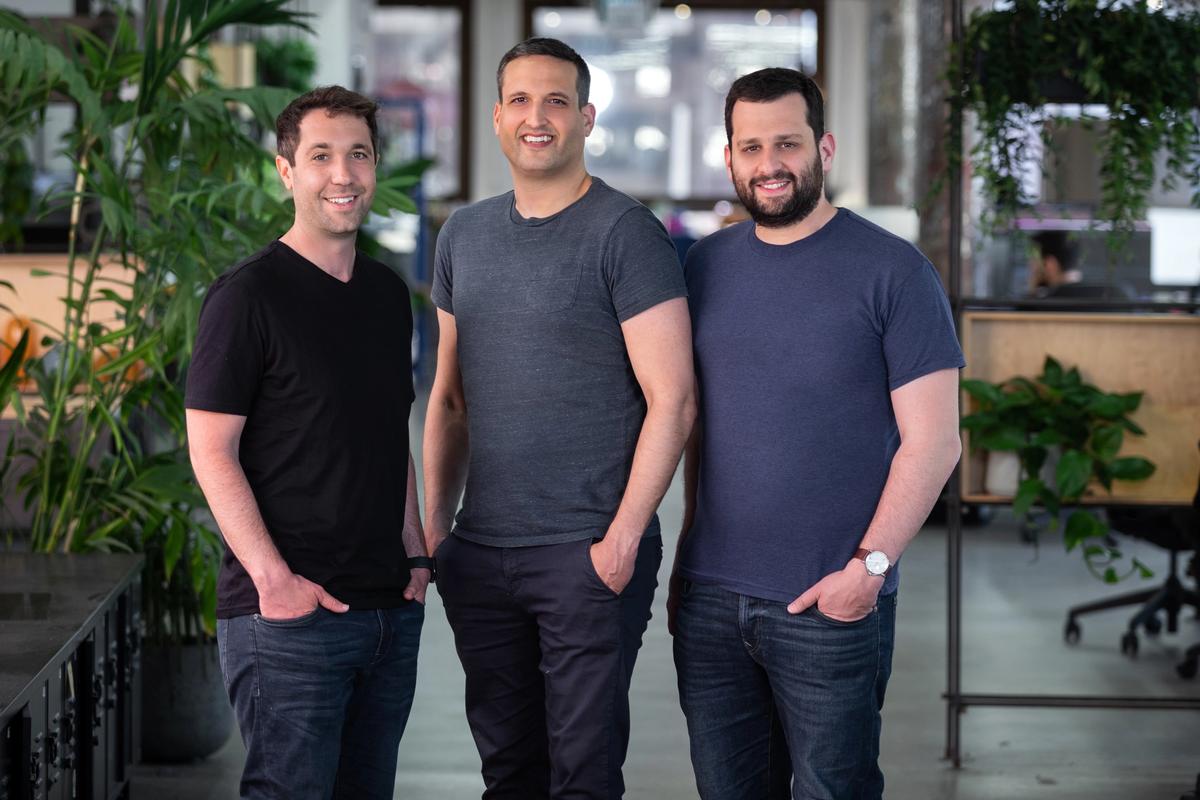
The founders’ 2022 photograph catches the three of them standing together in an office: Hakim, Friedman and Avidan. It is a useful interruption to the habit of telling a company’s story through its chief executive alone. The relationship with Hakim preceded Demostack; Avidan was part of its founding trio. The company required more than one person’s irritation with a sales screen.
Capital also brought the less photogenic work of operating through changing conditions. In a 2023 discussion with fellow founders, Friedman talked about growth during a downturn. The panel included Pocus’s Alexa Grabell, QuotaPath’s AJ Bruno and Cacheflow’s Sarika Garg, with cash management, business models and leadership on the agenda.
The setting adds a different scale to the origin story. An early customer can tell a founder what needs fixing. A larger company has to make choices across teams, spending and uncertain demand. The attractive simplicity of an idea survives only if people keep doing the complicated work around it. The cooler was the easy purchase.
Led by Tiger Global.
Disclosed company funding passed $50 million.
Leaving the chair, keeping the question
In April 2025, Friedman announced that he was stepping away as CEO, with Hakim taking the reins. His message thanked the team and customers, reflected on the company they had built and set out an immediate plan for travel. He also said he expected to return to building. The handover carried an echo of Reactful: the colleague who once argued for the demo would now lead the demo company.
By March 2026, he was discussing a different way of building businesses on Jorge Soto’s StartupsUnedited podcast. His interest was in ambitious companies with small teams and limited outside funding, made more feasible by AI and inexpensive infrastructure. He used the term indie startup for that possibility.
It is an interesting question for someone whose previous company raised tens of millions of dollars. His own experience gives him a reason to examine the relationship between the size of an ambition and the machinery used to pursue it. A smaller team may still want to build something substantial. The number of employees and the amount raised need not answer every question about the work.
There are other measures of ambition in his public remarks. He has spoken of wanting children in disadvantaged places to have better access to education, arguing that talent can emerge anywhere while opportunity remains uneven. That concern belongs alongside the product discussions: who gets a chance to do something with an ability or an idea?
Read across his ventures, an enduring interest comes into view. Friedman pays attention to the conditions around a product: the temperature of a drink, the example on a screen, the time a buyer gives up, the organization a founder chooses to build. The useful idea still has to reach another person. Sometimes the next improvement requires a company. Sometimes it requires ice.
Follow the conversation
Work, writing and conversations from across Friedman’s career.