The scratched CD had one reliable feature: it could summon a parent. A story would stick, a child would need help, and the supposedly simple business of listening became an adult’s job again. In Düsseldorf, Patric Faßbender had two daughters who loved audio stories. He wanted them to enjoy the choosing as well as the listening. In 2013, he began looking for something they could operate themselves.
Giving them a smartphone or tablet did not appeal to him. Nor did the available audio players. The search became a design project: what would a listening device look like if the child’s hands, rather than an adult’s habits, determined its shape? Faßbender was a graphic designer. He approached the problem through objects, gestures and the pleasures of picking something up.
His eventual answer would become the Toniebox. Put a little character on a padded cube and its story begins. Take it away and the story stops. A child gets to make the decision. For the grown-ups, there is the agreeable prospect of sitting down again.
An advertising career, redirected
Faßbender was born in Düsseldorf in 1970 and studied visual communication at the city’s Fachhochschule. His working life ran through freelance creative work in Germany and the Netherlands, then agency roles at planetactive and OgilvyOne. Between 2009 and 2013 he was OgilvyOne Düsseldorf’s head of creation. He had spent years making other people’s products understandable and desirable.
That background matters to the object he eventually made. A character is an unusually efficient piece of communication. A child can recognise a favourite hero without reading a title or navigating a menu. The packaging, the player and the choice of story can all speak the same visual language. Faßbender brought an advertising professional’s attention to that encounter.
He also brought the habits of a listener. He has described himself as a cassette child of the 1970s, with an attachment to audio drama. His new device would preserve the pleasure of hearing a story while changing the small domestic rituals around it. The ambition began at a scale he knew well: his own family.
Give the story a body
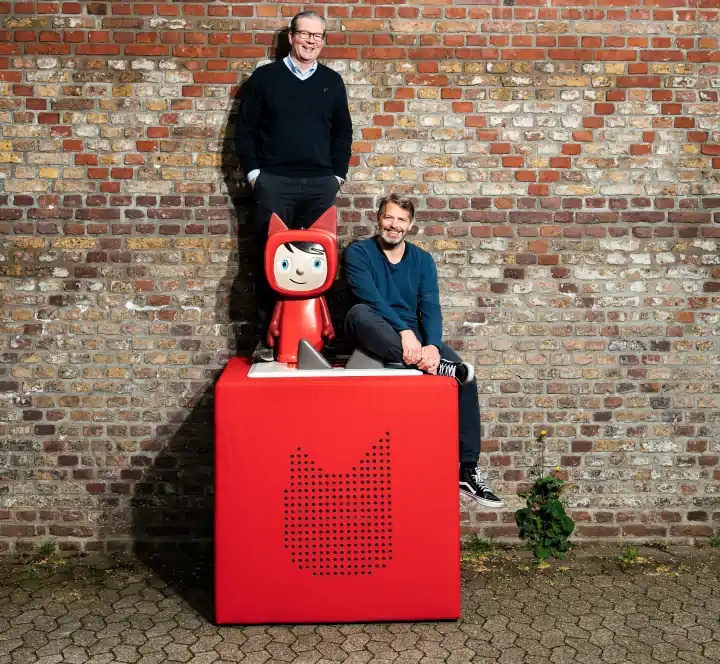
“Ich wollte das Hören anfassbar machen.” Faßbender’s explanation is compact: he wanted to make listening tangible. The figure was part of the concept early on. It gave an invisible activity something a child could hold, recognise and carry around. Choosing a story could have the same physical confidence as choosing a toy.
The device’s apparent simplicity concealed a connected system. The figures identify their audio; the box retrieves content and can keep downloaded stories available without a continuing internet connection. The child encounters the character. The adults building it have to make the electronics, software, content and manufacturing cooperate. A small audience can impose quite demanding specifications.
Creative-Tonies widened the idea. Families could add recordings of their own: a story from a travelling parent, a message, a grandparent reading aloud. The familiar voice could arrive through the same physical ritual as a published adventure. Faßbender spoke about this possibility with particular enthusiasm. A character on a shelf could stand for somebody the child actually knew.
He has also named the Preußler characters among the figures he was especially pleased to bring to Tonies. They were stories with an existing place in childhood, now asking to be handled in a different form.
Two fathers, three and a half years
Faßbender knew the limits of a sketch. To build the thing, he approached Marcus Stahl, an engineer he knew through their children’s kindergarten. The relationship started with mutual regard; friendship grew through the work. Their skills gave the partnership a practical shape: the designer’s concept needed engineering and commercial execution.
The first idea arrived in 2013. A sellable product took roughly three and a half years. Friends and family helped finance the development. Alongside the box, the founders had to assemble a brand, a catalogue and a way to reach shops. Every reassuringly simple action in the finished product represented work somebody had to do first.
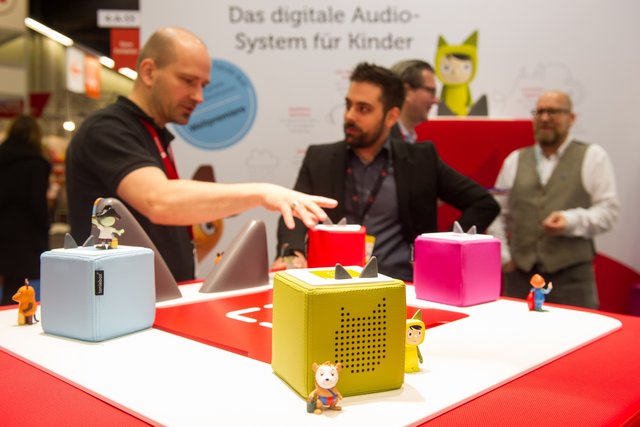
In January 2016 they took the Toniebox to the Spielwarenmesse’s press preview in Nuremberg. Their exhibition stand covered 46 square metres. On a limited budget, they enlarged the central idea: an oversized figure above a table-sized box. Even the trade-fair display behaved like a demonstration of the product.
Before facing the trade, Faßbender said, they had faced their own children and their friends’ children. It is hard to imagine an audience less interested in a founder’s presentation skills. The product had to earn attention on its own terms. The commercial launch followed in 2016, bringing several years of work into shops.
The trouble with being wanted
The early problem was soon availability. By the end of 2017, demand had outrun the founders’ planning. Faßbender later explained that 70,000 boxes had initially seemed an optimistic annual forecast. Actual sales reached 148,000. Manufacturing required a lead time of about 16 weeks. Christmas, inconveniently, declined to move.
Tonies bought urgent components at higher prices and used air freight to shorten delivery times. It also stopped selling boxes through its own online shop four weeks before Christmas to give retailers a better chance of receiving stock. Success had become a series of uncomfortable allocation decisions.
Faßbender recalled a bookseller whose telephone kept ringing after word spread on Facebook that one light-blue box remained. The anecdote is funny at a distance. For the people answering those calls, the difference between a popular product and a missing product was rather less charming.
The founders had already turned down an invitation to pitch on the television programme Die Höhle der Löwen. Faßbender’s explanation was practical: financing and distribution were in place. A single burst of publicity held less appeal than building demand gradually. They were discovering how quickly demand could grow without assistance.
He was equally clear about geography. Asked about moving to Berlin or Munich, he said they wanted to stay in Düsseldorf, where their families and employees were rooted. Growth could happen without packing up everybody’s home life.
A familiar gesture travels
International expansion began in 2018. Britain and Ireland came before the American launch in 2020. The gesture travelled easily; the business around it still needed local work. An audio catalogue, a retail relationship and a parent’s willingness to pay could not simply be translated word for word.
Faßbender had warned early on that German-speaking success would count for little in Britain. The market had different listening traditions and different price expectations. For a designer who had started with his daughters’ habits, expansion meant learning the habits of families he had never met.
In November 2021, Tonies became a publicly listed company in Frankfurt through its combination with a special-purpose acquisition company. On LinkedIn, Faßbender marked the occasion with visible excitement and thanks to colleagues. His most personal acknowledgment was to Stahl: the two had started as acquaintances and become close friends.
By their 2022 OMR podcast appearance, the founders were discussing American expansion, licensing, original stories and the stock market. The cube on the nursery floor now belonged to a much larger set of conversations. It still had to make sense to the child picking it up.
The decision to hand it over
At the end of 2023, Faßbender and Stahl stepped down as co-CEOs. Tobias Wann took over on 1 January 2024. The founders initiated the change themselves and remained connected as shareholders and senior advisers. Faßbender said the decision had been difficult, while expressing confidence that the company would benefit from Wann’s experience.
The distinction between inventing a product and continuing to run the resulting company had become personal. In their later account of the transition, the founders described an organisation whose size called for different processes and management. They spent time with Wann before the handover. Their judgment of the next leader became part of their responsibility to the company.
Faßbender’s advice to other founders is direct: “Making decisions is the most important thing. Even if they are wrong. Then you can revise them.” It is a useful thought from somebody whose most visible decision involved beginning, and whose later one involved stepping aside.
The connection continued to change. In 2025, Faßbender joined Tonies’ supervisory board. The designer who once worked out how a child should start a story now helps oversee the organisation carrying those stories into other homes.
“Making decisions is the most important thing. Even if they are wrong. Then you can revise them.”
Patric Faßbender
Still interested in what children can touch
His investment work offers a clue to what continues to interest him. Faßbender and Stahl backed a2zebra, the company behind the mathematics learning toy Tuktoro, in 2024. They increased their investment in its €2.5 million seed round in June 2025. The company combines physical play with digital feedback.
In a public LinkedIn post, Faßbender explained his enthusiasm through the relationship between handling things and learning. He praised the team and offered to introduce people to founder Elisha Benner. The connection to his earlier work is visible in the products themselves: both ask a child to do something with their hands.
He has described professional success in terms of reaching people who value what he makes. In a 2023 conversation about his working life, he linked his own sense of achievement to children using the Toniebox, while giving family and friendship a central place in his account of a good life.
By 2026, Tonies was reporting €630 million in revenue for the preceding year under its successor leadership. That figure belongs to the company and its team. Faßbender’s part in the story begins with something much smaller: noticing when a child needs help, and wondering whether a better object could give that child a little more freedom.
Keep listening
Conversations, the company and Faßbender’s public updates.
Patric Faßbender on LinkedIn ↗The Tonies founding story ↗Listen: the founders on OMR, November 2022 ↗Watch: Faßbender and Stahl, Turning Points ↗YouTube: Creative-Tonies video linked in his 2018 interview ↗Read: Faßbender on the early supply shortage ↗Tonies’ current supervisory board ↗