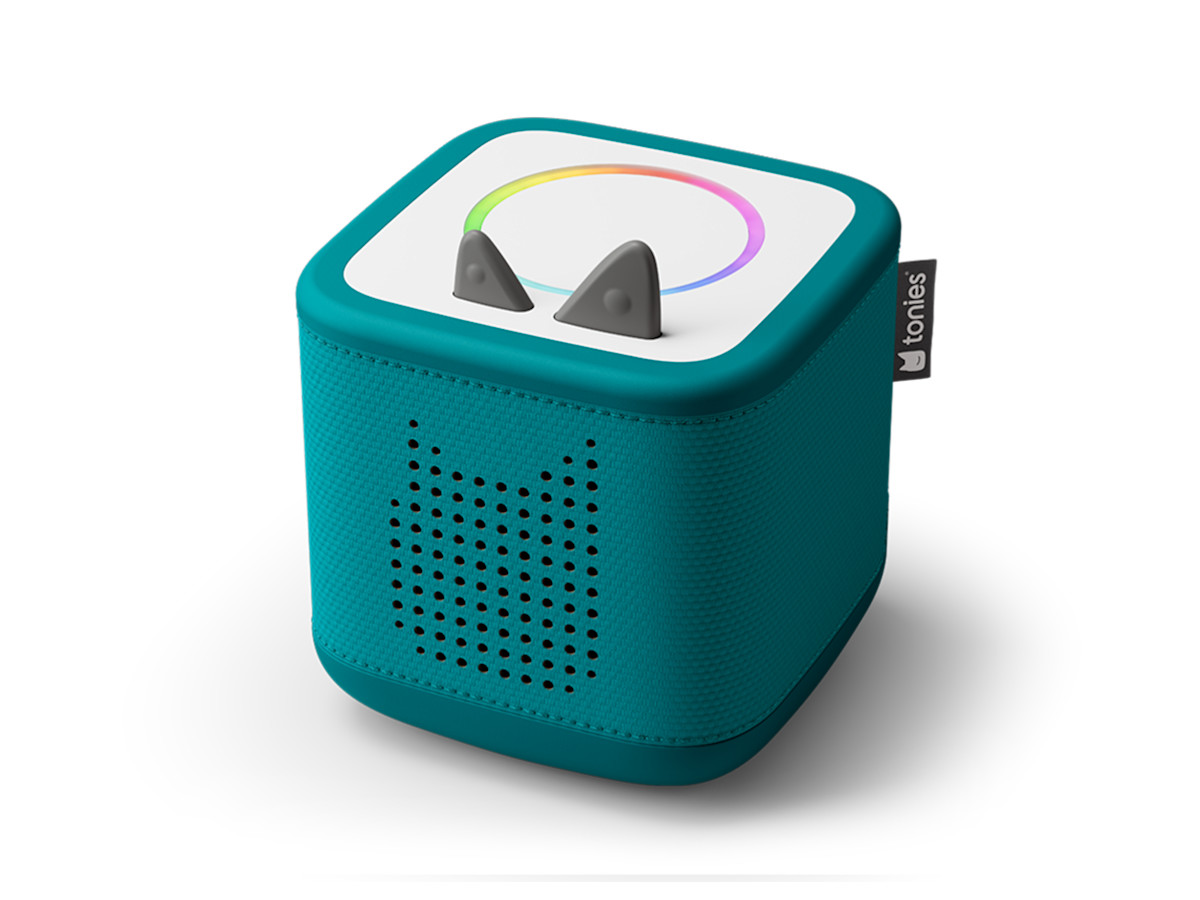
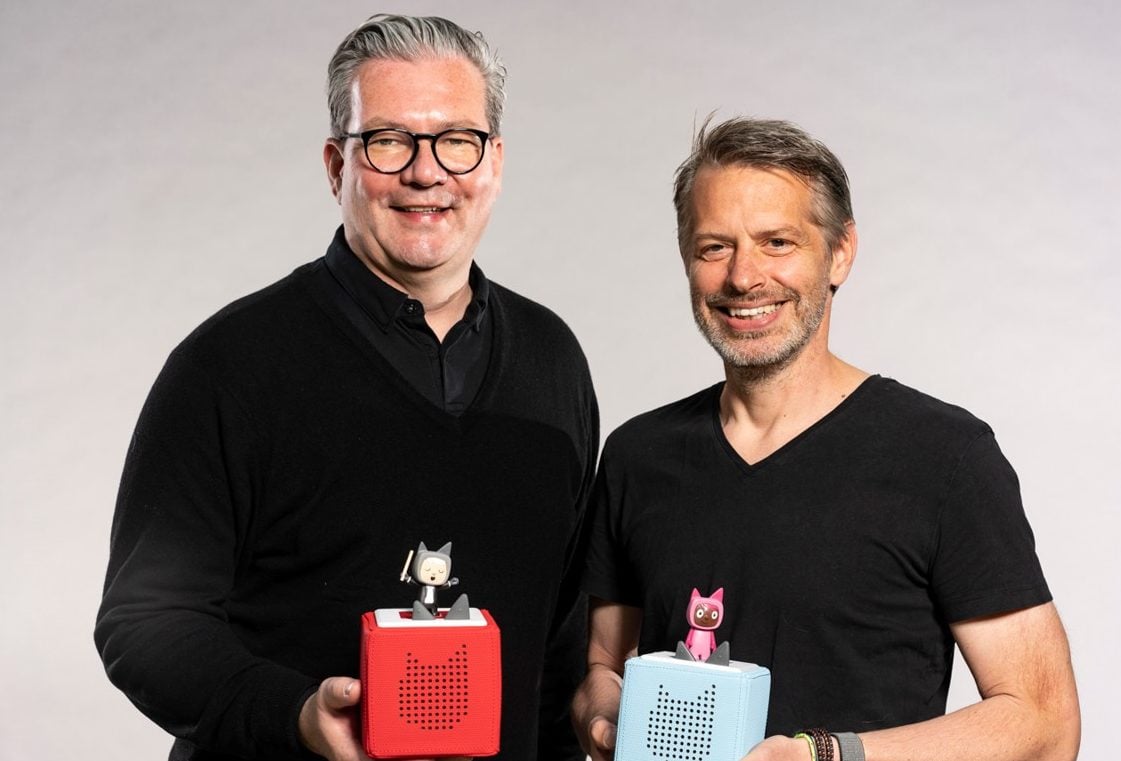
The first Toniebox did not promise to make children smarter, parents calmer or family life frictionless. It solved a smaller problem: scratched CDs. Patric Faßbender was tired of discs that tiny hands could not reliably use. He met engineer Marcus Stahl through their children's nursery, and the two fathers began sketching a digital player a child could operate without borrowing an adult's phone. Their answer looked less like electronics than a piece of nursery furniture - a soft cube with two rubber ears and no screen in sight.
The founders spent roughly three years on the product before launching in Germany in 2016 with 14 audio figures. Put a magnetic character on top and the box recognizes it, fetches the linked story or song over Wi-Fi, and stores the audio for offline replay. Squeeze an ear to change volume. Tap the side to skip. Tilt to rewind. The cloud does the difficult work while the child sees a toy doing something obvious.
01 / The moveMake the internet disappear
tonies is easy to mistake for a toy company with a clever speaker. Its filings describe something more ambitious: an interactive audio platform where hardware acquires the household and content keeps the relationship alive. By June 2026 the company said it had sold about 12.6 million Tonieboxes and more than 173 million Tonies. Divide the cumulative figures and you get roughly 13.7 characters per box sold. That is not an average active collection - boxes can be resold and totals span a decade - but it reveals the shape of the machine.
The original Toniebox created the ritual. Classic Tonies supply licensed stories, songs and learning material. Creative-Tonies let a parent or grandparent assign personal recordings. My First Tonies extend the system down to age one. In 2025, Toniebox 2 added a light ring, sleep tools, USB-C charging and Tonieplay - screen-free games and quizzes operated with discs, cards, pieces and a physical controller. The older figures still work on the new box, an unflashy compatibility decision that protects every family collection.
This is recurring behavior without the emotional weight of another monthly subscription. The current US shelf makes the economics tangible. In August 2026, a standalone Toniebox 2 listed for $129.99. Many figures cost $19.99. Tonieplay games generally ran from $19.99 to $24.99, with a $14.99 controller required for play. The hardware is a considered gift. The content is small enough to become a birthday add-on, a reward or a grandparent's easy answer to “what do they like now?”
The customer is technically the adult with a wallet, but the user is unusually young and unusually independent. Families use the box for wake-up music, quiet play, car trips and bedtime. Creative-Tonies can carry a relative's voice across a long distance. Educators can use recorded instructions, songs or language exercises without placing another display in the room. The product solves several jobs, but the shared promise is modest: a child can choose what to hear next without summoning an adult or opening an algorithmic feed.
That puts tonies in a peculiar market pocket. It competes with toy brands for affection, publishers for listening time, streaming services for content and consumer-electronics companies for a place in the home. The figurines make it legible in a toy aisle; the cloud makes the library renewable. Neither side is sufficient alone. A charming figure without dependable audio is a trinket. A capable speaker without a child-sized ritual is just another appliance parents must operate.
“Every Toniebox we sell today locks in future revenue, and that engine keeps running.”Hansjörg Müller, chief financial officer
02 / The cold startFirst, too much demand. Then, not enough permission
What failed first was not the idea. It was the young company's ability to keep up. Faßbender later described early demand as difficult to manage. That is the hardware founder's champagne headache: a popular object still needs manufacturing, inventory, customer support and retail delivery. A software launch can spin up servers. A padded cube with radios, batteries, fabric, magnets and child-safety requirements must physically exist before Christmas morning.
The second constraint was content. The founders had to persuade publishers and rights holders before Toniebox had a large audience. For years, they did the calling. As box and figure sales accumulated, the direction changed. By around 2018, publishers and entertainment companies increasingly approached tonies. Market traction had turned the odd little cube from a licensing risk into another shelf for valuable characters.
The catalog now mixes tonies Originals with familiar names from Disney, Warner Bros., NBCUniversal, Mattel, Marvel, Paramount, Hasbro and Sony Music. Bluey arrived through BBC Studios in 2026. Hasbro board games became interactive audio experiences. Pokémon joined the pipeline. This is where the company differs from a generic children's speaker: the figure is simultaneously a character, a controller, a collectible and a license made physical.
03 / The numbersThe box takes a margin hit for the team
The model is showing up in the accounts. Revenue rose from €360.9 million in 2023 to €480.5 million in 2024 and €630.3 million in 2025. The company turned net income and free cash flow positive in 2024. North America, entered years after Germany, produced €276 million in 2025 and became the largest market. The interaction traveled; the catalog had to be translated culturally, not merely linguistically.
Group revenue / € millions
The cube is growing up. Revenue expanded by about 75% across these two years.
The latest half-year result contains the useful tension. H1 2026 revenue climbed 38% to €242.9 million, and box revenue jumped 65%. Yet adjusted EBITDA margin slipped to 0.7%, partly because US tariffs raised costs and lower-margin boxes made up more of the mix. Management's argument is simple: a box sold now is an installed customer for higher-margin figures later. The dip is acceptable only if those households keep attaching content. A flywheel is not magic; it is an advance on future behavior.
tonies expects more than €760 million in 2026 revenue and has set a 2030 ambition above €1.4 billion, with a 16% to 18% adjusted EBITDA margin. Those are company targets, not destiny. They assume consumers keep spending, retailers keep giving the brand room, licensing stays productive, tariffs do not overwhelm efficiencies and children continue to find a physical character more inviting than a cheap tablet.
04 / What to stealDesign the ritual before the roadmap
The copyable part is not an NFC chip in a figurine. That mechanism is available to anyone. The useful lesson is how tonies arranged anxieties and incentives. Parents wanted less screen time but did not want to become full-time entertainment directors. Children wanted control but could not navigate menus. Licensors wanted reach. Retailers wanted a product that generated repeat visits. The Tonie ritual gives each participant a reason to continue.
The playbook that fits in a toy bin
- Begin with one visible nuisance, not a sweeping manifesto.
- Make the user's next move legible without instructions.
- Hide technical complexity at the moment of use.
- Give every add-on a job beyond “more content.”
- Preserve old purchases when the hardware changes.
There is a second lesson in restraint. The first box had almost no interface because its user might not read. Toniebox 2 adds games, alarms, lights and app controls, but tonies still has to defend that initial clarity. Feature expansion is tempting precisely because the installed base is large. If the child begins needing a parent to explain what happens next, the company will have spent its best advantage.
05 / Where it breaksThis is not a universal cube
It works when...
Parents value screen-free independence, licensed characters are culturally relevant, retail makes discovery easy and a family expects to buy content over several years.
It fails when...
A household wants cheap, portable media, broad long-form books for older children, open audio sources, remote app playback or no additional objects to lose under the sofa.
Card-based rival Yoto is thinner to pack, often cheaper to expand and broader in podcasts, radio and longer-form listening. Storypod, Lunii and Tigerbox occupy nearby territory. Smart speakers and old phones are already in many homes. A family that treats the figure price as a toll, or whose child quickly graduates to audiobooks, may not generate the repeat purchases tonies needs. The system also depends on cloud operations, rights management and a reliable supply chain even though the daily experience feels offline and simple.
Still, tonies has earned a particular place in children's media: between the toy aisle and the streaming app, with the collectibility of one and the delivery system of the other. The founders did not eliminate technology. They dressed it in fabric, gave it ears and let a three-inch character take all the credit. That is the trick worth remembering. For the child, the story starts with a small hand placing a favorite on the box. For the company, that same gesture starts the next transaction.