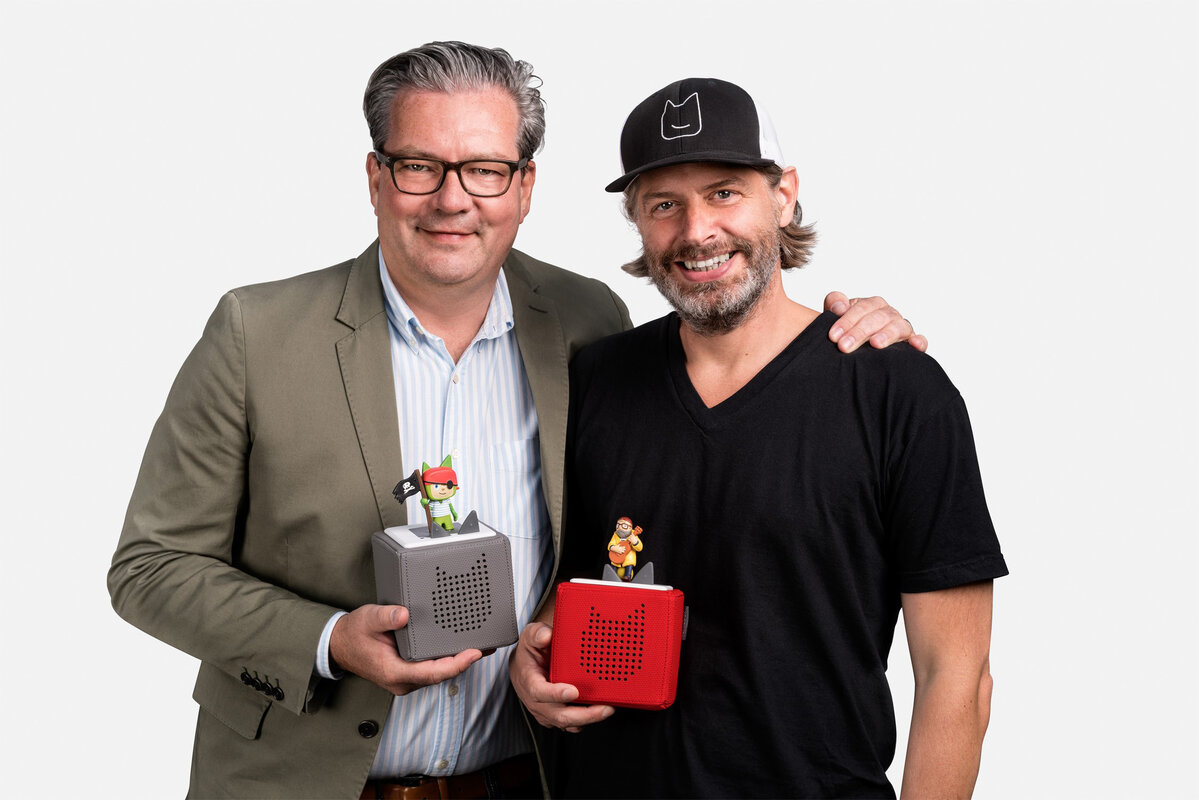
The useful thing about a nursery board is that people have to do things together. Marcus Stahl and Patric Faßbender met through their children and served on the same board. Before there was a company, there was a working acquaintance. Before they had to agree about a children’s audio business, they had a chance to discover whether they could agree about anything at all.
Faßbender was a designer with a household irritation. His daughters loved recorded stories; their CDs were less durable than their enthusiasm. Phones and MP3 players offered digital alternatives, but their controls were poorly suited to small children. He wanted something they could operate themselves. Stahl, an engineer with experience in connected audio, supplied skills the designer knew he needed.
Their eventual answer was a padded cube and a cast of small figures. Place a figure on top and its audio plays. The story has an object you can pick up. The child has a decision to make. The parent, for once, need not serve as the entertainment department’s technical support.
The co-founder was already at nursery
The division of abilities was visible in the people. Faßbender came from advertising and design. Stahl came from electronics and management. They had found a way to appreciate each other before becoming close friends. Stahl compressed the contrast into a musical description: “Here punk, there classical.” It is a rather better partnership diagram than two overlapping circles.
Both were fathers of two. Their children were at the center of the enterprise: they left established jobs to build a different listening experience. It gave them a practical audience against which to judge the idea. Could a child handle it? Could choosing a story become part of play? How much explanation should a toy require?
Stahl’s enthusiasm arrived early. An early prototype, with a frog called Günter Kastenfrosch, helped make the proposition clear. A character on a padded box demonstrated something that a description of cloud-connected audio might have struggled to convey. The idea could be understood by watching it happen. For a product intended for children, that was a useful starting point.
The engineer had already changed jobs once
Stahl was born in Siegen in 1967 and studied electrical engineering at FH Aachen, concentrating on communications engineering. He worked at Nokia Mobile Phone as a development engineer from 1995 to 2001, then as director and general manager at Nokia Automotive from 2002 to 2008. These were years spent making electronics useful in very different surroundings from a child’s bedroom.
He also went back to school. He completed the Kellogg-WHU Executive MBA in 2000, adding finance, marketing and an international business perspective to his engineering education. Years later, he was still pointing to the usefulness of its alumni network. One fellow alumnus was making accessories for tonies. A business-school connection had acquired a surprisingly tangible afterlife.
In 2008, a management buyout at Nokia led to Novero, a business specializing in connected audio entertainment. He was co-founder, vice president and management-board member until 2013. So the move into tonies followed an earlier move beyond a large corporate employer. He had already encountered the business of taking responsibility for a company.
The sequence matters. It makes the children’s toy less of a career costume change. Communications engineering, connected audio and business management all had a place in the new venture. What changed was the person at the controls. An adult might tolerate a menu. A small child needed a more immediate invitation.
Three years behind one gesture
The work began in 2013. The business was founded in 2014, with Stahl as co-founder and co-CEO of Boxine GmbH, later tonies GmbH. The Toniebox reached the market in 2016. Between the initial idea and something a family could buy lay roughly three years of development.
“It took us three years of development until we were ready to go to market in 2016.”
Marcus Stahl, 2019
The figure, the electronics and the audio had to work together. Character rights and recording rights had to be secured. The product needed to feel inviting while surviving ordinary use. Even its fabric covering created difficulties: getting the finish right in volume was harder than expected. The softness was part of the engineering problem.
Money had to arrive before the finished product did. The founders raised financing in several rounds during development, drawing on investors who could also contribute expertise in areas such as intellectual property, tax and content. Stahl described the value of that combination. A cheque was useful; a cheque accompanied by someone who understood the next obstacle was more useful still.
- 01ChooseA story has a figure.
- 02PlaceThe figure goes on top.
- 03ListenThe box plays the audio.
The child sees three moves. Behind them sit hardware, software, content and licensing.
The commercial proposition also had two audiences. Children would use the box; adults would decide whether to buy it. The physical character made the experience legible to both. It could be a toy in a child’s hands and an explanation in a shop. The founders had made a digital service that could introduce itself without opening an app.
A little Beethoven in the box
The catalogue gave Stahl room for a personal interest. Classical music was an important part of his life, and he wanted children to encounter it in a form made for them. In 2020, a Beethoven Tonie developed with violinist Daniel Hope joined the range. Other releases adapted Mozart’s The Magic Flute and Humperdinck’s Hansel and Gretel for young listeners.
That detail changes the scale of the story. Licensing can sound like an exchange of documents between companies. Here it also involved a founder’s taste and a question about how to introduce something he valued to a new audience. A small figure had room for a composer as well as a familiar fictional character.
Stahl also took the product into public conversations about audio. At DLD Munich in January 2020, he appeared alongside June Cohen of WaitWhat and Matt Cooper of Skillshare, with Christian Teichmann moderating. His contribution concerned entertaining and educational listening for children. The Toniebox belonged in a discussion of spoken audio even though its most distinctive control was a toy.
The company had entered the UK and Ireland in 2018. Its American debut followed in September 2020, bringing the system to another audience with its own familiar stories and characters. A local insight about damaged CDs had become a proposition that could travel. Making it travel still required the less photogenic work of content, retail and distribution.
- 2013Begin the Toniebox project
- 2016Bring the player to market
- 2020Launch in the United States
- 2021Take tonies public
- 2024Hand over operational leadership
A different sort of independence
Recognition came along the way. The Toniebox collected design awards; Stahl and Faßbender received the German Founders Award in the Rising Stars category in 2019. In 2020, the pair were named Germany’s audiobook people of the year. Their work sat at an intersection of toys, technology and publishing, and the awards reflected those different constituencies.
In 2021, the business went public in Frankfurt through a SPAC transaction. Faßbender’s public reflection around the listing included a thank-you to Stahl and an observation that their working relationship had become a close friendship. For all the new shareholders and financial machinery, he singled out the person with whom he had started.
Growth changed their responsibilities. A product needed people to develop it; a company needed people, structures and judgment across markets. Stahl joked that the business forecasts had always been wrong. Behind the joke lies a familiar difficulty for a growing venture: success can make the next version of your own job arrive before you have finished the current one.
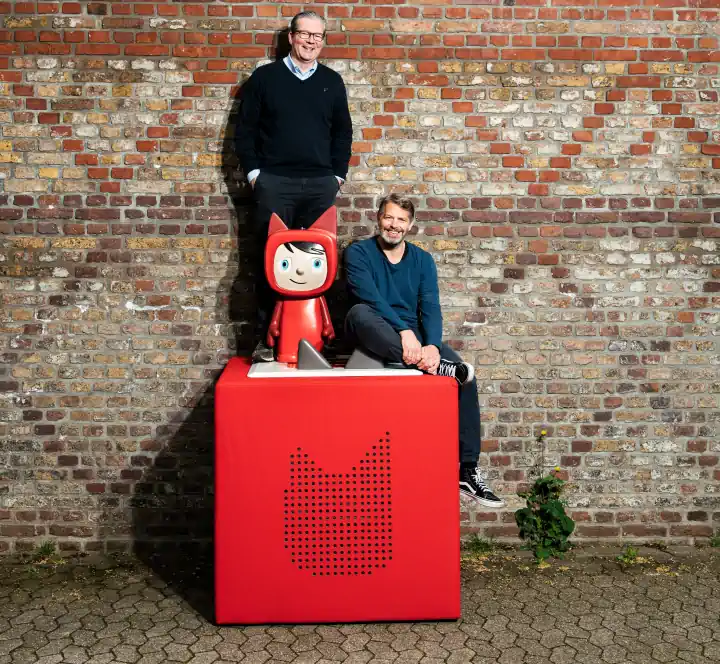
On 2 November 2023, tonies announced that both founders would step back from operations at their own request. Tobias Wann would become CEO on 1 January 2024. They would remain senior advisors and shareholders. At the announcement, the company reported more than 5.3 million Tonieboxes sold worldwide. The handover concerned an established international operation.
Stahl’s statement about Wann emphasized experience in scaling digital businesses, a founder’s perspective and an understanding of tonies’ culture. Those priorities reveal what the succession needed to preserve and what it needed to add. The founders were choosing someone for the company they had built, with a job shaped by what it had become.
The story keeps playing
The distinction between founder and current operator matters when reading the numbers that followed. Toniebox 2 and Tonieplay were announced in 2025 under the subsequent leadership. In June 2026, Wann’s mandate was extended through 2029. These developments belong to the company’s continuing history, after Stahl’s years running it.
Cumulative Tonieboxes sold worldwide, alongside more than 173 million Tonies figures.
By August 2026, tonies reported first-half revenue of €242.9 million. The physical idea had become a substantial catalogue and an international business. Those figures describe how far the system had spread; they cannot describe the experience of a child choosing a story. The original gesture remains easier to understand than the financial report.
Stahl’s part in that gesture drew on work that preceded it: engineering in Aachen, phones, automotive electronics, connected audio, business school and a nursery acquaintance who became a friend. Each supplied something useful. The product gave those experiences a new purpose and an unusually young audience.
Eventually, he and Faßbender made room for another leader. A company designed around children doing something for themselves had reached a point where its founders could let others take the controls. The figure still goes on the box. The story carries on.
Keep listening
- Marcus Stahl on LinkedIn
- tonies website
- The Most Awesome Founder: a conversation with Marcus Stahl
- DLD video: The Future of Spoken Audio
- Turning Points: the founders in conversation
- Vodafone podcast: the audio business and expansion
- WHU: From Engineer to Toy Maker
- Beethoven and Daniel Hope on the Toniebox
- The 2023 management handover
- The company’s August 2026 results