The first product a machine shop makes is not a bracket, a turbine blade or a stainless-steel enclosure. It is a promise: we can build this thing, by this date, for this price. That promise is the quote. Get it wrong and the shop may win a job it should have declined, miss an operation that eats the margin, or answer so slowly that the buyer has already moved on. Paperless Parts has spent nine years turning this anxious prelude to production into software.
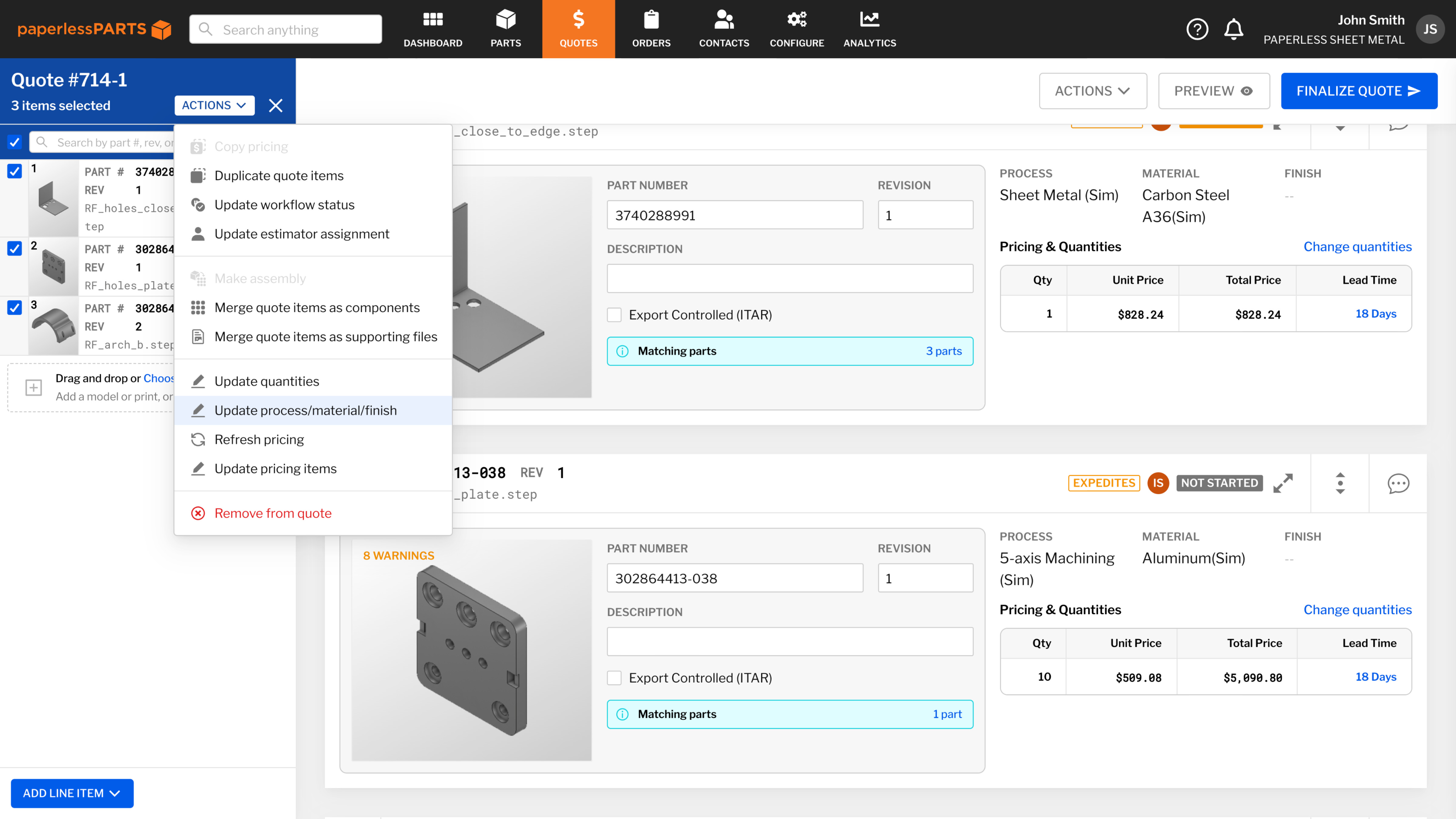
The Boston company serves the people who translate technical drawings into business decisions: estimators, owners, engineers, sales teams and operations leaders at custom manufacturers. Its cloud platform gathers RFQs, CAD models, PDFs, customer messages and pricing rules in one place. It analyzes geometry, highlights manufacturing requirements, helps calculate cost and markup, produces a digital quote and hands won work toward the ERP. Recently, the company has begun pushing the same intelligence upstream to OEM sourcing teams through a product called Radar.
The expensive work happens before the machines turn on
Manufacturing quoting is a peculiar mix of arithmetic, pattern recognition and scar tissue. A veteran estimator looks at a drawing and remembers the fixture that failed six years ago. Another notices that a tolerance demands a process missing from the router. Somebody calls a distributor for today's material price. Somebody else hunts for the last time the shop made a similar part. In many shops, these moves live across inboxes, shared drives, spreadsheets, marked-up prints and one person's head.
Paperless Parts does not sell a universal price oracle. It sells a place to turn that scattered judgment into a repeatable workflow. Shops can build costing templates around their own labor, machines, setup assumptions and overhead. Geometry from uploaded models can drive those formulas. Drawing callouts and manufacturability warnings can prompt review. Matching-parts search brings old quotes and outcomes back into view. The final customer-facing quote can include quantity breaks, lead-time options, online acceptance and payment.
Born in a job shop, not a pitch deck
The company's origin gives its positioning some weight. Co-founder and chairman Jay Jacobs built RAPID Manufacturing from five employees into a business with roughly $50 million in sales before Proto Labs bought it for $120 million in 2017. Paperless Parts' own line is tidy and accurate: it started in a job shop, not a garage. Co-founder and CEO Jason Ray brought a different view of the same disorder from his time as a U.S. Navy supply and logistics officer. Scott Sawyer, now chief scientist, and Matthew Sordillo, now head of marketing services, round out the founding group.
That background shaped a useful contrarian choice. Instead of forcing every factory through one rigid estimating method, the software is configurable around how a particular shop actually thinks about a job. Paperless Parts calls its formula language P3L. In practice, it is a way to encode the local rules that usually hide in Excel: how much to charge for difficult titanium work, what setup applies to a geometry, where a rush premium belongs, which warning should stop a quote altogether.
“Quoting is a team sport.”Paperless Parts' explanation for not charging by seat
The line doubles as product strategy. If only one estimator can enter the system, the sales rep, programmer and floor expert retreat to email and hallway conversations. Paperless Parts does not price by user seat. It charges a custom-scoped subscription based on shop complexity, modules, integrations, onboarding and contract length. There is no public sticker price. The company says a typical implementation takes about 10 to 12 weeks and frames its pricing around delivering at least a threefold return.
What failed first was visibility
The customer stories are most persuasive when they are mundane. At Metalmite, RFQs had arrived by fax, letter and even napkin sketch. Three estimators worked from piles of paper without a shared view of the queue. Once the shop measured the problem, it found it handled 200 to 300 quotes a week and missed its promised timing on 20 to 30 percent of them. Customers supplied the blunt diagnosis: respond faster. A friend's mention of a Paperless Parts demo changed the owner's mind because the first idea was not dazzling automation. It was simply one cloud queue everyone could see.
That sequence matters. Centralization came before intelligence. A digital inbox made lateness visible. Collaboration attached questions to the work. Historical quotes made prior judgment reusable. Only then did automation begin to carry weight. Aurora Machine says matching-parts search saves five hours a week and helped support a 24-hour quote promise. Zero Hour Parts says quote throughput rose 200 percent, enabling a four-hour maximum turnaround guarantee. Momentum Manufacturing Group says easier margin adjustment lifted profit margins four percentage points and a clearer interface helped catch an input error that could have cost nearly $40,000.
Selected customer-reported outcomes
Different measures, shown as reported by individual customers. These are case-study outcomes, not guaranteed platform averages.
An AI assistant that shows its work
In 2026, every software company can put “AI” on a label. Paperless Parts' more interesting claim is narrower: its models understand manufacturing documents inside a security environment designed for sensitive industrial data. Wingman 2.0 reads drawings for surface finishes, bend lines, chamfers, threads, weld symbols and dimension properties. It suggests materials and highlights where each finding came from. The company reports that the new version extracts 14 times more technical elements per print than its predecessor, identifies the presence and type of 88 percent of callouts, and correctly extracts detail on 83 percent in its evaluation.
The phrasing around the product is refreshingly cautious. Wingman is meant to be objective, traceable and reviewable. It presents findings for an estimator to validate until a rule is trustworthy enough to automate. That is the right order for a system touching aerospace, defense and regulated work. A fluent guess is useless when a missed weld symbol changes the router. Paperless Parts says its models operate within a FedRAMP Moderate Equivalent and CMMC-compliant boundary so controlled files do not wander into a generic public model.
The same file intelligence now anchors Radar, the company's move toward buyers and sourcing teams. Radar classifies parts, identifies duplicates and geometric cousins, shows historical supplier and pricing context, flags incomplete RFQ packages and helps group similar work for suppliers. The pitch is less “find the cheapest shop” than “stop spraying incomplete files across the supply base.” It gives Paperless Parts a place on both sides of the transaction: the OEM trying to buy a part and the manufacturer trying to quote it.
The moat is workflow, context and the unglamorous handoff
Competitors range from focused quoting tools such as DigiFabster, Machine Research and MTI Systems' Costimator to broader shop systems such as ProShop, Fulcrum and JobBOSS. aPriori occupies an adjacent enterprise cost-modeling lane. But the incumbent is usually the improvised stack: email plus Excel plus a CAD viewer plus an ERP screen that somebody retypes later.
Paperless Parts differentiates itself through depth in custom manufacturing, configurability and the connective tissue around the quote. Its open API and integrations with systems such as Plex, JobBOSS, MIE Trak Pro and Autodesk Fusion reduce the duplicate entry between sales and production. Live pricing relationships can feed metals and components into costing. Five U.S. patents, including recent protection for drawing comprehension and geometry-aware extraction, add technical defensibility. The company reported more than 86 percent year-over-year growth in net-new annual recurring revenue bookings in the first quarter of 2026, alongside 93 percent gross revenue retention and 103 percent net revenue retention.
Where it earns its keep
- High RFQ volume or complex, variable parts
- Several people touching each estimate
- Margins sensitive to missed operations
- A need to preserve veteran knowledge
- Regulated or multi-site workflows
Where the fit weakens
- Very few quotes and mostly repeat work
- No owner for implementation or training
- Pricing logic nobody will document
- Dirty inputs treated as somebody else's problem
- An expectation of unsupervised one-click quoting
What another operator can copy tomorrow
Most readers will not buy quoting software tomorrow. They can still borrow the operating logic. The lesson is not to sprinkle AI over a disorderly process. It is to make the work observable, preserve the reasoning behind decisions and automate the parts that have become repeatable.
The five-move quote-desk reset
- Put every request into one queue with an owner and due date.
- Write down how the best estimator turns material, geometry, labor and risk into price.
- Attach questions and decisions to the part, not to a disappearing email thread.
- Make warnings visible before the quote leaves, then keep a human accountable for the decision.
- Measure turnaround, win rate and realized margin. Speed without pricing discipline only produces losses faster.
The approach will not work merely because the software is installed. A shop has to expose its estimating logic, clean up inputs, involve the people who know the work and connect the quote to downstream systems. Ten to 12 weeks of implementation is not trivial for a small operation. Nor does an AI extraction score eliminate the need for judgment on unusual geometry, poor scans or ambiguous specifications. Paperless Parts works best when management wants a common process but respects the exceptions that make custom manufacturing custom.
That is also why the company has room to grow. The American industrial base is full of valuable businesses whose commercial systems still depend on personal memory and heroic inbox management. Paperless Parts has identified a control point where better information changes revenue, margin and customer trust at once. The quote may look like paperwork. In a factory, it is the business model rendered as a number.