Before she helped build a thyroid clinic, Marina Tarasova worked on a thyroid drug. Synthroid was among the brands in her healthcare career. Her family had also experienced thyroid problems. She knew something about the medicine and something about the people taking it. Those are useful qualifications for noticing a gap: having a treatment available does not necessarily make treatment easy to live with.
- Paloma connects thyroid testing, virtual visits and continuing support.
- Basic membership buys access; appointments and home kits cost extra.
- The company’s current brief also includes menopause and weight care.
Paloma Health, founded in 2018 by Tarasova and Guillaume Cohen-Skalli, addresses the ordinary work surrounding hypothyroidism. The condition involves an underactive thyroid; Hashimoto’s is an autoimmune cause. Patients may need repeated tests, prescription management and conversations about symptoms. A clinic can handle each task individually and still leave the patient responsible for joining them together. Paloma’s proposition is to make that joining part of the service.
A familiar drug, an unfamiliar business
The company announced its online practice in October 2019, initially serving five states. It had closed a $2.5 million seed round that June. The modest geography matters. An internet business can put its website everywhere; a medical service needs clinicians licensed where its patients are. Paloma’s early footprint was a practical illustration of that distinction.
Tarasova’s knowledge of healthcare did not confer instant fluency in venture capital. In a 2021 interview, she described learning what term sheets and dilution meant. Cohen-Skalli, a former venture investor, and startup studio Human Ventures helped her through the process. The unfamiliar territory was financing the company. Knowing the patient’s problem and knowing how to fund a solution turned out to be separate competencies.
“There is a lot more executing to be done yourself for some time.”
Marina Tarasova · 2021 founder interview
Her account of founding also included a consequential hesitation. Shortly after deciding to start the company, she learned she was pregnant. She and her husband discussed whether to continue. His support, and her conviction that waiting could mean someone else built the business first, helped her proceed. It is an origin story with logistics in it: time, family responsibilities and the people who make a decision possible.
The kit is the beginning
The most photogenic part of Paloma is a small blood-test kit. A patient collects a finger-prick sample at home and sends it for laboratory analysis. The core panel includes TSH, free T4, free T3 and TPO antibodies. The appeal is straightforward: one task can happen at the kitchen table rather than requiring another trip.
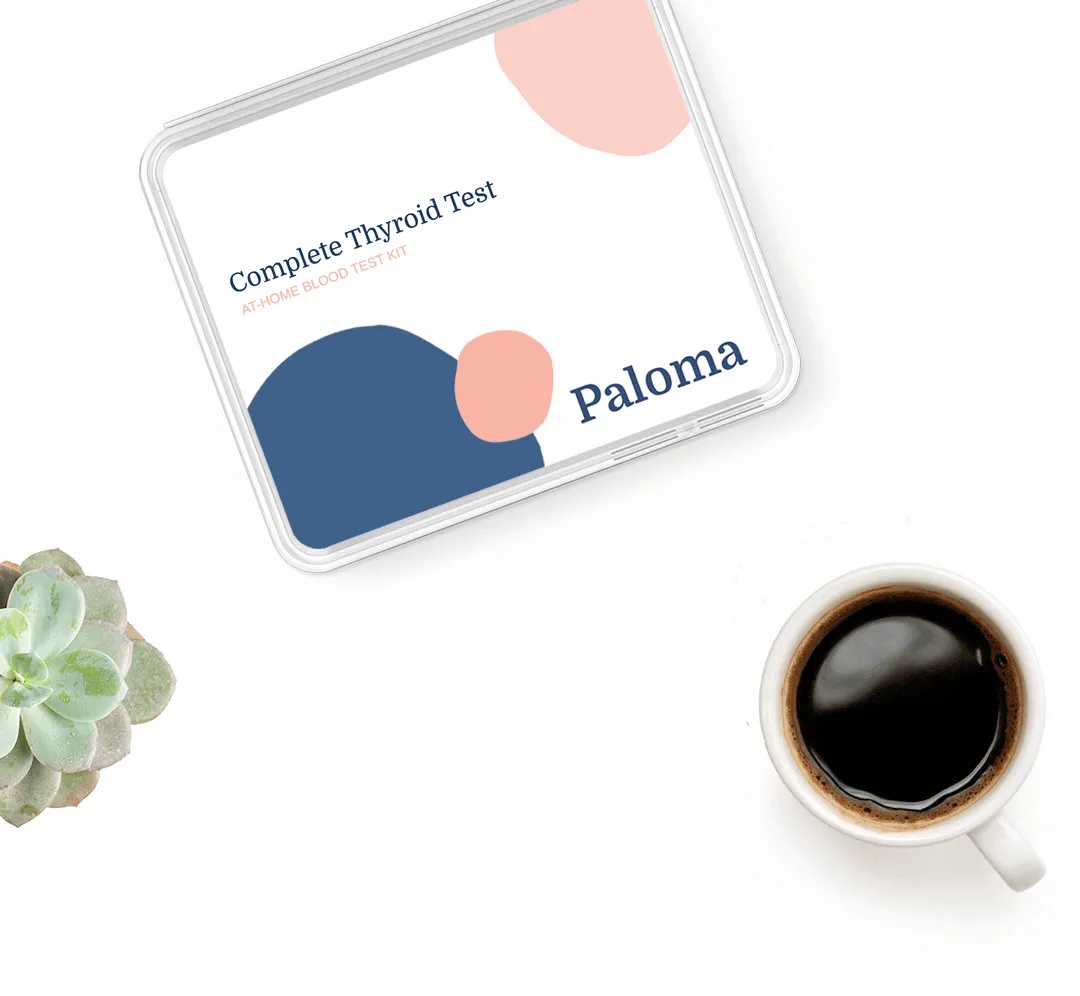
But buying the kit is not the only way into care. Paloma’s published workflow accepts outside labs less than four months old and describes orders through Quest and Labcorp. That is a revealing detail. The company can accommodate a patient who already has bloodwork, instead of asking everyone to start again with the product most visible in its photographs.
- 01Obtain
labs - 02Meet a
clinician - 03Follow
the plan - 04Track &
follow up
From there, the service brings together a provider and a care manager. Prescriptions can go to the patient’s pharmacy. The app provides symptom and laboratory tracking, messaging, educational material and a twelve-week nutrition program. These features give patients places to put the questions and observations that accumulate after an appointment. Recording a symptom is useful chiefly when someone can discuss what it means.
Paloma’s clinicians include endocrinologists, other physicians and nurse practitioners; specialist thyroid experience is the thread connecting them. Nutrition support sits alongside medical care. The company advertises consideration of different thyroid medication options, with treatment determined by a clinician. For a patient choosing among providers, the relevant question is who will review the evidence, explain the plan and stay available as circumstances change.
The roster makes that breadth concrete. Andrew Cunningham is described as board-certified in family medicine and integrative and holistic medicine. Nicole Shin is a board-certified women’s health nurse practitioner whose work includes thyroid and menopause care. The patient is choosing a practitioner as well as a platform, and those backgrounds deserve attention.
The arithmetic of attention
The basic advertised membership is $20 a month, billed annually: $240 paid for the year. A self-pay thyroid visit is $60; a member-priced home kit is $75. Consider a hypothetical year with two visits and two kits. The total is $510 before medication or other services. That is a shopping example, rather than a recommended testing schedule.
Insurance changes the arithmetic for eligible visits, depending on the network and the patient’s benefits. The membership fee remains separate. The distinction is worth carrying into any comparison with an existing doctor: compare the whole basket of services you expect to use. The appealing monthly number is only one line in it.
The business receives recurring membership revenue, with additional charges for services and products. Its commercial challenge is implicit in that arrangement. Patients need enough continuing value to justify renewing even when they are not booking frequent appointments. Messaging, coordination and useful records therefore matter to the economics as well as to the experience.
A thyroid company grows a wider brief
Paloma’s current website extends into perimenopause, menopause and weight management. It lists additional monthly plans and clinician-directed medication services. An interpretation of the expansion is that the company is following customers into neighboring concerns. The public menu establishes the broader offering; it does not establish what persuaded management to broaden it.
Distribution has broadened too. A Centivo enrollment page describes access through benefits plans, while an employer brochure presents thyroid care as a workplace health issue. Paloma was also selected for Healthworx’s 2024 accelerator cohort. These routes place the company between a consumer subscription service and the more complicated world of insured and employer-sponsored care.
Its alternatives include a trusted primary-care clinician, an endocrinology practice, general telehealth and standalone testing. Paloma makes particular sense as a proposition when repeated coordination is the difficulty. Someone already receiving accessible, satisfactory thyroid care may have less reason to add another membership. Clinical eligibility, state availability and the need for examinations or procedures also shape what a virtual service can accomplish.
The useful idea to borrow is specific: follow the customer past the transaction. Ask who arranges the next test, answers the next question and remembers what happened last time. For a chronic condition, those apparently small obligations recur for years. Paloma has made a business out of offering to share them.
Continue the conversation
Explore Paloma Health, plans and coverage, the thyroid app and menopause articles.
Watch Tarasova’s conversation with thyroid advocate Mary Shomon, or listen to her Think Yourself Healthy interview. Read the founder interview.