The old bargain of a doctor’s appointment is that you surrender a piece of your day before you know whether the visit will take five minutes or fifty. First you find an opening. Then you arrange work, childcare, transport, or all three. Finally, you sit in a room and explain an issue you might have been ready to describe on Tuesday night. Hello Alpha began with a mischievous question: what if Tuesday night were the appointment?
The Palo Alto company, founded in 2017 as Alpha Medical, built a virtual practice around a mostly asynchronous exchange. A patient enters symptoms and medical history online. A licensed clinician reviews the case, asks follow-up questions when needed, and sends a treatment plan through secure messages. There is no need to make a video call the centerpiece of every ordinary concern. Founder and CEO Gloria Lau put the idea plainly in 2021: “We do all of this online, asynchronously.”
- Patients can start a visit at any hour; replies usually arrive later.
- The company concentrates on women’s health across primary care, mental health, hormones, diabetes, and weight management.
- Consumer memberships and contracts with employers, clinics, and campuses fund the service.
- Current listed consumer plans start at $29 a month; prescriptions and tests may cost extra.
A clinic door that stays open
To understand the service, imagine a patient worried about acne, menstrual changes, and a family history of diabetes. In a conventional system, those concerns can become three appointments with three different histories retold from scratch. Alpha’s proposition is that a continuing primary care provider trained in women’s health can look at the pieces together. Its roster spans urgent and primary care, reproductive and hormonal health, mental health, diabetes, PCOS, and weight management. The company lists more than 100 conditions under its broader plan.
The sequence is prosaic, which is its appeal. Open a visit, answer structured questions, add photos if the condition calls for them, then let the clinician work. When labs are needed, Alpha can order them through a nearby lab or, for some conditions, an at-home test. If a prescription is appropriate, it can go to a chosen pharmacy or a delivery partner. Patients can return to the same provider when possible, so a new question need not begin with an empty chart.
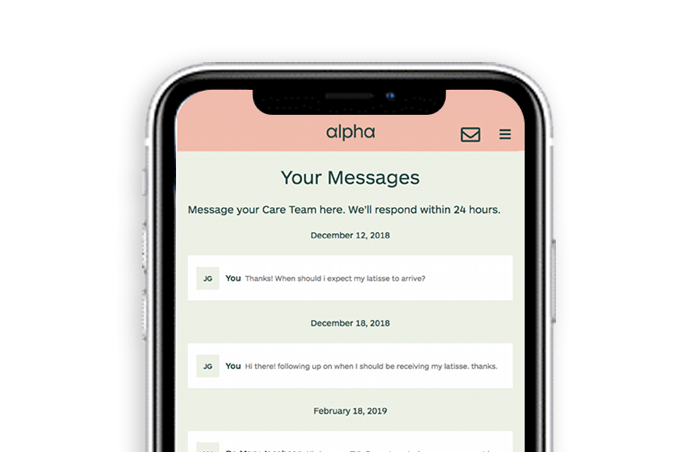
“Anytime” needs a careful reading. It means a patient can start at any time. Alpha’s support guide says providers often reply within 24 to 48 hours, depending on volume and complexity; urgent visits often receive a response within eight hours. Messaging is usually neither instant chat nor an emergency service. Depending on state rules and the clinical situation, a real-time call may still be required. The trade is clear: less scheduling and waiting for the patient, in exchange for a conversation that unfolds over time.
The price of removing the calendar
Lau came to healthcare from data products, with experience at LinkedIn and Timeful and a Stanford engineering doctorate. Her operational idea was that an organized intake could gather a patient’s history before a clinician began the review. In 2021 she told TechCrunch that asynchronous work helped keep visits affordable because a clinician was not paid to wait while a patient remembered symptoms or family history. Clinical expertise still had to be supplied by the practice: Mary Jacobson, an obstetrician and gynecologist, shaped its women’s health approach, and Loni Belyea, trained in internal medicine, geriatrics, and obesity medicine, is now its chief medical officer.

The pricing tells a story of a company changing scale and scope. A 2020 guide advertised a $120 annual membership with up to 24 visits. Today’s consumer page lists Basic at $29 per month for two online visits and Plus+ at $79 per month for four visits and the widest condition list. Medical and membership fees are self-pay; medication and lab charges can be separate. Some pharmacies may accept insurance for prescriptions. Those figures are a snapshot of the listed plans, not a lifetime promise, and they make clear that “affordable” depends on how often a patient uses the service and what treatment follows.
Membership prices exclude possible medication and lab charges. Plans and availability can change.
The appeal is easy to see for a worker who cannot make a midday appointment, someone with a high-deductible plan, or a patient in an area short of primary care. It is also limited by the body itself. A screen cannot listen to lungs, perform a pelvic exam, or resolve every ambiguous symptom. Alpha’s own process refers patients for tests or in-person care when needed. The promise is a useful front door for many conditions, not a replacement for every room in medicine.
“The reason why we can be so affordable is because it’s asynchronous.”Gloria Lau, speaking to TechCrunch in 2021
From one patient to an entire payroll
Alpha’s early commercial story was direct to consumers. Its 2021 $24 million Series B, led by SpringRock Ventures, brought reported funding to $35 million. At that point the company had expanded from about ten states to 46 and Washington, D.C. Its clinical menu had grown from roughly three conditions to about 60. The narrow first version had found a larger job. The money was meant to increase provider capacity and develop a second route to patients: employers and health plans. Lau said small employer contracts arriving on their own had helped prompt that shift.
That second route became visible in 2023, when Sonrava Health was announced as its first corporate client, offering Alpha membership to employees and dependents. The same year Alpha introduced Ahead with Alpha, a weight management program pitched to employers facing the clinical and financial complications of GLP-1 medications. The company now also markets virtual capacity to community health centers and university clinics. It is a practical extension of the original thesis: a patient who has no available appointment is a problem whether the appointment book belongs to a private practice, a campus, or an employer’s benefits network.

The 2025 BODi partnership widened the supporting cast further, pairing Alpha’s medical service with fitness and nutrition programs. It fits the company’s insistence that women’s health is not merely a reproductive-health aisle. PCOS can meet insulin resistance; diabetes can complicate fertility plans; anxiety can affect the management of either. A single continuing clinical conversation is a more plausible response to that overlap than a series of isolated checkout carts.
The useful lesson in the inbox
This is where Alpha sits in a crowded market. General telehealth services can provide fast virtual visits. Women-focused companies such as Tia and Maven organize care around life stages or specialty networks. Alpha’s distinctive combination is breadth, a continuing provider, and a mostly message-based workflow. It has also widened access beyond women: its site says clinicians trained in women’s health can treat men and people assigned male at birth for most supported conditions.
The company says it has served more than 150,000 women and saved patients $27 million in healthcare costs. Those are company-reported cumulative figures, useful as signs of reach rather than proof that every patient saves money. What can another organization copy? The clear intake, the permission to start outside office hours, and a provider who sees the previous conversation. What cannot be copied by changing a button color is the trained clinical team, the pharmacy and lab coordination, or the judgment to say when a patient must be seen in person.
The most revealing detail about Hello Alpha may be the time between a message and a reply. For a rash, a refill question, or a lingering concern, that interval can be a gift: the patient gets on with life while the provider works. For chest pain, a rapidly worsening illness, or an issue that needs an exam, it is the wrong instrument. A good doctor’s office without appointments still needs to know which door to send you through next.