Pablo Stanley offered people a library of hand-drawn characters and let them decide what it was worth. They could pay nothing. In the launch results he published in February 2020, 6,435 people had downloaded Open Peeps. Just 221 had paid. The total came to $1,801.75. He also announced a $500 donation to Latinitas, which helps girls explore media and technology.
It was a small business with a rather large front door. Most visitors walked through for free. Stanley showed the arithmetic anyway, making the launch itself another thing other creators could learn from. The library was already being used for avatars, comics, and user flows. His drawings had gone out and found employment.
There is a temptation to read a designer’s career through job titles. Stanley’s makes more sense through the things he has put within reach: a hairstyle, a tutorial, a character’s expression, a way to turn an idea into something another person can see. The recipient gets to make choices. That seems to be where the fun begins.
3.4% paid · $1,801.75 in total proceeds
A launch-day snapshot, not lifetime revenue.
A person, in pieces
Take Humaaans. The extra vowels suggest a character having a pleasantly unproductive afternoon, but the mechanics are quite precise. You can change the hair, tops, and trousers, then rotate and position the parts. A fixed drawing becomes a collection of decisions. Stanley releases the library under CC0, allowing personal and commercial use.
The same principle gives Open Peeps its possibilities. Bodies, expressions, facial hair, and accessories can be combined in design tools. Its website advertises more than 584,688 combinations. A mustache is a tiny component with an impressive capacity to alter a person’s apparent opinions.
The usefulness is easy to understand. A designer making an onboarding screen can compose a scene without drawing every elbow. Someone mapping a user journey can give the abstract user a face. A character system preserves a consistent visual language while allowing the person using it to express something particular.

Open Doodles loosens the line further. Its sketchy figures sit, leap, and generally refuse to resemble the solemn people in a corporate annual report. The collection is free for personal and commercial use. There is an appealing consistency between the drawings and their distribution: both make it easy to get started.
These systems turn illustration into an activity shared between artist and audience. Stanley makes the vocabulary. Other people arrange the sentence. A successful result can still bear his visual fingerprints while serving a story he has never heard.
Two comics before breakfast
Long before those characters became components, Stanley was making comics. He grew up in Mexico, and Mexicali appears in his early account of choosing a career. He had considered physics and mathematics. A local design program at Xochicalco offered another possibility, one that let him study something appealing without the expense of moving away.
Later, a job took him to San Diego. Drawing comics had slipped out of his working routine when a visit to San Francisco’s Cartoon Art Museum, on December 30, 2011, sent him back to an art shop. He bought pens and a notebook, made two comics that evening, and uploaded them to 9GAG the following morning. People responded.
The episode has the satisfying modesty of a real beginning: a museum ticket, some stationery, a few hours of work. His account of comic inspiration was equally ordinary. Daily life, friends’ stories, embarrassing moments, wordplay. You do not need an exotic expedition when your own day is willing to make a fool of you.
The doodler gets a company
By 2020, Blush was taking the editable-illustration idea beyond Stanley’s own collections. The company brought work by artists around the world into a tool where people could customize a composition. Its web app and plugins placed the artwork close to the design process, making an illustration something you could revise as the surrounding project changed.
Stanley had a CEO title, though he preferred the more comfortable description of doodler. He described the team as collaborative, with decisions made together. The distinction fits a product whose purpose depends on giving users room to contribute. A tool that invites participation would look rather odd under a philosophy of absolute personal control.
“Inclusion is embedded in Blush.”
Pablo Stanley, 2020
Representation also entered through the controls. Skin colors, hairstyles, accessories, and other elements could be adjusted. The plugin randomized components when beginning a character, an approach Stanley hoped would help people avoid repeating their unconscious defaults. A dropdown menu can carry quite a lot of cultural baggage. Giving it more options is a practical place to begin.
The company chapter added another kind of work to the drawing: making a place where different artists’ styles could coexist, and where a customer could choose among them. The person building a scene was also discovering the people who had drawn its parts.
The adjustable artwork changes what a request for an illustration can mean. A person can try a different expression before settling on the scene, or change a character as the story develops. Those revisions give the user a way to think through the picture while making it. The tool has to preserve enough structure for the pieces to fit, while leaving enough freedom for the result to feel chosen. That balance explains why an illustration system belongs in a product designer’s working life: it turns a series of small visual decisions into something people can explore for themselves.
Someone has to open the door
Stanley’s teaching has its own appropriately sociable name: Sketch Together. On YouTube, he shares design tutorials, livestreams, and critiques. The title makes the lesson sound like an invitation to sit beside someone while they work. That is a useful way to lower the stakes for a beginner staring at an unfamiliar canvas.
His advice to newcomers is practical. Practice before expecting perfection. Learn to write. Learn to listen to the people involved in a project. Understand product thinking, interaction, and visual design. The designer will have to explain decisions as well as make them. A polished screen cannot attend every meeting on your behalf.
Writing appears elsewhere in his work, too. The Design Team turns startup design life into comics. The format offers room to notice the awkwardness inside a profession that spends much of its time preparing immaculate presentations. A comic needs a recognizable situation and a human reaction; a product brief sometimes benefits from remembering the same requirements.
Then there is Latinxs Who Design, a directory that makes designers and their work visible, and Diseño Cha Cha Chá, his Spanish-language podcast featuring Latinxs in technology. These projects address another obstacle to participation: knowing who else is there. The directory gives visitors people to discover, rather than another abstract appeal for a more inclusive industry.
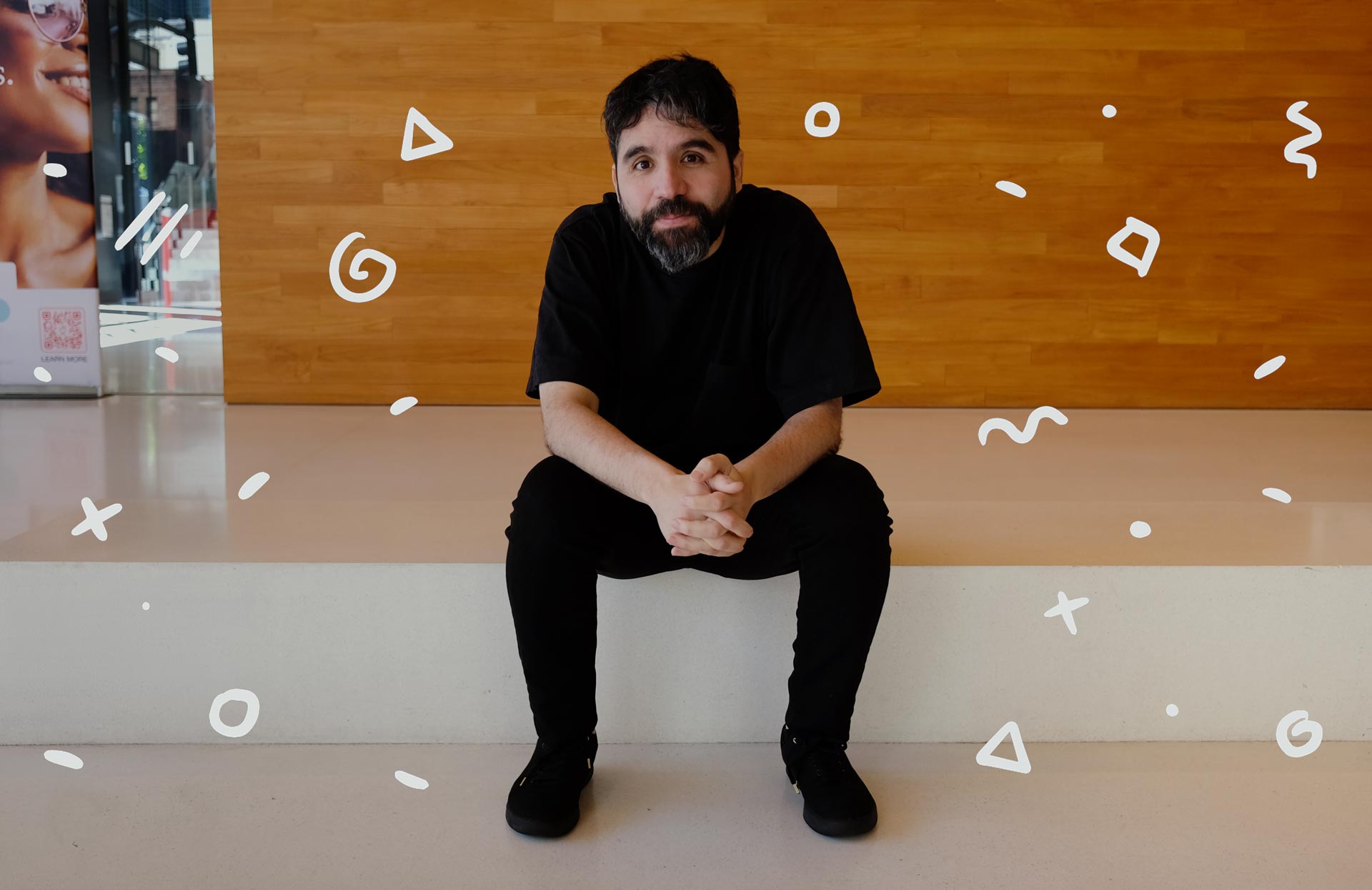
The robots arrive
His interest in characters also took a detour through digital collectibles. In November 2021, TIME Studios announced development of a children’s series based on his Robotos collection. It was a conspicuous move from illustrated robots into entertainment development. The announcement described a project in development, a distinction worth preserving in an industry where an announcement can travel farther than the eventual show.
Other ventures explored different ways to make creative production approachable. Bueno offered tools for generative art. Musho pursued AI-assisted design. Lummi assembled AI-generated imagery for designers. The projects differed in medium and business model, but each put some of the machinery of making into another person’s hands.
Lummi brought a particular return journey. Stanley had worked in product design and teaching at Udemy earlier in his career. On June 18, 2025, Udemy announced it was acquiring Lummi. The announcement named him and CTO Jason Donnette as its founders and described plans to bring creative tools into the company’s learning environment.
There is a pleasing loop in that sequence. A designer teaches people how to make things, builds tools that help people make things, and sees one of those businesses acquired by a company that teaches people. The loop also gives a concrete example of how his teaching and product work can meet.
- 2018Humaaans
Illustrations to remix - 2020Blush
More artists, editable scenes - 2024Vercel
Design work on v0 - 2025Lummi acquired
Creative tools meet learning
Leave room for the hands
Stanley now works on Vercel’s creative team, including v0. In July 2026, he discussed prototyping its design mode on Dive Club, alongside his own Efecto and hilos projects. The conversation concerned the changing relationship between design, code, and the tools a person reaches for when an idea arrives.
His February 2026 writing pushes the question further. He imagines interaction becoming more conversational, with software generating an interface when it is needed. He presents this as a prediction. The familiar application, with its permanent arrangement of buttons and menus, may become only one way to get something done.
Yet the old tools have left their marks. In a 2024 conversation at Config, he insisted on the human qualities of design and the importance of typography. Asked to describe himself, he offered: “Artist. Disguised as a designer.” He also spoke about playing in two bands and said that, outside design, he would want to act.
That sounds less surprising when you visit his walkable portfolio. Instead of merely reading a list, you can move through an illustrated world. The body of work becomes a place to spend time. After all the companies and software, there is still someone drawing the scenery and inviting you in.
Follow the drawings
Tools to try, lessons to watch, and more from Stanley’s corner of the internet.