The least glamorous moment in pharmaceutical marketing may also be the most valuable: a clinician has chosen a drug, opened the prescribing screen and discovered that the patient's out-of-pocket cost could sink the plan. OptimizeRx began in 2006 by putting a coupon there. Not in a glossy magazine, not between television shows, but inside the electronic health record and e-prescribing software where a decision could still be rescued.
That small wedge became a public company with $109.4 million in 2025 revenue, more than 100 pharmaceutical manufacturers as customers and access to a network reaching more than 2 million U.S. healthcare providers. The product changed, but the organizing idea did not: information has more value when it arrives close to action.
Today the Waltham, Massachusetts company sells a much larger contraption. It builds privacy-safe consumer audiences, predicts when patients may approach treatment eligibility, identifies the clinicians involved in their care and coordinates messages across EHRs, social platforms, connected television, audio, display, email, direct mail and billboards. The customer is usually a pharmaceutical brand or its agency. The people being reached are patients and clinicians, though neither group pays OptimizeRx.
The $95 million missing half
OptimizeRx knew the prescriber side. Its messages appeared in clinical workflows, its financial offers helped patients afford branded drugs, and its CareSpeak acquisition in 2018 added reminders and other direct patient communications. What it did not own was a strong way to find likely patients across the sprawling consumer media market without behaving like a health-data creep.
The answer arrived in October 2023, when OptimizeRx agreed to buy Medicx Health for $95 million. Management funded part of the deal with a $40 million loan from Blue Torch Capital. Medicx brought Micro-Neighborhood Targeting, or MNT, a patented method that searches de-identified medical and prescription signals, then scores more than 35 million nine-digit ZIP-code areas by the concentration of brand-relevant patients.

The method is deliberately geographic. It does not ask an ad exchange to find Jane Doe, oncology patient. It asks where groups with relevant, de-identified clinical patterns are concentrated, sometimes across just a few blocks, and makes those areas portable to media platforms. In regulated healthcare advertising, the constraint is part of the product: useful enough for a brand, aggregated enough to avoid identifying a patient.
One journey, two screens
MNT finds the consumer side. The Dynamic Audience Activation Platform, mercifully shortened to DAAP, works on timing. Its models use real-world data and the sequence of a disease journey to estimate when a patient may approach a clinical milestone. OptimizeRx can then prioritize the clinician likely to encounter that patient during what it calls a care window.
This is the difference from a static physician list. A list says which oncologists prescribed in the past. DAAP tries to say which oncologist is worth reaching this week, because the patient's progression may make the message actionable. The ad may appear in social media or connected TV for the patient, while the clinician receives treatment information or affordability support in an EHR. Both executions orbit the same care journey.
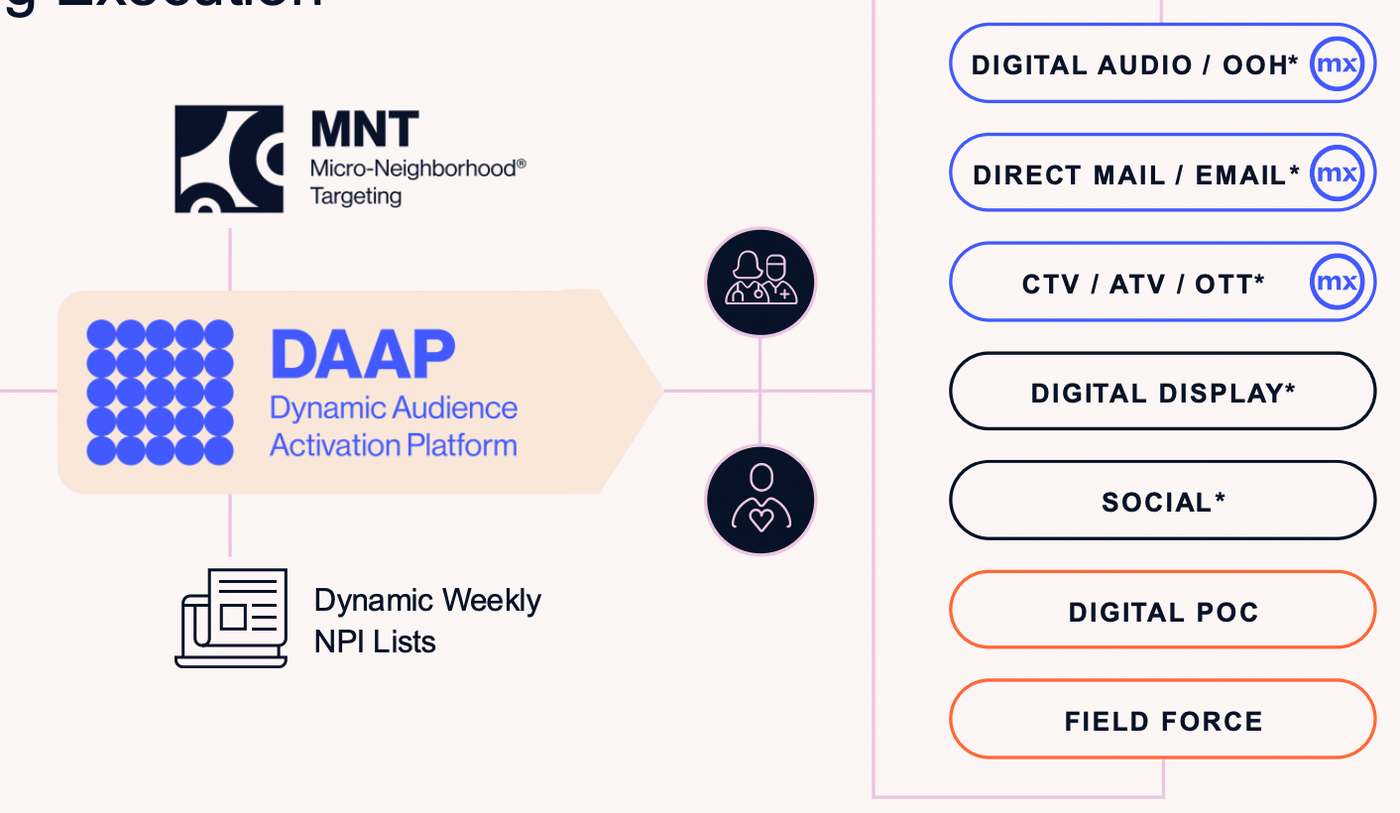
A published 12-month oncology program shows what the machinery is supposed to do. OptimizeRx built a model to detect patients likely to change therapy lines, sent EHR alerts shortly before eligibility and focused field teams on those clinicians. The company reported a 28 percent increase in patient starts, 33 percent of new patients coming from targeted HCPs and a 3.8-to-1 return on investment. Another case study reported a 10-to-1 return on addressable television spending.
These are vendor case studies, not universal constants. The setup needs several things to be true: a condition with visible claims signals, a definable treatment milestone, enough audience density for privacy-safe targeting, media or EHR access, and a measurable prescription outcome. A tiny cohort scattered across rural areas can disappear when privacy thresholds are applied. A brand with an indistinct eligibility event gives the prediction model less to grab.
The business hiding underneath the campaign
OptimizeRx earns money from program design, audience development, media, point-of-care messages, software licenses, reporting and consulting. Most 2025 revenue was recognized over time while services were delivered. When the company resells partner inventory, it may keep a commission or book the media sale and partner cost, depending on who carries the risk.
That sounds recurring, but it is not yet subscription software in the comforting sense. Pharma budgets move, campaigns launch late, and a few customers can bend a quarter. In 2025, the top five customers supplied about 47 percent of revenue. In the second quarter of 2026, revenue fell 30 percent year over year to $20.5 million. Net revenue retention for the trailing year was 90 percent, down from 121 percent a year earlier.
Management's answer is to make the platform less campaign-shaped. It wants the data components of DAAP and MNT sold by subscription, and it is embedding products where media buyers already work. In May 2026, DeepIntent became the first healthcare demand-side platform to integrate OptimizeRx's authenticated EHR inventory. In June, OptimizeRx launched a Natural Language Audience Builder that lets a planner describe an HCP audience in ordinary language inside a DSP or agency platform. CopayCue, also launched in June, triggers affordability support from real-time prescribing intent.
The attraction is obvious. An embedded audience tool can generate recurring revenue without asking a buyer to open another dashboard. The risk is equally plain: OptimizeRx depends on EHRs, e-prescribing platforms, data suppliers, identity partners and media systems it does not control. Its 2025 annual report still identified a material weakness in validating the completeness and accuracy of data from one third-party service provider.
What failed first was the old technology
The cleanest disclosed failure is small but instructive. OptimizeRx licensed certain technology to a customer in 2023 under a two-year agreement. The customer declined to renew in 2025. Because OptimizeRx no longer used the underlying technology, it wrote off the related patents and trade names, recording a $368,000 impairment.
Begin with the action, not the channel. Define the care or buying moment, build an audience from signals nearest to that moment, activate only while the opportunity is live, and measure the business outcome closest to conversion. OptimizeRx's version uses prescriptions; another company could use renewals, inventory events or service deadlines.
The broader strategic change is visible in the product line. Coupons were useful, but narrow. Static HCP targeting offered reach, but routinely arrived when no relevant patient was present. Medicx added the patient side; DAAP added a forecast; synchronization made both one proposition. The company did not abandon its original insight. It widened the frame around it.
There are limits. This approach is a poor fit where decisions are impulsive, outcomes are hard to observe, signals arrive too late, audiences are too sparse, or privacy rules prevent activation. It is also vulnerable when a brand cannot coordinate its own HCP and consumer teams. Software can synchronize audiences. It cannot make two budget owners share a plan.
A small company in a market of giants
OptimizeRx sits between healthcare data suppliers, specialized DSPs, agency stacks and point-of-care networks such as PatientPoint, Doceree and Phreesia. DeepIntent is also a partner, which captures the market nicely: today's distribution ally can overlap with tomorrow's product. The company's claimed difference is the combination of consumer geography, predicted care timing and authenticated clinical workflow inventory.
At the end of 2025, OptimizeRx employed 133 people, mostly remote across the United States and Croatia. That is a small team beside its pharmaceutical customers. It can be an advantage - senior specialists and a focused product - and a reminder of bargaining power. The top five customers matter more to OptimizeRx than OptimizeRx will ever matter to the top five.
Still, the company has moved a long way from the coupon. Its most interesting product is not a banner, an audience or even an AI model. It is the connection between a patient becoming ready, a clinician becoming relevant and a message becoming useful. That is a narrow window, which is precisely why the company believes it can charge for finding it. Twenty years in, OptimizeRx is still trying to arrive before the prescription is decided.
Continue exploring