Consider the difference between a doctor who treats a condition and a doctor who is reading about a new treatment tonight. Both belong on a pharmaceutical company’s target list. Only one has just supplied a clue about timing. For an advertiser, that distinction can be expensive to ignore. It is also a useful place to begin understanding PulsePoint.
- PulsePoint turns health audience data into advertising decisions.
- Its buyers are pharmaceutical brands and the agencies running their campaigns.
- Its connection to WebMD and Medscape supplies a distinctive health-media and data foundation.
- The practical idea: make the next campaign decision change when new evidence arrives.
The company sells technology for finding audiences, buying media, and studying what those audiences do afterward. A marketer can build a physician segment, reach it across channels, inspect engagement at the National Provider Identifier level, and use the findings to change the next round of outreach. Consumer campaigns have their own clinically informed audience tools. The ambition is to make those two sides of pharmaceutical marketing work together.
There is a pleasingly awkward truth here. A person can be exactly the right audience and still receive an advertisement at the wrong time. PulsePoint’s recent product announcements keep returning to that problem. Their collective wager is that relevance has a clock.
A specialist assembled from generalists
PulsePoint did not begin with a physician, a laboratory, or a particularly cinematic garage. In September 2011, Datran Media and CONTEXTWEB merged. One brought audience measurement; the other brought contextual targeting and real-time bidding. Timothy Murray became chief executive, and Patrick Vogt became executive chairman. The new business inherited technology, customers, and a collection of activities that did not all deserve to stay together.
By 2015, reporting described a company shedding inherited operations, including lead generation, an ad network, compliance services, and owned websites. That is a documented narrowing of the business, rather than evidence that one particular product failed first. The distinction matters: the story is about choosing where to compete.
There was money behind that choice. Silicon Valley Bank announced $30 million in debt financing in September 2015, intended for expansion and future acquisitions. Debt comes with obligations; it was not a complimentary cheque from an admirer. The announcement described a profitable business with positive cash flow and 106% year-over-year revenue growth. Those are historical company claims, not a description of today’s accounts.
In its account of the 2021 acquisition, PulsePoint dated its healthcare opportunity to 2016. The logic was specific: real-time data and programmatic buying could serve an industry whose audiences, measurement requirements, and media environments needed specialist attention. Life, its unified healthcare marketing platform, followed in 2019. Internet Brands completed the acquisition in 2021.
WebMD has the reader. PulsePoint has the machinery.
Ownership helps explain the positioning. WebMD and Medscape operate health-information environments for consumers and professionals. PulsePoint supplies the technology that can extend audience activation across a broader media plan. The combination joins content, audience signals, and distribution under one corporate roof.
A general advertising platform can buy impressions. A healthcare platform needs to help a planner distinguish specialties, prescribing patterns, clinical relevance, and appropriate environments. PulsePoint’s expertise lies in organizing those distinctions into tools a brand analyst or media trader can actually use. Its company materials put the mission plainly: “Our Mission Is Moving Healthcare Forward.” The commercial route to that mission runs through marketing budgets.
This is a business-to-business company. Publicis Health Media, CMI Media Group, Butler/Till, and Good Apple appear in its published customer material. Pharmaceutical brands are the underlying buyers in many campaigns; agencies plan and operate the media. Publishers sit on the other side of the advertising market, offering space that buyers can purchase through the platform.
PulsePoint occupies the healthcare demand-side platform market, alongside specialists such as DeepIntent. The overlap is substantial: clinical audience intelligence, campaign activation, and outcome measurement are competitive territory. PulsePoint’s WebMD and Medscape affiliation is a concrete distinction. It does not, by itself, settle which platform is best for a particular campaign.
The product is a loop
The names make more sense when arranged as a sequence. Studio’s HCP Explorer helps marketers research and segment professionals using specialty, prescribing, and engagement filters. Life activates campaigns. HCP365 studies professional engagement with brand websites and media at the NPI level. Findings can return to audience selection and outreach. Each handoff is an opportunity either to learn something or to lose it in a spreadsheet.
- 01 / ResearchHCP Explorer
- 02 / ActivateLife
- 03 / ObserveHCP365
- 04 / RefineLists, media, outreach
Repeat with the next useful signal. Schematic workflow, not a performance chart.
A published Publicis Health Media case study makes this process tangible. PHM worked with an unnamed top-10 global pharmaceutical company across its oncology franchise. Display and video reached a target NPI list. HCP365 captured engagement information. The client analyzed those observations against brand-specific indicators and returned a refined list for further activation.
The agency then personalized cross-channel media. Brand teams could also use their own analysis and business rules for sales-representative alerts and CRM programs. The useful detail is the return trip: measurement became an input to another action. A report that merely decorates a meeting has a rather limited career.
PulsePoint’s homepage highlights a 36% increase in new-prescriber prescriptions from this work. The associated study describes retrospective analysis across three oncology brands using 2024 data. Such a result is an advertiser case study, not a randomized clinical experiment. Exposure, selection, and other activity can complicate comparisons. Readers can copy the workflow without treating the percentage as a promise.
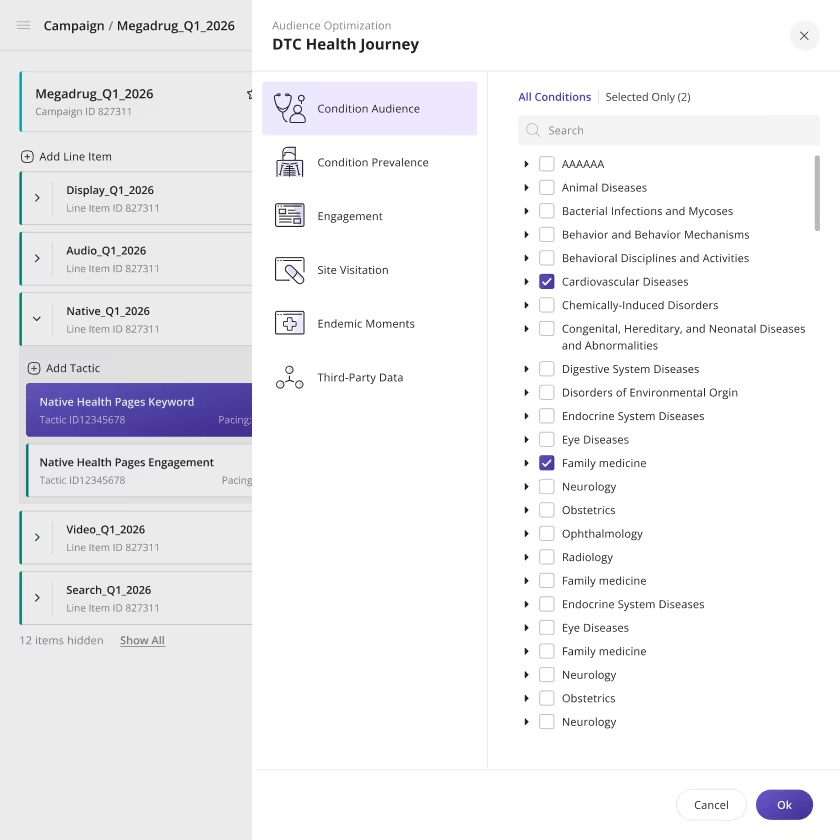
The physician and the patient finally share a plan
Pharmaceutical marketing has two conspicuous audiences: healthcare professionals, usually shortened to HCPs, and consumers, addressed through direct-to-consumer campaigns. Planning them separately creates an obvious coordination problem. Consumer attention and physician prescribing preferences may point in different directions.
HCP2DTC Influence, introduced in June 2026, uses physician prescribing habits and brand-engagement intelligence to inform consumer campaign delivery. The proposal is to let the professional side influence how consumer media is allocated. It is a marketing coordination tool; it does not select a patient’s treatment or replace a clinician’s judgment.
DTC Explorer arrived in September 2026 to move audience creation into a self-service workspace. Users can filter by clinical signals, drugs, geography, insurance provider, and other attributes, inspect aggregate audience counts, and publish segments for activation. The company says these audiences refresh as new claims data arrives. The advantage is less waiting between asking for an audience and using it.
A faster answer, with a slower rollout
Hatch, announced in August 2026, approaches another kind of delay: the time a marketer spends getting an answer out of software. Its conversational interface is designed to handle audience research and questions about live campaign pacing, budgets, delivery, and performance. PulsePoint describes an interface connected to its own data foundation, with links back to underlying information.
The rollout details deserve attention. At announcement, Hatch was being piloted with internal product and account teams; selected alpha users were the next phase. A launch announcement and universal availability are different milestones. The interesting question for a buyer is whether the interface can reliably move from a useful answer to a reviewable campaign action.
September’s Moments announcement makes the timing argument more explicit. Medscape activity, such as reviewing a drug monograph, and WebMD activity, such as comparing treatments, supply engagement signals. PulsePoint’s Adaptive Optimization engine uses them across the media plan. A broader open beta was announced for January 1, 2027. The machinery is intended to respond to what an audience is doing now, alongside what historical data suggests.
Distribution is expanding too. A September 30 partnership with LANE4.io added access to more than 115,000 incremental NPIs in electronic health record and e-prescribing environments, according to the companies. PulsePoint reported that its EHR Curated Market was approaching one million reachable NPIs. The clinical workflow becomes another place to run coordinated media, rather than a separate buying exercise.
Buy the feedback, then ask what it changes
For a prospective customer, the purchasing conversation should begin with the decision the campaign needs to improve. Is the aim to reach a defined physician list, identify relevant consumers, or understand which professional interactions should trigger another message? PulsePoint directs buyers to sales for pricing. A serious evaluation needs the actual proposal, media budget, data scope, and measurement design together.
The approach also has conditions. A useful signal must arrive in time, the audience must be reachable in the chosen channel, and the team must have an approved action ready. A refined segment achieves little if every change spends weeks awaiting internal agreement. Nor does a high match rate demonstrate better health outcomes: matching, reaching, engaging, and prescribing are distinct events.
Privacy is part of the operating design. PulsePoint’s policy distinguishes professional information, pseudonymous advertising identifiers, and licensed de-identified health data. It says clients may not input certain sensitive or HIPAA-covered data. Buyers should evaluate the permitted inputs and intended use of a campaign rather than assume that every health dataset belongs in an advertising platform.
Relevance has a clock. The campaign has to be ready when it rings.
The transferable lesson is modest enough to be useful outside healthcare. Specialize around a decision that matters. Give the observation a route back into the work. Decide who can act on it. PulsePoint’s business is built around shortening those distances. The next advertisement is merely the visible part.
Follow the next signal
PulsePoint · Platform and demos · Newsroom · Insights · Interviews and webinars