The first thing Immersv sold was a pause. A person in a virtual-reality app would stop, find themselves in a theater-like scene, and see an ad for another VR experience. It was an ingenious little piece of stagecraft. The audience was already wearing a device that made looking around the natural thing to do. The ad could offer more than a rectangle. It could offer a place.
But places need people. In 2016, virtual reality had no shortage of grand predictions and a rather shorter queue of regular headset users. Immersv, founded in 2015 and based in Emeryville, California, had to solve two problems at once: make an ad native to an immersive medium, then assemble enough buyers and viewers to make that medium worth anyone's time. The second problem would prove more consequential.
- Immersv connected advertisers with VR and mobile 360-degree publishers.
- It began with ads for VR app installs, then sold campaigns for brands including Mountain Dew, Nissan and the Hawaii Tourism Bureau.
- By 2017 it had raised $10.5 million and signed more than 15 programmatic platform deals.
- Its response to slower headset adoption was to put immersive ads on ordinary phones.
A business built inside the intermission
Mihir Shah, Immersv's co-founder and CEO, knew the less glamorous machinery of attention. Before Immersv he had led Tapjoy, a mobile in-app advertising network, and Flyby Media, an augmented-reality company later bought by Apple. His new company took a familiar exchange - advertiser pays, publisher shows, network keeps a spread - and carried it into an unfamiliar room.
At its March 2016 public launch, the platform's ads promoted other VR apps. Shah gave a disarmingly plain explanation: app installs paid the bills. Developers needed discovery; other developers had an audience already interested in VR. Immersv could supply the staging, delivery, attribution and sales system around those encounters. Its offering looked like several pieces of ad technology in one, though Shah described the publisher side as the clearest way to understand it.
The price tells the story more clearly than a headset ever could. In a 2016 interview, Shah said publishers were receiving roughly one or two cents per view, depending on the content, while Immersv kept the difference between that payout and what it charged the advertiser. The terms were described as deals made up front, not as a public rate card. Still, the mechanism was unmistakable: a futuristic ad format ran on the very terrestrial arithmetic of inventory, yield and margin.
The phone was hiding in plain sight
Immersv's early demos were made for mobile VR devices such as Samsung Gear VR and Google Cardboard. Yet a 360-degree video has another useful property: it can live on a phone without the cardboard. Tilt the handset or drag a finger and the scene moves. The experience is thinner, but the potential audience is much larger. When headset sales ran below the hopes of 2016, that became a commercial fact, not merely a design compromise.
By 2017 the company described itself as a mobile 360 and VR advertising platform. It sold pre-roll and interstitial video, and connected its inventory to programmatic buyers. The August funding announcement said Immersv had signed deals with more than 15 demand-side and supply-side platforms. Named partners included Tremor Video, YuMe, Bidswitch, ironSource, Supership and United in Japan. A separate VideoAmp agreement linked 360 and headset inventory to cross-screen targeting. United's adstir integration offered Japanese app developers another route to monetize with the format.
That chain explains the company's place in the market. OmniVirt was bringing 360 ads to mobile browsers and large publisher sites; Vertebrae focused on native VR ads. Conventional mobile video networks offered far more reach but less novelty. Immersv's pitch sat between them: immersive creative that could be bought through recognizable ad pipes and seen beyond a small headset population. The competitive edge was as much a distribution design as a visual effect.
The basketball court test
Mountain Dew provided a revealing campaign. To promote its VR game with streetball player Grayson “The Professor” Boucher, the brand and agency OMD ran a 360-degree trailer across Immersv's network. The ad did not ask viewers to imagine a virtual basketball world from a flat still. It gave them a modest taste of that world, then directed them toward the fuller experience. Publishers carrying the campaign included Condé Nast and Meredith properties, according to reporting at the time.
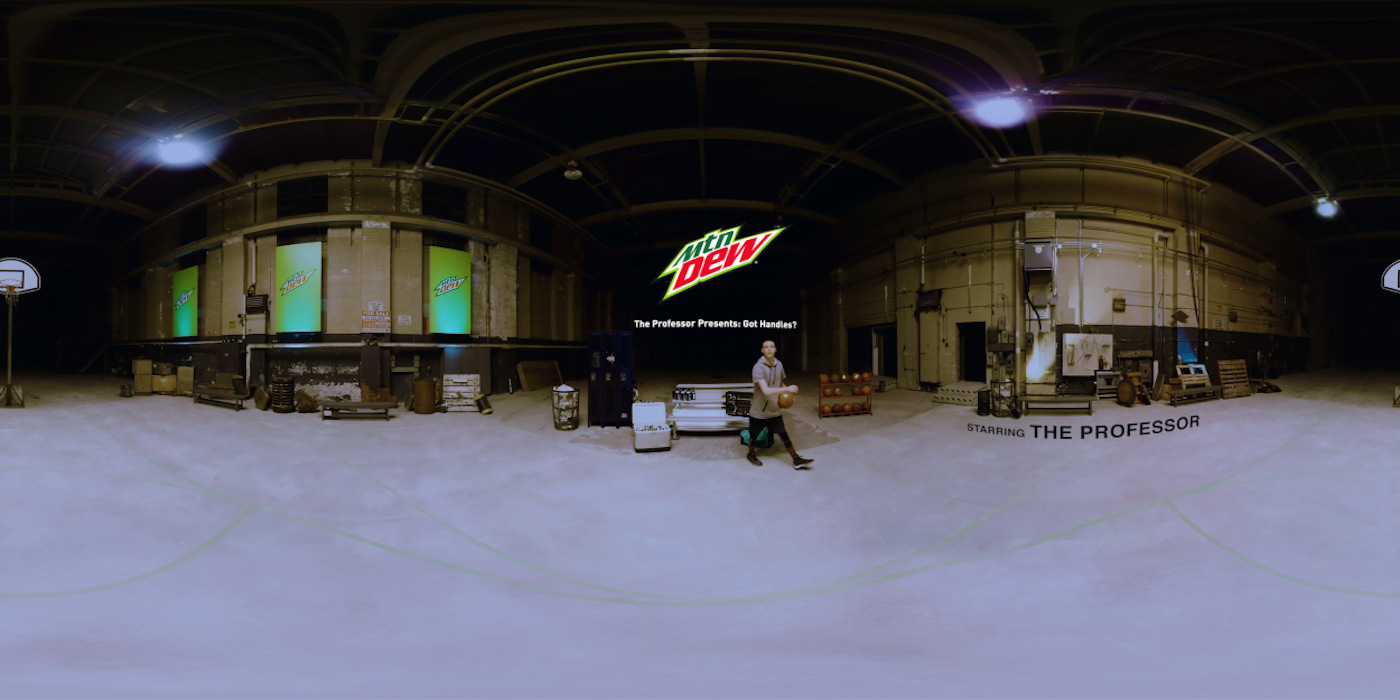
The reported numbers were eye-catching. Mountain Dew said the trailer received more than 100,000 views during its July 31 to August 31 run. Campaign accounts reported a 63 percent video completion rate and a 22 percent post-video click-through rate. Those figures describe this campaign, not a general law of 360 ads; the post-video measure in particular should not be confused with every viewer clicking. But they do show why an advertiser might test a format that lets the ad behave like a sample of the product.
The brands were not buying a headset company. They were buying a way to make existing immersive content visible. That distinction matters. A holiday destination, car interior or game world is unusually well suited to being previewed spatially; a product whose appeal depends on fine print or immediate price comparison may gain much less. The viewer also has to want to explore. A 360-degree canvas cannot rescue a dull reason to look.
The cost of an idea that arrived early
Immersv's public financing milestone came in August 2017: a $10.5 million Series A led by Rogers Venture Partners, with Foundation Capital, The Venture Reality Fund, HTC Vive, GREE, Metaps and others participating. The stated uses were product development, more publisher and supply-side integrations, and expansion to global brands and performance marketers. Shah also spoke of hiring beyond a team of about 15 and pursuing Asian markets. These were plans in an announced round, not a ledger of completed results.
The broader market had a mismatch built into it. Producing sophisticated VR work could be expensive, while the number of people wearing headsets was still modest. If an advertiser had to fund a custom experience and then pay to distribute it, the creative work alone would not make the economics work. Immersv's answer was to make the 360-degree preview portable and the inventory buyable. It did not need every viewer to own a headset for an advertiser to run an immersive trailer.
This is the useful part of the story for a marketer now. Start with a destination that genuinely rewards exploration. Cut a small, interactive preview rather than asking for an app download on faith. Put that preview where the audience already spends time. Measure a specific next action, such as a qualified visit or install, along with attention metrics. Then count the production and distribution cost together. Immersv's own reported results are an invitation to run that test, not a promise that every spherical ad will produce a 22 percent response.
Immersv's best insight may have been less romantic than its product. The headset made the ad fascinating. The phone made it available. In advertising, the world inside the frame can be as wide as you like; someone still has to be there to see it.
Keep looking
- Immersv website · LinkedIn · X · Facebook
- Mihir Shah's Voices of VR interview - the network's early economics in his own words.
- Mountain Dew's 360-degree experiment and the 2017 funding report.