A Tuesday in the war room, and somebody just shipped a hallucination.
Picture a Slack channel inside a Fortune 500. An AI assistant has just confidently invented a refund policy that does not exist. Legal is on the phone. Engineering is grepping logs. Somewhere, a dashboard is blinking - and it is almost certainly an Openlayer dashboard.
This is the moment Openlayer was built for. Not the demo. Not the keynote. The Tuesday afternoon when a model that worked beautifully on Friday quietly starts misbehaving, and twenty-five people in San Francisco are the ones who can tell you exactly why.
Openlayer is an AI governance and observability platform - which is a long way of saying it is the layer between an enterprise's AI ambitions and an enterprise's AI accidents. It tests models before they ship. It watches them after they ship. It catches hallucinations, prompt injections, PII leaks, drift, bias, and the small, embarrassing failures that turn into front-page news.
The category is crowded. Openlayer's wager is that the winner will not be the loudest tool. It will be the one teams actually trust at 3 a.m.
A small company doing load-bearing work.
Three engineers, one shared frustration.
Gabriel Bayomi, Rishab Ramanathan and Vikas Nair did not meet at a hackathon. They met at Apple, working on separate AI projects - one of them the Vision Pro - and bonded over a deeply unglamorous observation. The headline numbers on their models were fine. The reliability of those models in the wild was not.
That gap, between what a model could do on a benchmark and what it actually did in production, became their pitch. In 2021 they joined Y Combinator's Summer batch, incorporated as Unbox Inc., and started building what would become Openlayer.
The bet was contrarian for its time. In 2021 the AI industry was chasing capability. Bayomi and his co-founders argued the next bottleneck would not be smarter models - it would be governing the ones we already had. Five years later, the EU AI Act and a parade of public AI failures have made that argument look prescient.
Gabriel Bayomi
Rishab Ramanathan
Vikas Nair
What Openlayer actually does.
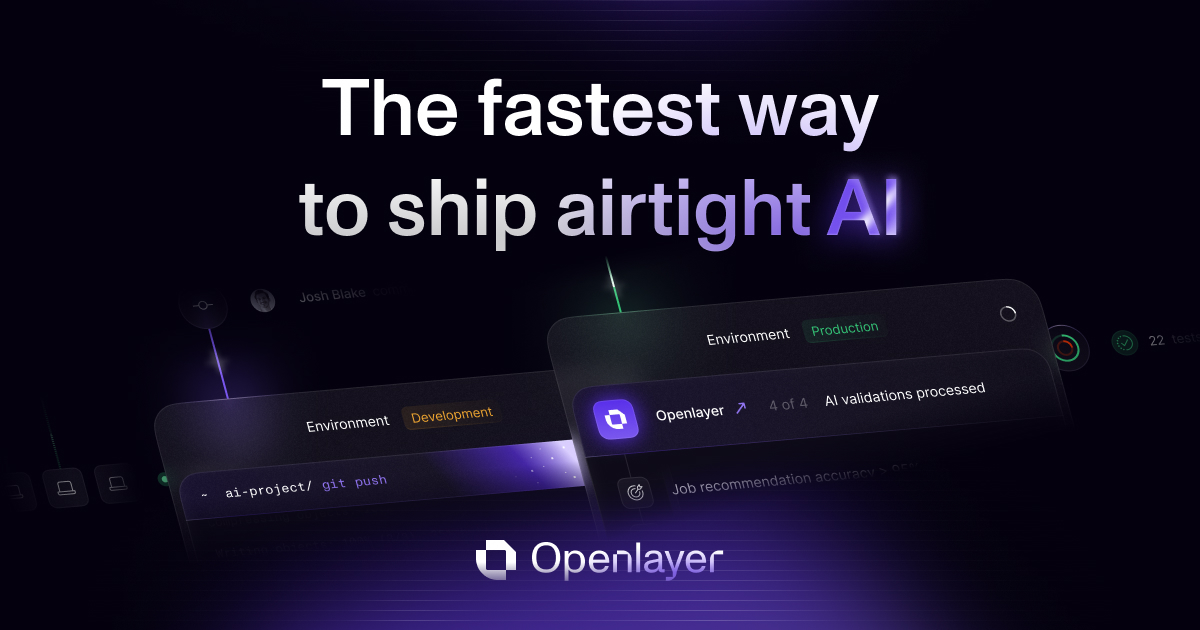
Imagine the CI pipeline you wished you had for AI - the one that catches a regression before your customers do. That is roughly the shape of Openlayer. You connect a Git repo. You define must-pass tests. Every commit triggers them. Every production response is monitored. Every agent decision is traced.
100+ behavioral tests
Accuracy, fairness, robustness, hallucinations, bias, PII leakage and toxicity - across ML and LLM systems.
Production monitoring
Drift detection, root-cause analysis and actionable alerts so issues get found and fixed quickly.
Real-time protection
Inline defense against prompt injection, PII leakage and unsafe outputs at the moment of inference.
Agentic visibility
Trace every tool call, chain and decision an AI agent makes - even as behaviors evolve in the wild.
Governance, by default
Model inventory and continuous compliance aligned to EU AI Act, ISO/IEC 42001, NIST and OWASP.
Lives where you live
Native ties into OpenAI, Anthropic, GitHub, Snowflake, OpenTelemetry - plus SDKs in five languages.
Where AI breaks - and where Openlayer catches it.
// Common production failure modes · relative frequency observed by AI eval teams
Approximate. Based on categories Openlayer's evaluation suite explicitly targets.
Who is on the platform.
Openlayer's customer roster is the kind that signals product-market fit without needing a press release: eBay, Hurb, Cutshort, Jericho Security and a growing list of enterprises that prefer not to be named in case their AI is being interesting that week. The pitch resonates with two audiences in particular - ML platform teams who want a single pane of glass, and CISOs who want a paper trail.
What you can actually do with it
Run an evaluation suite over a new model before promotion. Set guardrails on a customer-facing chatbot. Monitor an agentic workflow across a hundred tool calls. Generate the audit artifact your compliance team needs for ISO 42001. Catch the moment a model starts drifting because the world changed and the training data did not. The throughline is the same: you can ship faster because you know exactly when to slow down.
A short history of a long thesis.
Twenty-five people. Five SDK languages. One relentless roadmap.
Most twenty-five-person startups have one SDK. Openlayer ships five - Python, TypeScript, Go, Java and Ruby. That detail is a tell. The team is engineering-heavy, remote-friendly and built on the conviction that developer experience is a moat in a category where most competitors lead with sales decks.
Their backers seem to agree. Race Capital led the Series A. The cap table includes NXTP, KPN Ventures, Mindset, Quiet Capital, Telefonica, Y Combinator, and angels from Vercel, Instacart, Meta and Stripe - a who's-who of operators who have shipped enough product to know what reliability actually costs.
The bet looks simple in retrospect. Build the boring layer. Build it well. Wait for the rest of the industry to realize they need it.
Find Openlayer.
Watch & listen
Openlayer product walkthroughs on YouTube
Gabriel Bayomi on Frontlines: building Openlayer
YouTube interviews with the founders
Share this profile
Back in the war room - this time, quieter.
Return to that Tuesday. The hallucinated refund policy. The frantic Slack. Only now, the dashboard caught it before the customer did. The guardrail blocked the response. The audit log already shows which prompt, which model version, which retrieval chunk - and which test in CI should have caught it.
Nobody calls legal. Nobody pulls a release. A ticket gets filed. An engineer pushes a fix. The model behaves. The customer never knows the war room existed - which is the whole point.
That is what Openlayer is selling. Not a smarter AI. A more trustworthy one. The kind that lets enterprises stop holding their breath every time they ship.
The category will keep growing. Competitors will keep crowding in. But the company that started with three Apple engineers grumbling about reliability has quietly become the layer the rest of the AI industry is building on top of. Loud problem. Quiet fix. That is the Openlayer trade.