A medical record has two dates that matter. One is the date of treatment. The other is the day somebody finally finds it. Between them sits a small administrative universe: requests, follow-ups, permissions, invoices, attachments. For an insurance adjuster or a lawyer, a document can be perfectly real, entirely relevant, and practically useless until it reaches the right desk in a readable form.
Ontellus has made that interval its business. The company retrieves records for insurance carriers, self-insured organizations, third-party administrators and law firms. Then it helps put those records to work. Its central insight is easy to overlook: delivering information and making information usable are separate jobs.
- Find it: discover treatment locations and retrieve the records.
- Arrange it: turn separate files into searchable, dated evidence.
- Use it: review, summarize and share inside a connected workflow.
The file arrives. The puzzle remains.
Consider the ordinary shape of an injury claim. There may be medical notes, bills, pharmacy records, employment information and diagnostic images. They come from different places. They describe overlapping events. Receiving them answers the procurement question. Understanding the sequence of treatment requires another round of work.
SmartChron addresses that second round. Ontellus describes a tool that merges records into a case chronology, organizes them by date and makes their text searchable through optical character recognition. New records enter the chronology as they arrive. The useful detail is the updating: a timeline should not become another document somebody must rebuild every afternoon.
SmartOrg handles a related annoyance. A customer may already possess the documents but still need them indexed, bookmarked and organized. Ontellus accepts those existing records for processing. This expands its role beyond fetching things. It can help repair the information mess already sitting on the customer's desk.
The expensive art of typing it again
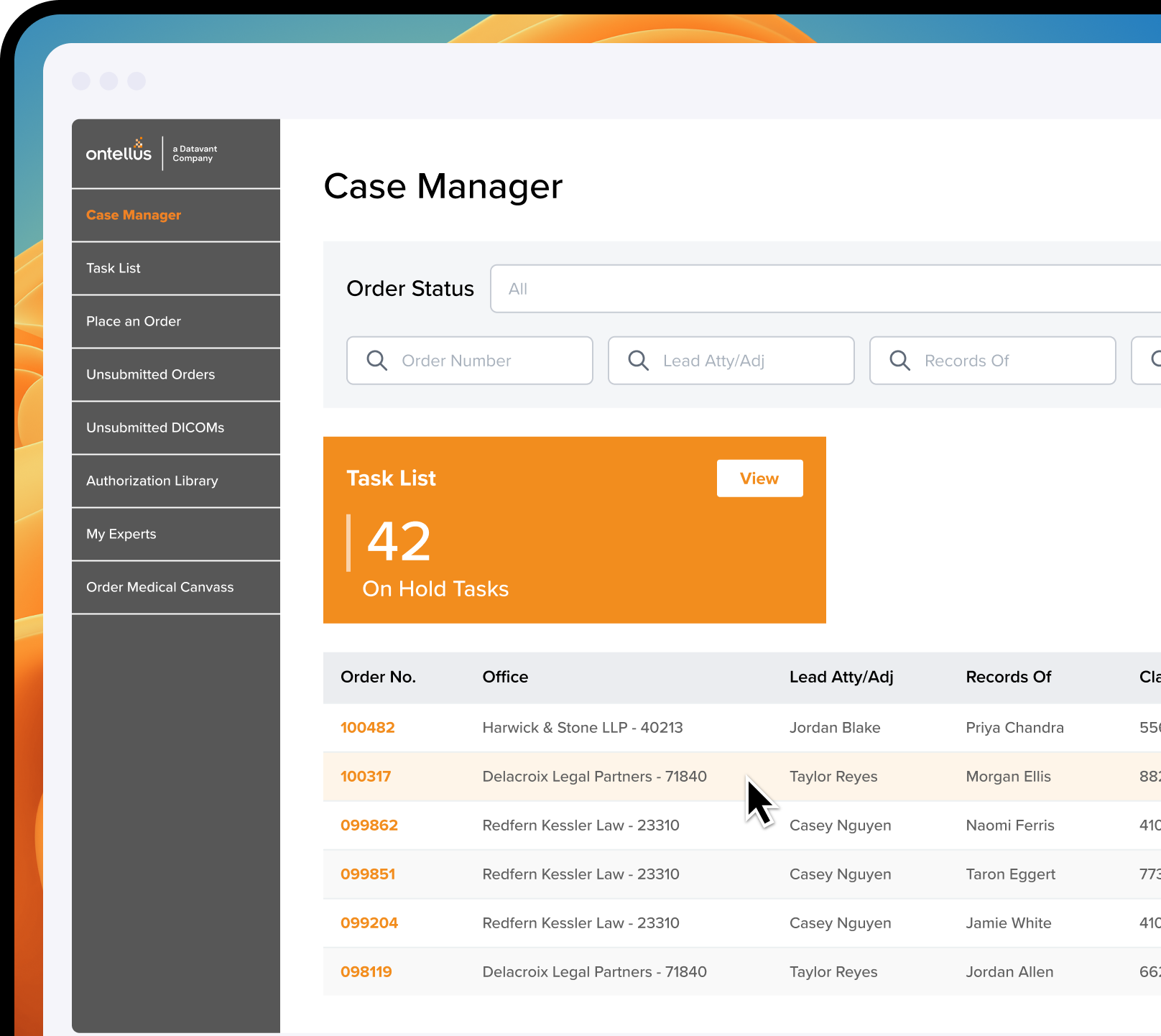
There is a wonderfully unromantic clue to the company’s positioning in its Guidewire integration. Before integration, an adjuster could hold claim information in Guidewire ClaimCenter, then enter it again in an outside records portal. Checking progress meant another trip between applications. The problem was sitting in the handoff.
In October 2021, Ontellus announced that Erie Insurance had gone live with AddOntellus. Its claims teams could order records from within ClaimCenter, with status updates and access to retrieved documents in that environment. Ontellus also offers an integration with Duck Creek Claims. These connections meet the customer where the claim already lives.
The lesson travels beyond insurance. Follow the information someone copies twice. That repetition is a candidate for improvement. Here, the practical proposition is fewer separate steps between opening a claim and reviewing its supporting records. Buyers can evaluate that against their own workflow without needing to believe a sweeping promise about transformation.
- 01DiscoverWhere else was treatment?
- 02RetrieveRequest and track records.
- 03OrganizeSearch a dated chronology.
- 04ReviewSummarize and share.
A business assembled around the next task
The underlying company began in 1975 as Keais Records Retrieval. The Ontellus name arrived in 2017, following seven acquisitions. Its history is a useful corrective to the idea that every technology business starts with a clean sheet. This one grew from the patient work of obtaining documents, then expanded around adjacent customer needs.
Capstreet first invested in 2015. Aquiline announced a majority investment in January 2020 alongside Capstreet and management. Later that year, Ontellus acquired INTERTEL and MasterTrace, adding medical canvassing. That changes the question from “Can you get this record?” to “Where might there be another record worth requesting?”
Canvassing seeks previously unidentified treatment information; social canvassing locates and preserves relevant online material. The distinction matters. A retrieval request follows a known lead. Discovery can produce another lead. Connecting those stages gives a customer a route from finding a possible treatment location to ordering its records.
What the invoice buys
Ontellus sells a combination of services and software. Its portal supports ordering, tracking, downloading and sharing. Its wider offering includes medical summaries, diagnostic-image viewing and connections to medical expert witnesses through AMFS. The buyer is paying for work around the record as well as access to tools.
The commercial mechanics are concrete. Portal terms describe rates agreed at ordering and monthly invoicing after records are published or a custodian reports no records. SmartChron is marketed with a flat charge per file. That gives buyers a defined billing unit for chronology work, which they can compare with the staff time involved in preparing it themselves.
Alternatives include U.S. Legal Support and other retrieval specialists, broader litigation-support providers, and an internal team doing the chasing and sorting. Ontellus’s positioning rests on connecting several tasks: discovery, retrieval, organization, analysis and secure exchange. Its security page describes annual SOC 2 Type II audits, employee HIPAA education and role-based access controls.

The next bottleneck is reading
Datavant announced completion of its Ontellus acquisition on August 6, 2025. In October, it completed its acquisition of DigitalOwl, describing a combination of retrieval, automated summaries, chronology, de-duplication and medical-data analysis. The sequence makes the strategy legible: get the information moving, then reduce the work of understanding it.
“Our customers do not need or want an entire medical chart”Kyle Armbrester, Datavant CEO · October 2025
That observation also identifies the constraint. An orderly chronology reflects the documents supplied. A summary still needs professional interpretation. Finding another treatment location does not, by itself, settle what caused an injury. Ontellus fits workflows where obtaining and preparing records consumes time; the claim decision remains a separate responsibility.
There is also a basic dependency beneath every dashboard: somebody has to release the record. Ontellus describes retrieval through authorizations, subpoenas and other request procedures. Digitizing the request does not make the document appear by itself. The service includes the follow-up, while the portal makes progress visible to the person waiting for it.
That combination explains why this is more than a software purchase. A team with an occasional, straightforward request may assess the value differently from an insurer handling recurring claims across many providers. Volume, document complexity and the amount of existing manual work shape the purchasing question.
For a prospective customer, the useful experiment is modest: trace one claim from request to review. Count the repeated entries, the status checks and the hours spent arranging pages. Those are the places to examine. The paper trail becomes valuable when someone can follow it.