The concrete may be local, but the anxiety is universal. Before a construction company lets a subcontractor near a site, somebody must check insurance, solvency, safety, tax standing, modern-slavery policies, environmental claims and a widening shelf of regulation. Then the project changes, the supplier changes or a certificate expires, and the ritual begins again. Once For All exists to make that repetition useful. It verifies the paperwork, keeps the record alive and turns the resulting data into a network for deciding who gets invited, who gets watched and who gets the work.
The company is a curious creature: young as a group, old in its parts. Once For All took shape in late 2021 when Britain's Fortius - built around Constructionline - combined with French compliance businesses including Attestation Légale and Actradis. Its present identity arrived through consolidation, not a lone founder's flash of inspiration. The old French idea supplied the excellent name: give customers the administrative file “once, for all” their relationships. Constructionline supplied decades of British market memory. The result now has more than 900 employees, with important offices in Paris, Lyon, Basingstoke and Madrid.
Trust is the product hiding inside the software
On one side are major contractors, property owners, facilities managers and infrastructure operators. They need qualified companies at short notice, but a long supplier list is not the same thing as a safe supply chain. On the other side are subcontractors and small suppliers. They want access to bigger projects without answering the same questions for every buyer. Once For All sits between them, part software vendor, part marketplace and part credentialing utility.
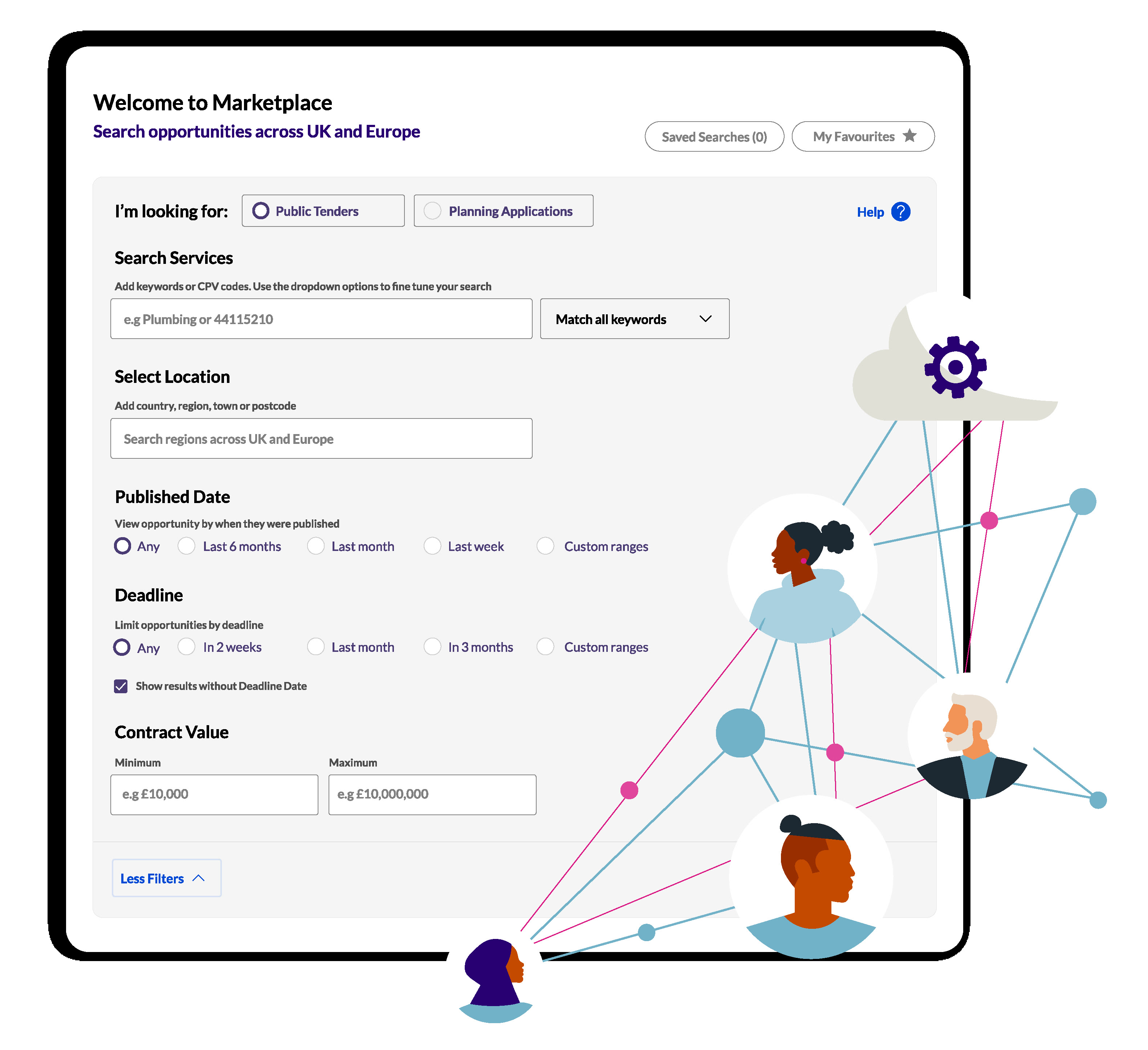
A buyer can search for a trade, publish an expression of interest, inspect credentials, issue tender enquiries and monitor a supplier's financial health. A supplier can maintain a profile, demonstrate compliance and see project opportunities. The clever move is reuse. A tax document collected for qualification can help with onboarding. An account filing can feed a risk alert. Performance on one job can inform the next shortlist. Product data gathered for specification can support an embodied-carbon calculation.
“Every workflow produces verified data that feeds back into the network.”Once For All strategy
This is where the company differs from broad procurement suites and jobsite-management platforms. SAP Ariba and Coupa cover procurement across industries. Procore and Autodesk Construction Cloud organise projects. CHAS, SafeContractor, Achilles, Avetta and ISNetworld each overlap with qualification or contractor risk. Once For All's pitch is narrower and deeper: European construction rules, a built-environment supplier graph and a record that begins before the jobsite exists.
A roll-up becomes a product road map
Private equity supplied the next plot turn. GTCR agreed to buy Once For All from Warburg Pincus in July 2023, partnering with software executive David Hornsby as chief executive. The purchase price stayed private. The financing did not: Bloomberg Law reported a £180 million unitranche loan from Blackstone, Golub Capital and HPS Investment Partners, plus a line for future acquisitions. That second facility was a clue. Once For All was going shopping.
The reported private-credit package backing GTCR's acquisition. It is not the purchase price, which was undisclosed. The deal also included capacity for add-on acquisitions.
In 2024 it bought BidWork, whose AI tools scan tender documents and help estimators manage enquiries. Nalanda Global added a Spanish compliance network, worker-level health and safety tools and reach into Latin America. Batis extended the French product into contracts, signatures, invoices and site administration. In 2025, Sytrix brought supplier scorecards and performance monitoring. Then 2050 Materials added product and embodied-carbon intelligence.
Two of those purchases show how the company changes its mind in practice. Batis was not a blind leap into site administration: its tools had already been integrated with Once For All for three years, and customers including Eiffage and Equans used both. Acquisition converted a tested connection into ownership. Sytrix followed a different signal. Once For All said customers had been asking for supplier-performance management for years, particularly organisations managing subcontractors under ISO 9001. Buy after observing repeated demand; integrate after watching a working partnership. It is less cinematic than inventing a category, and considerably easier to diligence.
The expanding pre-construction stack / capability, not revenue
Read together, the acquisitions reveal the intended sequence. Find the supplier. Prove it is allowed to work. Ask it to quote. Sign the contract. Watch its finances and performance. Measure what its materials do to the carbon budget. Each additional step increases the number of reasons to return to the same record. It also increases the integration burden. Customers do not buy a corporate family tree; they buy fewer logins, fewer duplicated fields and fewer surprises.
AI gets a clipboard, not a cape
Once For All talks about AI, but the useful applications are agreeably mundane. BidWork's “X-Ray” scans tender documents to expose scope items and irregularities. Risk Radar combines proprietary records with industry and regulatory information to flag financial distress before it reaches a project. Matching tools can narrow a sprawling supplier universe. The machine is not designing the building. It is reading the attachments nobody wanted to read at 4:45 on Friday.
That restraint matters because compliance data is only valuable when someone trusts its provenance and freshness. A model can structure a document or rank a signal; it cannot wish an expired certificate current. Once For All's harder expertise lies in mapping national schemes and private standards: the UK's Building Safety Act and Common Assessment Standard, France's Loi Sapin II obligations, Germany's supply-chain rules and Spain's contractor-verification regime. Local verification is the expensive part. AI makes it more usable.
The model works because both sides feel the paperwork
Revenue comes from B2B software, memberships and marketplace access. Buyers pay for sourcing, compliance, risk and workflow capabilities. Suppliers can buy scheme memberships or upgrades that make credentials visible and open access to opportunities. Industry bodies can use Once For All's technology to operate specialist qualification schemes. The company does not publish a simple group-wide price card; the cost depends on membership, market and module.
The flywheel is easy to sketch. More buyers attract suppliers. More suppliers make sourcing useful. More verification creates more data. More data sharpens monitoring and matching. Regulation adds a steady tailwind because due diligence is becoming continuous rather than occasional. In September 2026, the company gained a place on Britain's G-Cloud 15 SaaS framework, giving public-sector buyers a pre-vetted route to purchase its risk and compliance tools.
Marketplace data also gives Once For All a second product: a live view of demand. Its analysis counted £19.8 billion of UK construction contracts awarded in the first half of 2026. The quarterly path was lumpy - £12.75 billion in Q1, then £7 billion in Q2 - while the second quarter's project count still rose 4.3 percent from a year earlier. More striking was the £1.3 trillion pipeline of future opportunities published during Q2. These are company-derived market figures, not audited revenue, but they show why contractors might keep the tab open. A compliance portal is visited when a certificate demands it; an opportunity feed can earn a daily habit.
The moat is not the form. It is the history of the form - who supplied it, who verified it, when it changed and which decision came next.
The conditions are not universal. The model is strongest where qualification is mandatory, suppliers repeat across projects, buyers share enough requirements and records can legally travel between relationships. It is weaker in one-off, lightly regulated purchasing; in markets without a critical mass of buyers; or where every customer insists on unique evidence that cannot be reused. Network effects also cut both ways. A supplier passport saves time only if the next buyer accepts it.
What another operator can copy
The transferable lesson is not “buy five companies.” It is to begin with a painful, compulsory workflow and make its exhaust valuable. Once For All started around qualification, a task neither side can simply ignore. It then placed opportunity, risk and performance decisions beside the same record. That creates a credible path from tool to system of record to network.
A practical version of the playbook
- Choose a document people must maintain, not one they merely ought to.
- Verify it once, timestamp it and preserve who changed what.
- Give the contributor an immediate benefit, such as access to work.
- Attach the next decision to the same record: shortlist, tender, monitor, review.
- Keep local expertise close when regulation changes by country.
Once For All now sits at an interesting threshold. The acquisition logic is coherent; the pieces cover much of the construction lifecycle before and around site work. Its next proof is operational rather than financial: whether a customer experiences one platform instead of a bundle of respected regional brands. If it succeeds, the company will have turned Europe's least glamorous construction material - the compliance dossier - into connective tissue.