A construction drawing can be wrong in an almost charming way. A door carries one fire rating in the schedule and another on the plan. A duct arrives at a beam as if the beam had agreed to move. An electrical panel serves equipment whose voltage belongs to a different universe. On a screen, these are lines and labels. On a jobsite, they are phone calls, requests for information, new prices, idle crews, and someone asking who approved this.
The short version
- Buildcheck reads 2D construction drawings with computer vision, then has industry experts verify the findings.
- It sells to owners, developers, general contractors, architects, and design teams on a per-sheet basis with unlimited seats.
- The company reported 110-plus paying customers, 150,000-plus reviewed sheets, and 115,000-plus flagged issues by September 2026.
- The reusable lesson: automate the tedious first pass, preserve human judgment, and measure value in avoided downstream cost.
Buildcheck exists because this small-error-to-large-invoice conversion is common enough to support a company. Its software takes a PDF set and examines the drawings across architecture, structure, civil, mechanical, electrical, plumbing, fire protection, and other disciplines. It looks for missing information, mismatched schedules, two-dimensional clashes, coordination failures, and code concerns. The result is not a chat window delivering confident prose. It is a marked-up drawing with a questionable spot, a severity, an assignee, and a trail toward resolution.
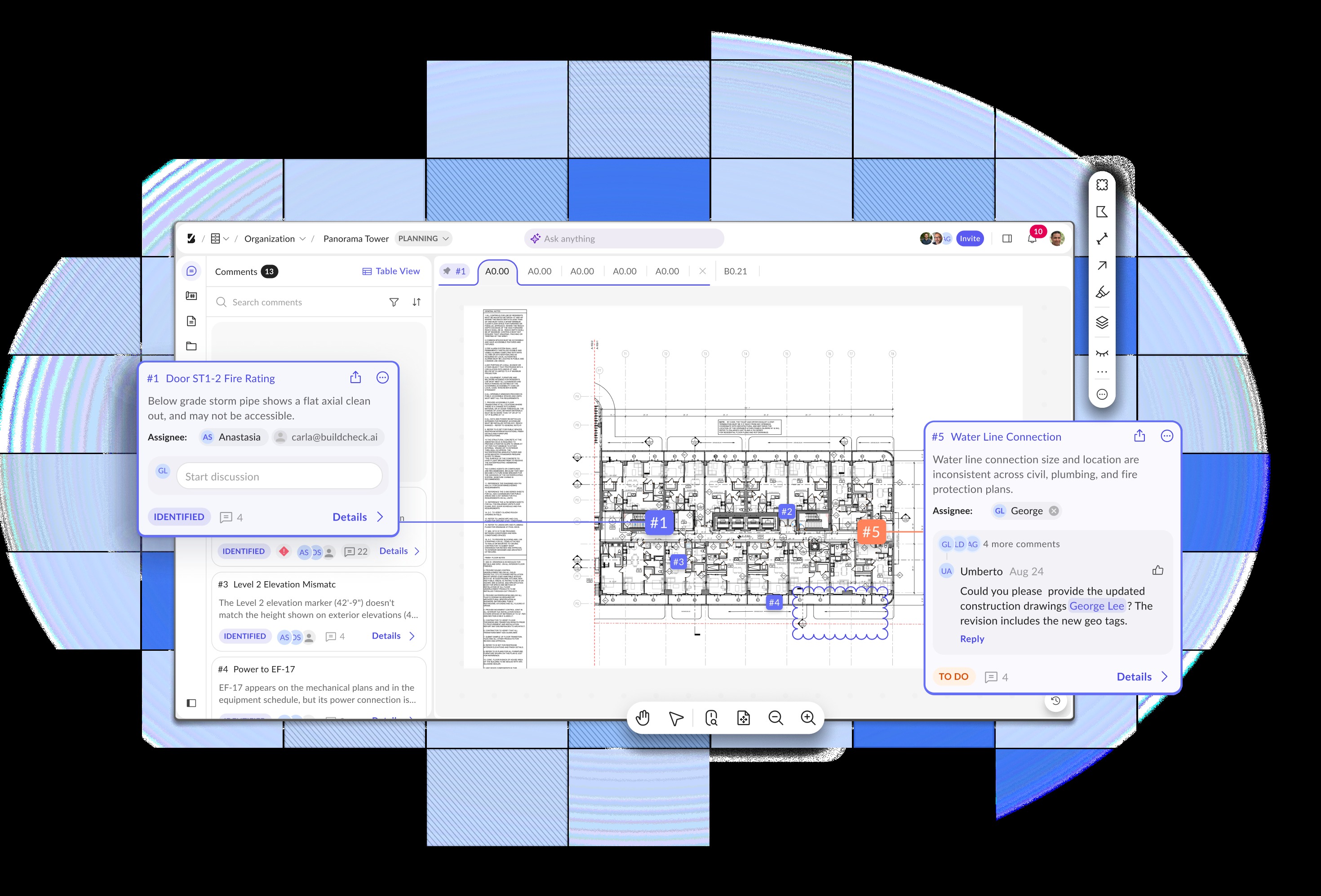
The company lives between the sheets
The founding story is unusually literal. Alexander Michalatos grew up around his father's residential construction work in Canada and Greece, then worked across design, contracting, building systems, and ownership. At Stanford, he met Alex Gureiev, an AI engineer, and Andrei Molchynsky, a lawyer and real-estate operator. The three formed Buildcheck in 2023. An early $6,000 grant from Stanford Professionals in Real Estate paid for data labeling and helped produce a proof of concept.
That tiny check matters because it reveals what the team believed the hard part would be. It was not a prettier upload screen. It was teaching software that a mechanical sheet and a structural sheet can contradict each other without ever sharing the same visual grammar. Firms use different symbols. Drawing quality varies. Information migrates between plans, details, schedules, and specifications. The models needed construction data, not merely fluency.
“Construction doesn't run on contracts or emails, it runs on drawings.”Alexander Michalatos, co-founder and CEO
Buildcheck released its product in September 2024. By December 2025, it said more than 50 organizations were paying, including AvalonBay Communities and Novo Construction, and announced a $5.9 million seed round led by Uncork Capital. Nine months later came a $12 million Series A led by Telescope Partners, with WND Ventures, the venture arm of customer DPR Construction, joining the round. Buildcheck said its customer count had passed 110 and its platform had reviewed more than 150,000 sheets.
What changed was the unit of attention
The old unit of work is the crawl: an experienced person combing through hundreds of pages, trying to remember whether the floor drain on sheet P-103 agrees with the slab opening on S-202. Manual review brings judgment but runs into time and fatigue. BIM clash detection is useful when a coordinated model exists, yet much of construction still travels through 2D PDFs. Text chatbots can retrieve a specification but are poorly suited to noticing visual disagreement.
Buildcheck's answer is a division of labor. The machine runs the broad, repetitive pass. Human reviewers check its output before a client receives it. The project team then decides what matters and what to do. The company says intake takes minutes and a full review generally takes five to ten days, compared with several weeks for a comparable manual process.
PDF drawings and specifications enter the secure workspace.
Hundreds of cross-discipline checks inspect the set.
Construction experts filter noise and review findings.
Teams assign, discuss, sync, and backcheck issues.
This is also why the first thing to fail is often not the AI but the conventional overlay. Shift one drawing slightly and a comparison tool may illuminate nearly everything. The meaningful moved wall disappears in a carnival of false changes. Buildcheck's Diffs product attempts to separate alignment noise from substantive revisions and explain the latter in plain language.
Novo Construction had been using tools such as Bluebeam to overlay revised packages. Across hundreds of pages, CIO Colin Stoner said, the work could make a person “go cross-eyed.” Novo tried Diffs on two California projects. Project managers moved from searching for changes to reviewing flags, dismissing irrelevant ones, and sending material changes back for repricing. Stoner's conclusion was not blind faith. It was a durable construction technology policy: “trust but verify.”
Public dollar pricing is not disclosed. A trial project comes first, and unlimited collaborators are included.
The pitch is fewer RFIs, change orders, permit comments, schedule slips, and rounds of manual comparison.
A spell-checker learns four new tricks
The original shorthand for Buildcheck was “spell-checker for construction designs.” It remains useful, but the Series A marks an attempt to become the review layer around the whole set. Custom Checks turns a contractor's internal QA/QC playbook into automated review agents. Diffs compares revisions. Code Reviews looks for regulatory issues. Value Engineering searches for cost and constructability opportunities. The last two are in beta in the United States and Canada.
In August 2026, the company also brought in Plangrep, whose team had worked on extracting structured information from plans and preparing construction documents for language models. This is a clue to the larger ambition. Once a drawing becomes machine-readable, review is only the first use. Estimating, procurement, change management, and closeout all become possible neighbors.

Alexander Michalatos
CEO, construction operator
Alex Gureiev
CTO, AI engineering
Andrei Molchynsky
CBO, law and real estate
The useful copy is the workflow
A contractor does not need to buy Buildcheck to borrow the workflow. Run a formal drawing review around 50 percent construction documents or later. Repeat it when revisions arrive. Separate repetitive checks from professional judgment. Give every issue an owner and a resolution state. Compare the new package against the old one. Measure avoided cost conservatively, and keep a record of which flagged items were accepted, rejected, or missed.
The method is convincing on large, multidisciplinary projects where drawing volume, revision churn, and coordination risk are high. It is less compelling when the document set is tiny, poor-quality, or too early to contain the needed detail; when a firm cannot act on findings before procurement or construction; or when teams mistake a flag for an engineering decision. Buildcheck itself advises that AI should not make the final call on safety, design, cost, or engineering. Its expert-verification layer exists because false positives are not an abstract model metric when a project team is already short on time.
The company's reported returns, generally 10 to 35 times the product cost, should be read as its commercial case rather than audited fact. Still, the shape of the value is easy to understand. A Canadian multifamily review cited by Buildcheck found 173 issues and estimated roughly $541,000 in savings and 27 days protected. The precise counterfactual is debatable. The timing is not. A problem noticed on a PDF is almost always cheaper than the same problem noticed by a crew.
The clever move was not asking AI to build the building. It was asking AI to notice what the building team was too busy to see.
That restraint places Buildcheck in a promising corner of construction technology. It competes with manual QA/QC, third-party constructability reviews, PDF overlays, BIM clash detection, and newer AI drawing-review tools. Its distinction is the combination of sheet-native vision, cross-discipline checks, human verification, and the collaboration layer where findings become work.
The larger vision is more romantic. Michalatos describes AI restoring the reach of the old master builder, the person who could see an entire project rather than one specialty. Modern buildings are too complex for any single person to hold that view. Buildcheck's wager is that a machine can hold the breadth while people retain the judgment. For now, the company is beginning with a humbler promise: before the wall is poured, it will read the footnote.
Open tabs
See the product, inspect how the review process works, or follow the company as it expands beyond its original drawing checks.