Omri Yacubovich has a rather personal reason to appreciate inefficient banking. His parents met while working at a bank as students, checking reports before the information entered its core system. The work brought them together. Their son would eventually make a business of helping banks automate the sort of manual effort that had given his family its beginning.
He told the story while announcing Lama AI’s Series A. A financing announcement usually arrives dressed in market forecasts and investor names. Yacubovich opened with his parents. It was a small family history tucked inside a software pitch, with an unusually good punchline: progress had been kind enough to wait until after the introductions.
Today he is CEO and co-founder of Lama AI, which develops commercial lending software for financial institutions. His route there includes online retail, a digital bank and insurance technology. Across those jobs, a recurring question emerges: how much effort should a customer have to expend before a business understands what they need?
Before the bank, the breakfast table
Years before Lama, Yacubovich wrote about working at Club Med shortly after turning 21. The memories he chose were wonderfully uncorporate. Colleagues welcomed arrivals with applause. Staff ate with guests. Evening entertainment could require the team to perform after dinner, whatever their private opinion of their theatrical gifts.
He turned those experiences into practical advice for entrepreneurs: meet customers before a problem develops, watch how they actually use a service, and learn to greet them in their own language. He recalled picking up greetings and introductions in more than ten languages. Hospitality offered immediate feedback; a guest did not need an analytics dashboard to look delighted or bored.
When he told colleagues about the job, they laughed. He kept the lessons. Read beside his later banking work, that early essay suggests a consistent interest in the person using the product. The resort supplied an education in attention, with rather more compulsory dancing than most business courses advertise.
A visitor is more than a demographic
In 2012, Yacubovich co-founded Commerce Sciences with Aviv Revach and Eyal Brosh. The company worked on website personalization and optimization. Its premise was that a visitor’s circumstances mattered: where someone arrived from, which device they used, when they visited and what they did could help shape a more useful experience.
Taboola announced its acquisition of Commerce Sciences in January 2017, with the deal closing on January 1. The technology would support Taboola’s personalization work for publishers. For Yacubovich, the transaction marked an exit from a company he had helped start; the more interesting continuity was the problem the company had chosen.
A website receives plenty of signals, but a page can still treat everybody alike. Commerce Sciences tried to close that gap. There is a useful resemblance to the problem he would later pursue in finance: information becomes valuable when it changes how an organization responds. Collecting another field is easy to celebrate. Making that field useful is a less photogenic occupation.
- 2012Commerce SciencesPersonalizing the visit
- 2016-18PepperGrowing a digital bank
- 2018-21PlanckUnderstanding business risk
- 2022Lama AIReworking business lending
An education in forms
Yacubovich studied law and accounting at Tel Aviv University. His professional experience then carried him through marketing, business development and growth roles. At Pepper, he served as chief growth officer. At Planck, he led marketing and business development, working on growth in the United States both directly and through partnerships.
In a 2020 interview, he described Planck’s use of a business name and address to generate information for commercial insurance underwriting. The target was familiar to anyone who has completed a long application: an institution needed to understand a business, but obtaining and validating the answers could consume considerable time.
His explanation focused on the quality of the information behind a decision. Better data could help an insurer understand risk and serve an applicant more efficiently. The resemblance to his next company is fairly plain. Before asking bankers to change their workflows, he had worked in another industry where understanding a small business meant working through a formidable collection of questions.
The loan has to be worth the work
Yacubovich and Ran Magen founded Lama AI in 2022. Yacubovich took the CEO role; Magen became CTO. They chose business lending, a field in which the usefulness of faster software depends on fitting the institution’s actual work. Borrowers want an answer. Lenders need enough confidence to give one.
The economic difficulty is particularly sharp for small loans. A modest request can demand much of the same administrative effort as a larger transaction. In Lama’s account of the market, that cost can make a worthwhile customer difficult for a bank to serve. Reducing the work involved is therefore part of making the lending relationship possible.
The company’s platform covers tasks from borrower intake and document collection to financial analysis, underwriting support, closing and monitoring. It is designed to work within a bank’s policies and approval processes. Yacubovich’s proposition asks institutions to keep their standards while spending less time moving information towards the people responsible for applying them.
The questions on the other side of the desk
Alongside selling software, Yacubovich has made a habit of interviewing banking executives. The conversations give him a second public role: the person asking the questions. They also make the work behind a banking product more visible. A bank is an organization with habits, history and people who must live with a purchasing decision.
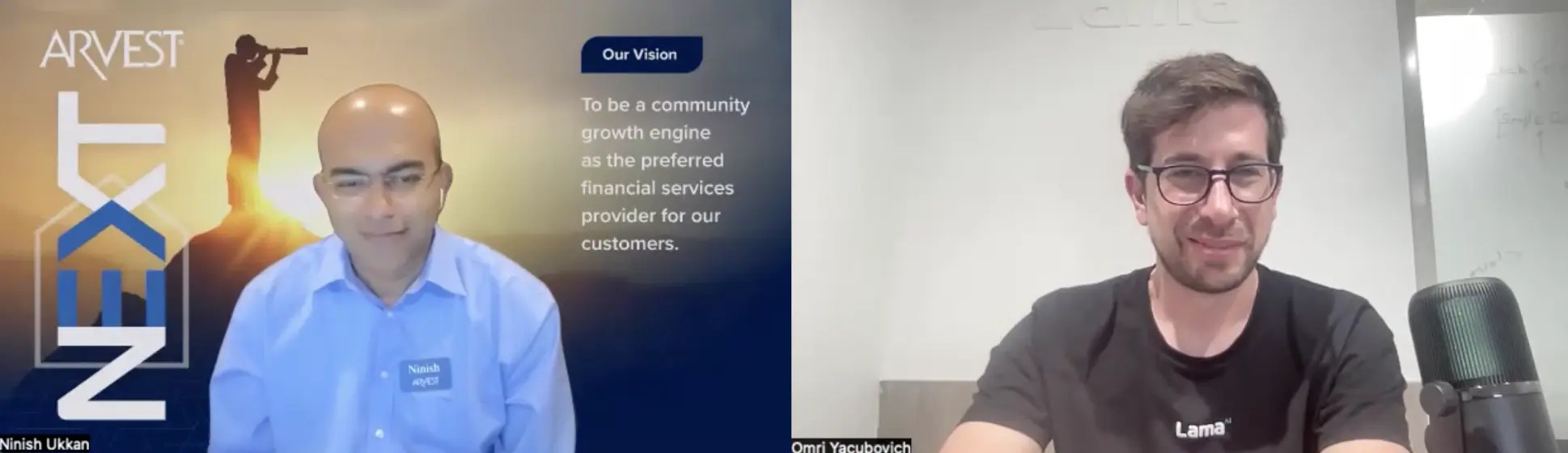
With Arvest CTO Ninish Ukkan, he explored how technology leadership connects strategy, culture and practical implementation. Yacubovich followed up on how to recognize cultural fit in interviews, then moved to core modernization and the choice between building and buying software. The questions stayed close to the compromises an institution has to make.
Ukkan described respecting the reasons older systems exist and the integration work required even when a bank buys a product. Those answers give useful texture to Yacubovich’s chosen market. A demonstration can end when the screen goes dark. The customer still has to make the technology work on Monday morning, alongside everything already there.
Listening is part of the product
Another conversation, with Royal Business Bank COO Gary Fan, concerned whether banks should rethink their operating models rather than simply digitize existing processes. Fan argued that smaller institutions could find opportunities in technological change. Yacubovich pressed him on the implications of banks building more tools themselves.
In an interview with SBA lender Shane Pierson, the discussion turned to the judgment behind a loan. Pierson described learning to challenge his own enthusiasm for a borrower’s plans. Yacubovich asked whether understanding people could improve portfolio safety. The exchange kept attention on a lender’s responsibility as well as the appeal of a faster process.
These are useful conversations for a founder whose company sells automation. They leave room for disagreement and for the customer’s professional experience. Taken together, the interviews suggest that Yacubovich understands the value of hearing how bankers describe their own work. The breakfast-table principle from his resort days has acquired a microphone.
A number the lending desk can recognize
By October 2026, Colony Bank provided a concrete example of what a changed workflow could look like. Its small-business specialty lending president, Darren Davis, described using Lama AI to reduce a lending process from 92 steps to 32. With an engaged and responsive customer, he said, approval took about seven business days.
The customer qualification matters. A bank cannot complete a conversation while the other party is absent, however capable its software. The result also belongs to a particular lending operation. It provides a specific example of the work Lama addresses, rather than a promise about every application at every bank.
For Yacubovich’s story, the revealing unit is the step. Funding rounds count dollars; a lending desk counts tasks that still need doing. Sixty fewer steps is an intelligible change. It connects the founder’s argument about administrative effort to a banker’s description of the working day, where somebody has to collect the documents and move the application along.
60 fewer steps in the reported workflow. Approval in about seven business days when the customer is engaged and responsive. October 2026.
Two hours in a different chair
Lama’s June 2026 Series A raised $12 million, led by EJF Ventures. Other participants included Fin Capital, 1st & Main Growth Partners and existing investors. The financing brought reported equity funding to $21 million. The company said it would expand its commercial and customer success teams and continue developing its technology.
After announcing the round, Yacubovich made another video. He joked about stepping down as CEO for approximately two hours to become an interviewer. Customers and partners were the subject. The joke was modest, but the choice of assignment fit the career: the growth executive, founder and salesman was again asking people about their experience.
“Customer trust is what actually builds a company,” he wrote. It is a statement with an operational consequence in his market. A bank buying lending software has to keep using it after the announcement, the demonstration and the congratulatory comments. For the founder, those subsequent decisions are where a commercial relationship acquires its substance.
“Customer trust is what actually builds a company.”Omri Yacubovich
The next introduction
Yacubovich has spoken about AI and small-business lending on Bank On It, Ridin With The FinTech Cowboys and Money20/20’s MoneyPot. His public work moves between explaining the technology and discussing relationships. That pairing helps explain the otherwise unlikely route from ecommerce personalization to the lending desk.
A shopper, an insurance applicant and a business borrower are different customers. Each encounters an institution trying to translate information into a response. Yacubovich has spent much of his career around that translation. His jobs changed, and so did the financial stakes. The interest in how people encounter a service remained visible.
The family story gives the whole enterprise a pleasing complication. Manual bank work once created an opportunity for two students to meet. Their son now wants banks to need less of it. His ambition leaves a fairly practical question for the people using Lama: when the checking and copying take less time, what will they do with the time they recover? There may even be room for a proper introduction.