A generative-AI platform that writes the ad, films the ad, grades the ad, and buys the media - across five networks, from one brief.
Here is a fact about advertising that everyone in the industry knows and almost nobody enjoys admitting: most of it does not work, and the people making it usually cannot tell you in advance which parts will. You make the ad, you run the ad, you find out. The finding-out is expensive. The making is slow. And the gap between the two is where a great deal of money quietly goes to die.
Omneky's proposition is that this gap is a software problem. Founded in San Francisco in 2018 by Hikari Senju, the company builds a generative-AI platform that produces ad creative - images, video, and UGC-style spokesperson clips - then scores it with computer vision, launches it across Meta, Google, TikTok, LinkedIn, and Reddit, and watches what happens. The point is not really the generating. The point is the loop.
Because once creative is cheap and fast, the constraint moves. It stops being "can we make the ad" and becomes "which of these hundred ads should we spend money behind." Omneky's pitch is that a system which can generate a hundred on-brand variations from a single brief, and then read the performance data back into the next hundred, will out-learn a human team that can only afford to try three.
That is a genuinely different way to think about a creative department. The traditional org chart - designers, media buyers, analysts, a lot of meetings - assumes creative is scarce and expensive. Omneky assumes the opposite, and reorganizes everything else around that assumption. Whether you find that thrilling or unsettling probably depends on which chair you sit in.
"Omneky is the AI-powered creative platform that generates high-performing image, video, and UGC ads in seconds."
- Omneky, company descriptionSenju is a useful character to understand the company through. He studied AI and machine learning at Harvard, cross-registered at MIT, and graduated in 2015. While still in school he built an on-demand tutoring app called QuickHelp, which was acquired by Yup.com, where he stayed on as Head of Growth. It was there, watching companies pour money into content without much idea of what worked, that he formed the thesis that became Omneky. His earliest angel backing came from his former boss - Yup.com CEO Naguib Sawiris - plus a new fund called Village Global.
The pattern in Senju's career is worth noting because it repeats: find an inefficiency, then build the machine that eats it. Tutoring was one. Advertising is a much larger one. And the company he built to eat it arrived early - Omneky was one of the first generative-AI startups to reach the finals of TechCrunch Disrupt, at a time when "generative AI for advertising" got polite nods and quiet skepticism rather than term sheets.
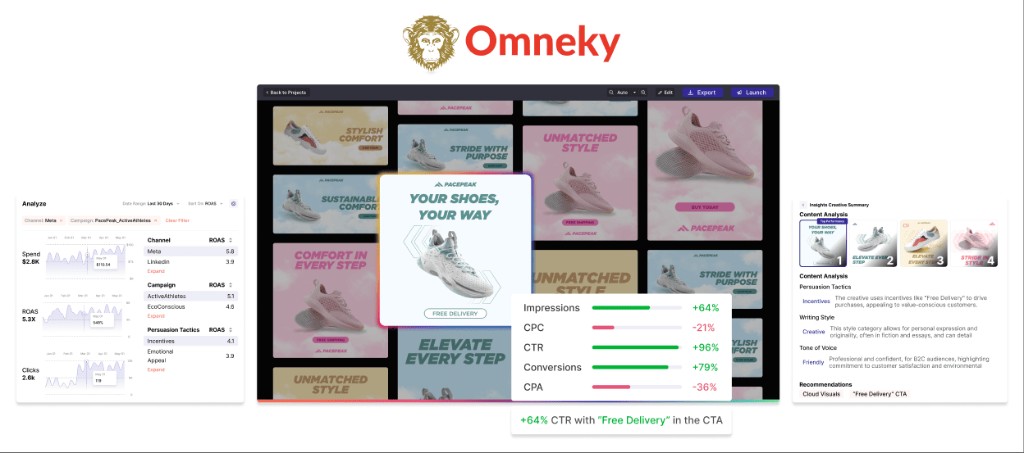
The platform is best understood as an assembly line for paid advertising - each station automated, the whole thing wired to a feedback loop.
Turns a single brief into a large volume of on-brand image ad variations - the raw material for testing at scale.
Converts a flat product photo into a cinematic AI-generated video ad. No studio, no crew, no week of edits.
Produces UGC-style spokesperson videos using AI avatars, so brands can make testimonial-style ads with no filming.
Pushes a campaign to Meta, Google, TikTok, LinkedIn, and Reddit in one workflow instead of five dashboards.
Uses computer vision and multimodal analysis to evaluate creative and predict performance, with real-time insights.
Autonomous agents set campaign goals, execute subtasks, and reallocate budget across platforms on their own.
Plenty of tools will now generate an ad. That part is, increasingly, a commodity. Omneky's more interesting bet is the closed loop - computer vision that reads a creative and predicts whether it will convert before a single human sees it, then feeds that judgment into the next batch. The critic shows up before the audience does.
The second bet is scope. In 2024-2025 Senju pivoted the company from "generative" toward "agentic" - the idea that an AI agent can run the whole relay, from setting a goal to executing subtasks to moving money between Meta, Google, and TikTok. Omneky describes this as folding omnichannel analytics, creative, and brand management into a single "AI mission control center," and claims roughly 10x time-and-cost savings.
Claims like "10x" deserve the usual skepticism - they are the company's own, not an audited figure. But the direction is clear enough, and it is the direction the whole industry is drifting.
Use generative and agentic AI to generate, analyze, and optimize personalized ad creative at scale - so a small brand can out-test a large one, even if it can't out-spend it.
Brands, D2C and e-commerce companies, fintechs, and marketing agencies. Named case studies span an underwear brand, a custom-portrait business, a chef-driven food-delivery service, and two fintechs.
~31 employees · partnerships cited with Nvidia, Meta & Amazon
| Round | Amount | Date | Notable Backers |
|---|---|---|---|
| Seed (initial) | $2.5M+ | 2020 | Village Global, SoftBank DeepCore, Hyphen Capital |
| Seed extension | $7M+ (~$10M total) | Nov 2022 | AIX Ventures, Cadron Capital, DG Daiwa, Ethos VC |
| Reg CF (StartEngine) | $124K-$1.24M target | Feb 2025 | Retail investors · ~$80M valuation |
Totals across trackers range from ~$10M to ~$13.7M depending on which extensions and instruments are counted.
Senju graduates in AI/ML; his tutoring app QuickHelp is acquired by Yup.com, where he becomes Head of Growth.
Betting on generative AI for advertising years before it was fashionable, backed by Naguib Sawiris and Village Global.
Raises $2.5M+ from Village Global, SoftBank DeepCore, and Hyphen Capital.
Adds $7M+ with AIX Ventures, Cadron Capital, DG Daiwa Ventures, and Ethos VC.
Shifts from generative tools toward autonomous advertising agents that set goals and reallocate budgets.
Opens a Reg CF crowdfunding round at a ~$80M valuation, citing 43% revenue growth and Nvidia/Meta/Amazon ties.
Compiled from public sources including Omneky's website, Crunchbase, PitchBook, PRNewswire, StartEngine, Forbes Councils, and press interviews. Figures such as valuation, revenue growth, and "10x" savings are company-provided and approximate. Where sources disagree on totals, ranges are shown.