A barcode is an unpromising place to look for a personal philosophy. It has no charm, no small talk and almost no tolerance for a bad photograph. Olivier Attia saw an opening there anyway. In 2000, he founded Scanbuy. The proposition was to connect physical products with information online, giving the shopper holding an object a practical way to ask more of it. Price, reviews, alternatives: the packet could become the beginning of a conversation.
That problem has followed Attia through a career that otherwise looks rather restless. He moved from consulting to mobile commerce, from phone photographs to the separation of recorded sound, and eventually to helping overseas businesses find American customers. The products changed. The troublesome distance between having something useful and persuading somebody to use it kept turning up.
Today, based in New York, he runs Gershon Consulting. Scanbuy belongs to an earlier chapter of his working life. To understand the connection between those chapters, it helps to return to a time when asking a telephone to read a grocery label sounded like a request from a particularly demanding science-fiction writer.
A shopping list with a patent application
Attia’s early work was in consulting. His career history runs through Marben Consulting Technologies from 1994 to 1997, then PricewaterhouseCoopers from 1997 to 2000. His education in Paris included Pierre and Marie Curie University and Paris Dauphine. Before the founder’s job came the disciplines of studying systems and working inside other people’s organizations.
A patent application filed in June 2001 shows how concrete his shopping ambitions already were. It describes uploading barcodes to a central repository, arranging products in personal folders and using the resulting lists to buy online. Billing and shipping details could be stored, reducing repeated data entry. The proposal even considered suggesting a substitute when the desired product was unavailable.
The specificity is appealing. A grand vision of electronic commerce is easy to applaud. A folder containing the things you actually need to buy has to survive contact with Tuesday afternoon. Attia was putting the ordinary mechanics of a shopping trip inside the system: remembering, comparing, organizing and ordering.
The consumer benefit was time saved. The commercial challenge was more complicated. A code, a device, a database and a retailer all had to cooperate before a person could enjoy that saving. Founding the company was one beginning. Getting the pieces to meet was another.
- 01PhotographA product’s barcode
- 02DecodeSoftware reads the image
- 03ConnectA server finds the record
- 04ReturnUseful product information
Simplified from the mobile-device patent co-invented by Attia and colleagues.
The camera phone goes shopping
By 2004, Attia was explaining how a shopper could photograph a book’s code and receive a competing offer. He also entertained a less welcoming response from retailers: a sign reading, “No smoking, no pets and no camera phones allowed inside.” A telephone capable of comparing prices was potentially an awkward guest in a shop.
There was a stubborn engineering issue underneath the sales pitch. Taking a picture of a barcode and reading one reliably are separate accomplishments. A patent granted in January 2007 names Attia alongside Prateek Shrivastava, Roman Zastepine and Avi Outmezguine. Its system processes the captured image, decodes the barcode and exchanges information with a server over a wireless network.
That sequence gave the camera a second job. It could supply a machine-readable reference, allowing software to find information without asking the customer to type a product description. The printed object supplied the starting point; the network supplied the answer. The appeal lay in making the first step small enough to happen in a store aisle.
In 2005, Attia was pursuing distribution through handset manufacturers and mobile carriers. He described an agreement with Spain’s Telefónica and expected phones carrying the software to reach Asia. His forecasts were ambitious; they were forecasts, rather than a count of phones already shipped. The practical lesson was distribution: useful software still needed a route into a customer’s hand.
Scanbuy appeared on Fortune’s 2005 list of 25 Breakout Companies. That recognition belongs to the business Attia was building during his tenure as CEO, which ran until 2006. It also offers a reminder of how unfamiliar the proposition once was. A gesture now easily understood had required explanation, partners and a persuasive business case.
The phone had other things to remember
Attia founded ClickOVA in 2006. Its territory was another emerging difficulty of mobile life: the contacts, photographs and videos accumulating on a phone needed somewhere to go. ClickOVA offered backup, management and sharing. A person could produce more digital material than they were prepared to organize.
Sidick Bakayoko worked alongside him on the application’s marketing. The product’s description in Bakayoko’s career history emphasizes wireless backup of contacts and media in 2007. That is a useful window into the work involved. Beyond the promise of sharing pictures sat the unglamorous business of moving files and preserving phone content.
Attia also maintained a collection of blogs, including one devoted to ClickOVA and another called Barcode 2.0. Their titles read like a small cabinet of the mobile internet’s unfinished business. BlackBerry synchronization, barcode applications and mobile media all had their own places. The concerns were practical, sometimes fussy, and closely attached to the devices people carried.
Seen together, Scanbuy and ClickOVA suggest an interest in the small operations between an intention and its completion. Find out about this product. Keep that photograph. Move these contacts. These are modest instructions with substantial technical consequences. The customer, quite reasonably, would prefer not to hear about those consequences.
A football match, minus one instrument
His next executive role took him into recorded sound. Attia led Audionamix from 2008 to 2012, working with a business focused on separating elements within audio. The company’s work reached an unusually audible public problem during the 2010 World Cup: the sustained sound of vuvuzelas on television broadcasts.
Audionamix developed a filter for Canal+ intended to reduce the horns while preserving commentary and stadium atmosphere. Attia described the team taking up the problem on a Monday morning and finding a solution that afternoon. The processing happened before broadcast, so viewers did not need to install or adjust anything. The football could remain complicated; watching it required no additional homework.
The attraction of that example is its clarity. An audience could judge the outcome by listening. A demonstration did not need to begin with a lecture on signal processing. Yet preserving the parts people wanted while suppressing another part was precisely the difficult work.
For Attia, the move from shopping software to audio technology put the commercial explanation in a different setting. The question became what a broadcaster or entertainment customer could do with the result. A technical team’s capabilities acquired meaning through a particular use. In this case, the plastic horns had provided a rather forceful product brief.
English was only the first language
In 2013, Attia founded Gershon Consulting to help international businesses develop in the United States. Vocabulary could get him through a conversation. Understanding how people bought, decided and worked together required a longer education.
“I spoke English, but I didn’t speak American culture.”
Olivier Attia
The advisory work became visible beyond individual client assignments. In 2016, he helped organize a Paris startup competition with the Chamber of Commerce and Industry Île-de-France. Ten finalists competed for an opportunity connected to entering the American market. Digitsole, founded by Karim Oumnia, won; the package included a trip to New York and practical business support.
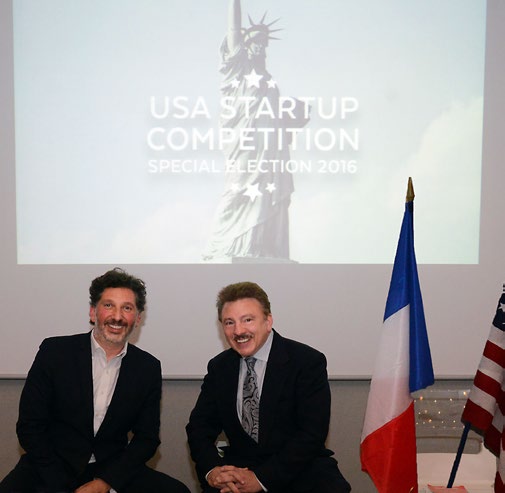
It was a tangible expression of the work he had chosen: bringing people with products into contact with people and institutions that could help them sell. A flight alone would not accomplish the crossing. Legal help, introductions, branding and operational assistance were part of the prize because entering a market involves several different kinds of arrival.
His teaching and advisory connections continued. Spark Labs lists him on its advisory board. A 2022 SOSA program brought him in to discuss software tools for generating sales opportunities. In 2019 he obtained mediation certification, followed by Negotiation Mastery at Harvard Business School in 2020. These additions fit a working life increasingly concerned with getting people to understand one another.
The recipe has to reach the table
There is a culinary side to Attia’s approach. A graduate of the French Culinary Institute, he compares consulting with cooking. His example is a tomato-and-mozzarella salad: familiar ingredients still leave considerable room for differences in preparation. It is a nicely grounded analogy for advisory work. Owning the ingredients does not settle the matter of dinner.
Gershon’s current method organizes work around three verbs: Promote, Network, Engage. Content creates visibility, outreach starts conversations and follow-up develops meetings. The firm also builds tools for tracking these activities, including Linalysis for LinkedIn analytics. Attia’s software background remains present inside a business devoted to sales.
Meanwhile, Scanbuy’s story has continued under other leaders. In February 2025, Kezzler acquired its smart-packaging and QR consumer-engagement business in a carve-out. The transaction brought that work together with traceability technology. The connection between a physical product and its digital information had acquired a broader commercial purpose.
In July 2026, Attia was writing about France-U.S. economic relations and their implications for international smaller businesses. The subject suits the path he has taken. He began by helping a phone make sense of a product in front of it. His present work asks what an American buyer will understand about a company arriving from somewhere else. Both jobs begin with something useful waiting to be understood.
Continue the conversation
Explore Attia’s work and hear more of his story.