A barcode is an unpromising place to begin a story about human judgment. It has no opinions, offers little conversation and dresses exclusively in stripes. Yet Avi Chai Outmezguine has spent much of his working life considering what happens when a small mark on a physical object opens a much larger world of information. His career began that inquiry with mobile scanning. His current company asks whether the information on the other side deserves to be believed.
Outmezguine, often known professionally as Chai, co-founded Scanbuy and became its CEO and chairman. Today he leads Becausal, the audience intelligence business that emerged from Scanbuy’s data division. Between those names lies a change of emphasis: from helping people reach information to demanding an account of how information was produced. A connection is useful. An explanation can be harder to arrange.
A bridge before the pocket computer
Scanbuy began in 2000 with the idea of linking physical products to the internet. The available equipment changed from dedicated scanners to personal digital assistants and, eventually, camera phones. In Outmezguine’s account, those phones entered the picture around 2002 and 2003. The now-familiar gesture of pointing a handset at a code still required a considerable amount of invention and persuasion.
His part in that work extended beyond the chief executive’s desk. He served as general counsel, managed intellectual property and developed international business. His education combined finance at IEA in Paris with legal studies at Essex and Georgetown. That combination put contracts, commercial relationships and ownership of inventions within the same professional field of view.
Partnership work meant dealing with mobile operators including Sprint, Telefónica and Vodafone, alongside handset manufacturers such as Nokia and Sony Ericsson. A scanning service needed a route into people’s hands. The relationships around the technology mattered alongside the software itself. For a company trying to make a new habit ordinary, distribution was part of the invention’s practical life.
A mobile camera captures a barcode. Software decodes it. A server returns related content.
Outmezguine is one of four inventors named on that 2007 patent for decoding and analyzing barcodes with a mobile device. Olivier Attia, Prateek Shrivastava and Roman Zastepine are named with him. The document describes a sequence that now feels almost domestic: capture an image, improve it, decode it, send the information and receive something relevant in return.
Patent language has a talent for making the future sound like office equipment. Here, that dry sequence is part of the appeal. It records the engineering underneath a gesture that eventually became unremarkable. Outmezguine’s early work sits in that gap between a plausible idea and a thing people can actually use.
Two destinations for one business
On February 11, 2025, Kezzler announced its acquisition of Scanbuy’s smart packaging and QR code consumer engagement business. The scope matters. Kezzler brought traceability technology; the acquired operation brought packaging and consumer engagement capabilities. The combination connected information about a product’s journey with the experience of someone scanning its package.
The businesses served international customers, and the announcement described operations across the United States, Europe and Asia. Product transparency was central to the deal’s rationale. Packaging could carry a route to information beyond what a printed label could accommodate, while the underlying systems helped companies manage that information across their operations.
The data operation took a different route. On April 28, Becausal announced its independent identity, with Outmezguine as CEO. Several colleagues continued with him: Chuck Ennis in the commercial role, Marc Le Maitre in technology and Daniel Daly in finance. The new business had a new name and an existing team behind it.
That continuity gives the transition its particular character. Becausal came out of work already underway inside Scanbuy. The transaction separated two kinds of activity that had grown within one organization. One would continue developing the connected package. The other would concentrate on explaining audiences and purchasing behavior.
The awkward little word: why
Outmezguine’s explanation for the name Becausal is unusually literal. He wanted an insight to come with a reason. In advertising, a system may identify people who resemble previous buyers, but resemblance leaves an important question hanging: what makes this audience a sensible choice for this particular campaign?
His company’s answer is to build audience intelligence around causal AI, transparent data lineage and tools that let customers inspect targeting decisions. Its launch described two offerings, ExtendedAudiences and AuditableAI. The first combines purchase-related data into audiences; the second is designed to expose the reasoning behind audience selection so marketers can review and adjust it.
These are the company’s stated capabilities and ambitions. The distinction between a product promise and a demonstrated result belongs inside any serious discussion of accountability. A system that claims to explain decisions should invite examination of its own explanations. Outmezguine has chosen a proposition that gives customers a reason to ask more questions.
“Every insight needs an explanation”Chai Outmezguine, on the Becausal name
The commercial difficulty, as he describes it, is that buyers have become comfortable with systems whose workings they cannot inspect. Convenience has a persuasive sales department. Asking a customer to care about data provenance means making the origin of a number as relevant as the number itself.
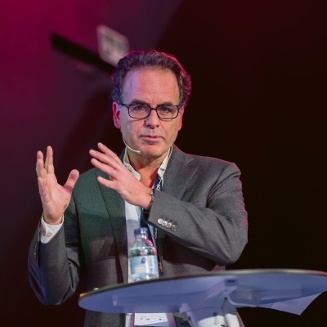
When the scoreboard sells the tickets
By February 2026, his writing was pressing a related question: who measures the people doing the selling? In an essay about self-measurement, he argued that platforms which deliver advertising and declare its success operate under incentives that deserve scrutiny. A neat dashboard cannot resolve a conflict of interest merely by displaying it attractively.
His case was for independent evaluation. Execution and assessment should have enough distance between them for judgment to mean something. This is a business argument about credibility, but its appeal is easy to recognize outside advertising. An examination becomes rather less informative when every candidate also holds the answer key.
That position adds a useful tension to his own role. He sells intelligence while asking buyers to be more demanding about intelligence vendors. The practical test of that argument is whether customers can inspect evidence, question methods and distinguish an observed result from a seller’s interpretation. The standard he advocates leaves room for an inconvenient answer.
A technology executive wary of the easy first draft
His concerns also reach beyond marketing. In an October 2025 essay, Outmezguine considered what happens when people let AI supply the beginning of their thinking. A first draft frames a question before the human reader has decided how to frame it. The convenience may arrive with assumptions already installed.
He worries about the resulting sameness of expression and judgment. In another essay that November, he examined the difference between giving everyone similarly polished answers and preserving individuality. Across these arguments, the recurring concern is human agency: who sets the terms, who makes the choice and who remains responsible for it?
By July 2026, he was applying that concern to constitutional self-government and the concentration of power around AI. These are his arguments about technology’s social consequences, rather than claims of settled consensus. They show an executive using his public writing to explore the authority granted to systems that mediate decisions.
His technical commentary returns to the same territory from another direction. He has argued for architectures that keep evidence and uncertainty close to the decision, instead of leaving explanation until afterward. Whether discussing an advertising audience or a generated answer, he keeps returning to the distance between a convincing output and an inspectable basis for believing it.
Permission to ask an inconvenient question
The management philosophy he described during his Scanbuy years gives this intellectual habit a human counterpart. He wanted employees to have the “freedom and discretion to challenge the status quo.” Failure, in that account, belonged within the process of trying something difficult. Teamwork needed space for individual judgment.
He also spoke of being an immigrant to the United States and of diversity as a guiding principle for the company. These statements connect his account of leadership to his own experience of belonging. The person asking an organization to challenge familiar habits also has to decide whether the people inside it feel free to speak.
In June 2026, his stated priorities for Becausal included expanding its Data Store, strengthening strategic partnerships and publishing measurable results with brands. Those are useful ambitions because they create things to evaluate. A larger catalog can be inspected. A partnership can be described. A published result can be questioned.
His September 2026 writing placed trust at the center of advertising’s next competitive argument. For Outmezguine, the work that began with a barcode has reached a more demanding destination. Opening the link was the first problem. Now comes the conversation on the other side: show the evidence, explain the choice, and leave the customer enough room to disagree.