Ari Paparo once had a bookmarking company, about $13 million, and a five-year head start. Then someone else made the idea work. In December 2005, as Yahoo bought the social bookmarking service del.icio.us, he published an unusually uncomfortable piece of founder writing: an explanation of what his own company, Blink, had got wrong.
The problem, he argued, lay in choices so small they could disappear inside a product meeting. Bookmarks lived in folders. Folders were private unless users deliberately shared them. A service intended to discover the web together had made togetherness an optional chore.
It is a useful place to begin with Paparo, the co-founder and founding CEO of Beeswax, later acquired by Comcast. Long before he wrote about Google’s power over advertising, he was examining the power of a default. Who made the decision? Who had to live with it? How much effort did it take to choose something else?
The folder problem
Paparo co-founded Blink in 1999. His retrospective offered no comforting explanation about arriving too early. He concentrated on design. People categorized things inconsistently; the company then asked them to fit their folders into another directory. Finding useful links became an exercise in navigating other people’s filing habits. The internet had acquired the inconveniences of a communal office cupboard.
He also described a recommendation system too demanding to deliver the effortless discovery he wanted. The expensive machinery and the useful experience had drifted apart. Anil Dash, writing about the post, praised the willingness to admit mistakes so that other entrepreneurs could learn from them. That public self-examination would remain part of Paparo’s working style.
“The bottom line is that we simply didnt get it right.”
Ari Paparo, looking back at Blink, 2005
A shared language for the machinery
A lifelong New Yorker, he earned an MBA at Columbia, graduating in 1999. His first startup belonged to the dot-com boom. His later account of Blink offers a useful corrective to the period’s mythology: money and a promising idea could coexist with a product that asked too much of its users.
Paparo’s professional home became the advertising systems behind the pages people actually visited. He worked at DoubleClick and moved into Google following its acquisition of the company in 2008. His responsibilities included products used by advertisers and agencies. It was a position from which to see both a product’s interface and the business arrangements beneath it.
One contribution was particularly practical. Video advertising needed a common way for players and ad servers to communicate. Without one, connecting another system could mean another development project. The Video Ad Serving Template, or VAST, gave participants a shared technical language. The IAB released the template for public comment in July 2008.
The VAST 2.0 specification, dated November 2009, names Paparo as its author. A specification has little of a startup launch’s theatrical appeal. Its achievement is compatibility: different companies can build against the same agreement. Paparo’s career contains plenty of public commentary, but some of his consequential work looks like documentation.
He went on to product leadership at Nielsen, AppNexus, and Bazaarvoice. AppNexus announced his arrival as senior vice president of product in March 2011, with responsibility for product strategy and expansion of its real-time advertising platform. These were different businesses with a shared demand: turn a complicated technical possibility into something a customer could use.
- 1999Blink
Co-founder - 2008Google
Via DoubleClick - 2014Beeswax
Co-founder & CEO - 2021FreeWheel
Beeswax acquired - 2025Yield
Author
A buyer with opinions
In 2014, Paparo founded Beeswax with Shamim Samadi and Ram Kumar Rengaswamy. The three had worked at Google. Their proposition addressed a frustration familiar to anyone who has bought software: your business may have a distinctive way of doing something, while the platform offers everybody the same controls.
For an advertising buyer, that distinction can be expensive. A buyer might have its own data, its own model of customer value, or its own rules for deciding what an impression is worth. A conventional platform can execute a campaign while leaving little room to express those differences. Building a complete bidding system, meanwhile, is a substantial engineering commitment.
Beeswax offered Bidder-as-a-Service. Customers could use managed bidding infrastructure and customize the logic above it. In plain English, the company would operate the machinery while the customer supplied more of the judgment. It gave technically capable buyers a way to make the software behave differently without starting with an empty server rack.
The distinction extended to money. Beeswax became known for selling software through a subscription model rather than simply collecting a percentage of media spending. That mattered in connected television, where expensive advertising impressions could make percentage fees especially noticeable. The details of the commercial model mattered as much as the ability to install an algorithm.
By its public unveiling in 2015, the company had attracted backing from an unusually knowledgeable group of advertising founders, including David Rosenblatt, Auren Hoffman, and Joe Zawadzki. In January 2019, it raised a $15 million Series B. Investors included RRE, Foundry, and Amasia. An independent advertising platform still had to explain why another one should exist.
Paparo was willing to acknowledge that awkwardness. Discussing the crowded market in 2019, he made himself the butt of the joke about starting another demand-side platform. The commercial point underneath was serious: differentiation needed to survive a buyer’s questions and an investor’s skepticism. An acronym was unlikely to carry the entire presentation.
FreeWheel announced its agreement to acquire Beeswax on December 17, 2020; the acquisition followed in 2021. FreeWheel brought television relationships and a place inside Comcast. Beeswax brought customizable buying technology. The fit connected tools for buying advertising with a business already serving the sellers. Asked about his future role, Paparo joked about commandeering Comcast’s Twitter account.
The operator picks up a microphone
After Beeswax, Paparo’s next substantial venture sold understanding. He co-founded Marketecture.tv in 2022, using interviews with people who built and ran advertising products to help buyers examine the offerings. A product executive could ask questions that a polished sales deck would prefer to leave until later.
There was continuity in the move. At a software company, Paparo had to explain why a customer needed a product. At Marketecture, he could ask whether the explanation held up. The audience already knew that advertising technology was complicated. It needed help distinguishing a useful capability from another impressive diagram.
The business grew into Marketecture Media, with newsletters, podcasts, video interviews, and events. Its current team lists Paparo as chairman and Jeremy Bloom as CEO. Bloom has described the later combination of his business, AdTechGod’s, and Paparo’s: the three co-founders did not meet in person until Advertising Week New York in 2024. Apparently a media company can begin before the introductions are finished.
An industry becomes a book
In 2024, Google’s advertising technology antitrust trial offered Paparo a different room to sit in. He covered the proceedings in person. Years of product work had given him familiarity with the language; the courtroom supplied documents, competing accounts, and the opportunity to examine decisions whose consequences extended well beyond the companies making them.
The result was Yield: How Google Bought, Built, and Bullied Its Way to Advertising Dominance, published in August 2025. It follows the development of Google’s position in digital advertising, including the DoubleClick acquisition through which Paparo himself had entered the company. The former employee had become a chronicler of the industry around his old employer.
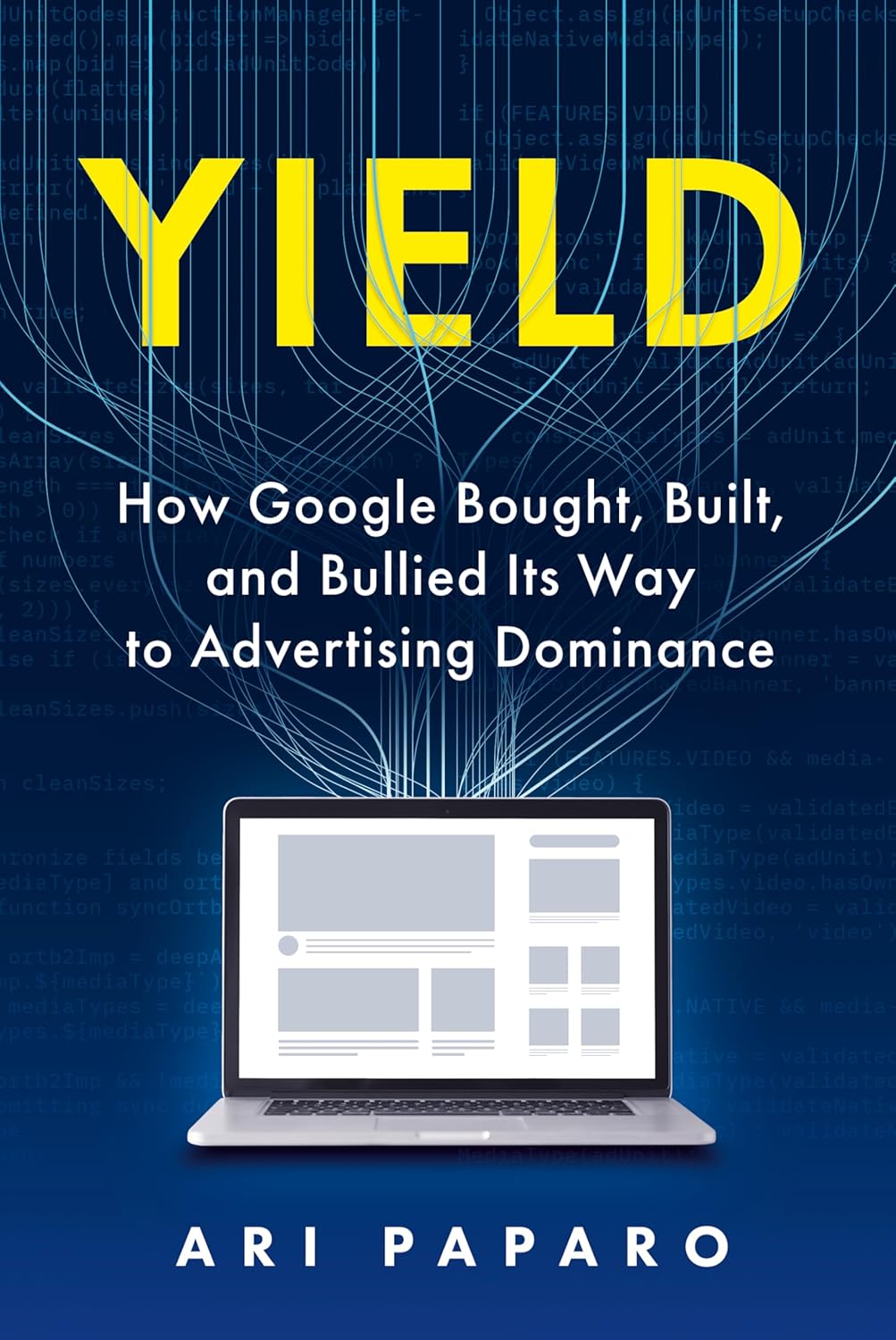
He has explained the title’s two meanings: the revenue a publisher tries to earn from an advertising opportunity, and the struggle over whose interests must give way. That double meaning gives a technical business a human plot. Behind the auction are people trying to preserve their room to maneuver.
The book’s subject also invites an easy simplification: the executive leaves the corporation and returns to denounce it. Paparo’s account of the business is more awkward. He has discussed questionable behavior by other participants, too. Knowing the systems means understanding that different parties can pursue their own advantage at the same time.
And knowing the participants does not make their memories agree. Paparo maintains a public corrections page for Yield, recording factual changes and contested recollections. It even includes a dispute over terminology in the glossary. Advertising technology can turn a definition into a contact sport.
The next set of questions
There are glimpses of another Paparo outside the auction vocabulary. In July 2025, he shared a podcast in which his friend and former CMO Paul Knegten discussed his artwork. Paparo wrote that he had not made new work for decades, but still displayed pieces in his apartment and office. The work remained part of his surroundings after it stopped being part of his schedule.
That summer, teenagers interviewed him at Cannes Lions about advertising technology and the book. He welcomed the conversation precisely because the interviewers did not inhabit the industry every day. It is a useful test for anyone who has spent years acquiring specialist language: can the explanation survive an audience that has no obligation to be impressed?
By October 2026, his newsletter was examining AI shopping agents, following September pieces about the practical consequences of Google’s antitrust remedies. The subjects keep changing, but the questions remain recognizable. A new intermediary arrives. It promises convenience. Somebody must decide what the customer sees and which choices are available.
Back at Blink, that decision had been tucked inside a folder setting. At Beeswax, customers paid for more freedom to make it themselves. With Marketecture and Yield, Paparo has made the decision visible enough to argue about. After a career in software, he is still asking readers to look closely at the controls.
Keep the conversation going
Writing, interviews, and the work behind the story.