The useful part of Oana Manolache’s founding story begins with an unreasonable itinerary. While working around the startup world, she kept receiving invitations to events in Silicon Valley and New York. Getting there could mean seven hours in transit for two hours in a room. Watching from afar was easier, but the livestream often reduced a gathering to a video window. There was little room to meet anyone, ask a useful question, or feel present.
Manolache started comparing notes with other founders. The frustration was shared. Then she asked event organizers whether they would try a platform built for remote participation. One prospective customer was already searching for something similar. The product did not have a name yet, but it had the beginnings of demand.
That exchange became Introvoke, the company now called Sequel.io. Its first version was designed as a digital venue for entrepreneurship, where people could watch startup events, chat across borders, vote in pitch competitions, and keep a recording of a presentation to send to investors. By early 2020, Manolache said the service had about 5,000 users, customers creating streams on four continents, and no marketing spend. Organizers brought their audiences; those audiences discovered other organizers. Distribution was built into participation.
A marketer learns to operate
Manolache was born and raised in Romania. Business was ordinary dinner-table material in her home. Her father ran an automotive company; her mother ran a compliance business focused on workplace safety and the environment. As a child, Manolache saw both parents working late before she understood the economic logic behind it. Entrepreneurship arrived first as atmosphere, not a job title.
At about 18, she moved to the United Kingdom to study business and marketing at Coventry University. Her degree was awarded with first-class honours. HP became a seven-year apprenticeship that moved her from London to the United States. She has said that she joined the company’s UK management board at 23 as its youngest manager and its only woman, then moved across the Atlantic to lead marketing initiatives for North America.
The international moves matter because the company’s first question was geographic: who gets access when expertise is concentrated in a few cities? Manolache had worked in Romania, Britain, Germany, and the United States, with long stretches around HP’s European center in Barcelona. She knew both the value of being in the room and the cost of getting there.
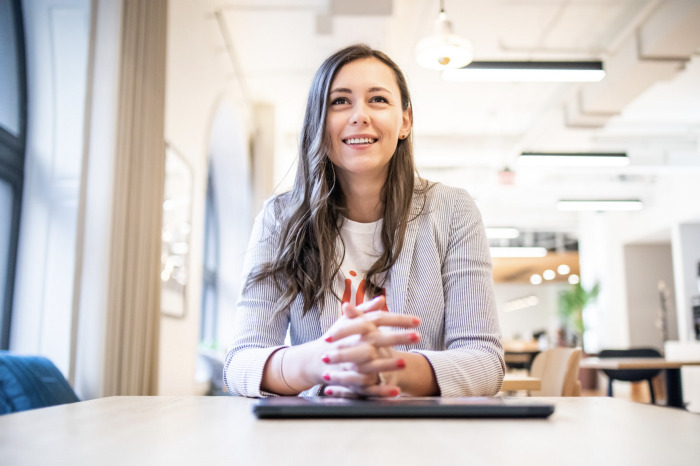
She also knew how large organizations make decisions. At HP she often stepped beyond her formal remit, serving as a spokesperson, working on partnerships, and attending events around the world. The experience left her with a corporate operator’s attention to stakeholders and a founder’s impatience with an awkward default.
Just because a business idea is good, that doesn’t mean you should be the one to do it.Oana Manolache
That sentence came from a detour. After HP, Manolache explored a subscription food business. She liked the model more than the industry. Technology offered a different kind of pull: hypotheses could be tested quickly, strange ideas could survive long enough to teach something, and useful software could scale across borders. The abandoned food company clarified the founder’s fit with the problem. A plausible market was not enough. She wanted to keep thinking about technology on difficult mornings.
From access to ownership
Introvoke launched in May 2019 at a hybrid WeWork event in Boston. Two hundred people attended in person; another 500 joined virtually. Soon the pandemic made remote events unavoidable, while a crowded market made their shortcomings visible. Sequel’s answer was to stop treating the webinar vendor as the destination. The experience should live on the brand’s website, where the surrounding content, identity, and customer journey already existed.
This was a marketer’s argument expressed as product architecture. A company spends years building traffic and trust, then sends interested people to a generic third-party room at a revealing moment. Bring the video home, Sequel argued, and the event can feel like part of the brand while producing first-party behavioral signals. Attendance is useful. What someone watched, clicked, asked, and did next is more useful.
We believed deeply that marketers should own their video strategy.Oana Manolache
The conviction did not remove doubt. Manolache has recalled investors telling her that Sequel had “no chance” while larger event platforms were raising enormous rounds. She and co-founder and CTO Andrei Ermilov continued to work from customer evidence. Ermilov brought experience building high-scale streaming systems at Microsoft. Manolache brought the marketing problem, the customer conversations, and a belief that the company website would remain a durable point of control.
Capital eventually followed. In September 2022, Sequel announced an $8 million Series A led by Javelin Venture Partners, with participation from Struck Capital, Social Leverage, Alumni Ventures, Growth Warrior Capital, Great Oaks, and V1VC. By then the company had powered more than 20,000 embedded live events. The financing gave the team room to expand the product and its route to market, but the core claim remained narrow: own the venue and learn from the audience there.
Host
Put the live experience on the company website.
Observe
Connect participation with on-site behavior.
Reuse
Turn the recording into clips, posts, and follow-up.
One hour becomes a system
Sequel’s next turn treated the webinar as raw material. In 2023, it introduced AI tools that could turn a finished session into search-oriented articles and social posts. Later versions added clips, dubbing, and smarter content tools. The point was less about adding a fashionable label than extending the useful life of work a marketing team had already done.
Manolache’s public language has grown more direct as AI has moved into daily operations. Her view is that routine execution can be delegated to tools while people keep judgment, instruction, and review. In her telling, an individual contributor increasingly manages a portfolio of automated work: break down the problem, decide what the machine can handle, specify the task, inspect the output, and spend human time on meaning.
That philosophy also shows up in how she talks about teams. In late 2025, she wrote candidly that she had been afraid to hire a vice president of marketing. As a marketer herself, she worried about friction and assumed the role would demand a larger team and budget than Sequel needed. Kathleen Booth changed her mind by beginning with segmentation, staying hands-on, and connecting strategy to the company’s current stage. The post offered a small portrait of Manolache’s management style: willing to name the fear, precise about the operating requirement, and quick to update when evidence changes.
By August 2026, Sequel was broadening its AI bridge again. Its MCP server, which initially gave customers access to webinar transcripts inside AI tools, expanded to audience intelligence, event participation, lead activity, account engagement, and company-level analytics. A marketer could ask which accounts were highly engaged, which attendees showed intent, or who still needed follow-up. The dashboard became less of a destination; the data became available where the work was happening.
The same month, Manolache brought the Sequel team together in Barcelona for second-half planning. Her public checklist mixed vision, campaign planning, product execution, training, and time together away from Slack. The notable detail was constraint: fewer session topics so the group could do real work during the offsite instead of leaving with a crowded document and no shipped result. An internal AI challenge sat beside product education and team meals. For a company selling a tighter connection between content and action, the agenda carried its own small consistency. Ideas were expected to move into use before everyone flew home.
Build where the relationship lives
The company has changed names, customers, and capabilities. Its founder’s first concern has stayed recognizable. In 2020, she spoke about people in Hawaii, Germany, South America, and Barcelona meeting in the same event chat. In 2026, she spoke about engagement signals moving into the tools marketers use each day. Both are attempts to close a distance: first between people and a room, then between an experience and the decision that follows it.
Manolache has said her mission is to give data-driven marketers a seat at the executive table. That aspiration sounds less abstract beside the product choices. Put the audience on owned ground. Preserve the context around what they do. Make the event reusable. Give the person responsible for growth evidence they can act on.
There is a practical founder lesson in the route from a missed event to a software platform. Start with a frustration you can describe without jargon. Find the person who shares it. Ask for a test before polishing the story. Then keep the durable principle while letting the product change around it. For Oana Manolache, the principle is ownership. The audience relationship is too valuable to rent by default.