A nephew needed to choose a university. Elsewhere in the same founding story, a niece was trying to make a similar decision. There were courses to compare, costs to consider and futures to imagine. In 2008, those family difficulties helped Edwin Tay and his co-founder see the opening for EasyUni. Nurbek Jusupov’s entrepreneurial story began with a problem that had the awkward habit of looking straightforward until someone actually had to solve it.
The name promises ease. The decision behind it is considerably less obliging. A course has to fit the student, the budget and the years that follow graduation. A family can accumulate an impressive collection of prospectuses and remain unsure what to do next. Information helps when it becomes comparable; otherwise, it can simply furnish the room.
EasyUni’s answer was to bring university research and applications together online. For Jusupov, the work would extend from the technology behind that search to a second question: how could a prospective student meet an institution without first making the journey? The connection between those questions gives his career its particular shape. First, make the options easier to examine. Then, make the people behind them easier to reach.
A nephew, a niece, a difficult choice
The founders initially worked on the idea part time and outsourced the first version. Government grants helped them hire employees, and the portal launched in December 2010. That sequence gives the origin story a useful sense of proportion. Seeing a need was the beginning. Turning it into a service required development, money and a way to discover whether the proposed answer helped.
Tay later described a year of searching and three changes of direction before the team settled on a business model. The founders had to learn from students and parents as well as from the institutions they hoped to serve. A product for university choice comes with a demanding audience: people who may be making this decision for the first time, alongside organisations that recruit new students every year.
There is a difference between knowing that a decision is difficult and understanding which part makes it difficult. Someone may need a scholarship. Someone else may know the subject but have no idea where to study it. A portal has to give those people a useful starting point without pretending that their destinations are identical. “Easy” becomes a design problem, with quite a lot of work hidden behind the welcome screen.
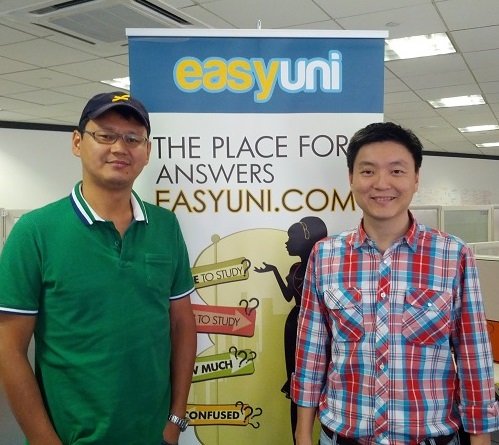
The person behind the portal
Jusupov had already made an international education journey of his own. A student exchange programme between Kyrgyzstan and Malaysia brought him to Malaysia in the 1990s. He stayed to live and work there. His public professional profile places him in Kuala Lumpur and records studies at Staffordshire University from 2008 to 2010.
By May 2013, he was identified as EasyUni’s chief technology officer and one of its stakeholders. That title puts him close to the machinery of the proposition. A university portal has to keep information usable, help visitors find their way and turn an enquiry into something an institution can act on. The student sees a page. The company has to make the process behind that page hold together.
The partnership also involved plenty of conversation. Tay recalled working with Jusupov and angel investor Dr V. Sivapalan on marketing, sales and the business model. They sought feedback from teachers, families and institutions. The technical founder’s role belonged inside that wider effort to understand what people needed, rather than in a sealed room at the end of it.
One small professional detail brings the work into focus. In a recommendation for developer Azamat Toktakunov, Jusupov described a project to turn supplied website designs into HTML and CSS for an EasyUni revamp. He praised the resulting code and the ease of communicating with the developer. It is an ordinary piece of professional gratitude, and a reminder that a usable website is also the product of people managing to work well together.
The bill goes to the university
EasyUni’s early revenue model combined university listing charges with placement commissions. The company brought together institutions seeking applicants and families seeking an appropriate course. Its present website says university funding allows students to receive guidance and application support free, while paying required fees to their chosen university.
That arrangement gives the service a recurring responsibility. A university wants enquiries; a student wants a decision that fits. A good introduction can serve both purposes. The quality of the information matters because the parties arrive with different needs, and the applicant carries the consequences of the choice beyond the moment of enrolment.
In 2013, EasyUni raised an undisclosed round from Teak Capital. The amount and valuation were kept private. A year later, Tay reported that the company had become cash-flow positive in March 2014. He was nevertheless seeking more capital to expand. The milestone marks a point in the company’s history; it also illustrates the distance between running an operation that pays its way and financing the next stage.
EasyUni became cash-flow positive, according to Tay’s account that July.
For a technology co-founder, growth brings work that a headline percentage cannot show. More visitors need clear routes through the product. More institutional relationships need information that remains useful. Each expansion enlarges the audience and the obligations attached to serving it. The most convincing version of a university portal earns its place by helping the next visitor with a specific question.
Paper, radio and the work of explaining
The company’s answer did not stay entirely inside a browser. EasyUni published an 80-page university guidebook in 2013, covering subjects such as studying abroad, applications, scholarships and loans. An online service had found a reason to use a very portable piece of older technology: paper.
The choice has a certain charm. A guidebook can sit between family members at a table. It can be marked, passed around and revisited without a login. A university decision often involves more than one reader, and those readers may want to discuss the same information together. The format changes the setting in which the explanation can be useful.
Jusupov also appeared in public conversations about the business. EasyUni’s press archive records him joining Tay for a BFM discussion of affiliate marketing with Irfan Khairi in April 2012. A May 2018 episode of the Startups to Scaleups podcast introduced Tay as CEO and Jusupov as CTO, discussing the challenges of running a global university-and-course website.
These are practical subjects. How does someone discover the service? How does the site organise a large collection of options? Once the novelty of putting information online has faded, those questions remain. Explaining the product is part of finding out whether it makes sense. A service can be technically available everywhere and still need a careful introduction in each place.
An open day opens another door
The next product began close to the existing customers. Jusupov described a university client asking EasyUni to host an online open day. Serving that request helped reveal the possibility of a dedicated event service. Fairwiz gave the team another way to work with institutions it already understood.
His own public timeline is specific: development began in November 2019, and selling began in March 2020. The dates distinguish the work of making a product from the work of finding customers. Both matter. A useful idea needs a functioning answer, and a functioning answer needs people willing to adopt it.
- Nov 2019Fairwiz development begins
- Mar 2020Fairwiz begins selling
- Apr 2021Jusupov discusses the two businesses
In April 2021, he was considering how to pursue Fairwiz while continuing EasyUni. The older business carried relationships and meaning for him. New demand offered possibilities beyond the original education focus. He wanted to keep developing the event service without immediately making a complete break from the university-search operation.
“EasyUni is very meaningful to me”
Nurbek Jusupov, April 2021
A founder making that decision has more to weigh than the appeal of a fresh product. Years of serving customers create knowledge that does not appear on a launch announcement. The question becomes where that knowledge can do useful work next, and how much of the existing business deserves continued attention. Jusupov’s answer at that moment left room for both.
A visit with fewer miles attached
By August 2021, Jusupov was describing Fairwiz as an environment in which attendees could explore different areas of an event and make individual contact through video tools. The emphasis was on giving visitors somewhere to go and people to ask. An applicant exploring a university has a different task from an audience simply watching a presentation.
He acknowledged that virtual events offered a different sense of presence from physical ones, and discussed the possibility of using virtual reality to narrow that gap. This was an ambition expressed in 2021. It reflected a familiar tension in digital services: removing the journey makes access easier, while recreating the useful parts of being there requires further thought.
Consider what a prospective student wants from an open day. A general introduction may help, but a personal question can carry more weight: how a course is organised, what a room is like, who can explain a requirement. The event succeeds when it gives that question an audience. A large screen and a polished presentation cannot do the entire job.
Jusupov’s two products sit at different stages of the same decision. Searching helps a person identify an option. Meeting helps that person examine it more closely. The family difficulty that started EasyUni was a reminder that choosing a university involves both. Years later, the work still comes back to making a consequential next step a little easier to take.