Consider the blood pressure cuff. It has one obvious job: produce a number. But in a remote monitoring program, that number starts a much less obvious sequence. Someone must receive it, decide whether it matters, contact the patient, record the conversation and, when necessary, reach the physician. A single measurement takes a moment. The organization around it has to keep working.
Nsight Health sells that organization. The Miami company combines connected medical devices with patient outreach, software, clinical monitoring and billing support. Its proposition to a busy practice is straightforward: extend care into the home without building another department to run it.
- The buyer: practices, specialty clinics, health systems and other healthcare organizations.
- The bundle: devices, enrollment, clinical follow-up and documentation.
- The deal: no upfront provider cost, with fees linked to successful reimbursement.
A small green light, a long chain of work
A useful place to understand the service is the Tenovi cellular gateway in its device lineup. Monitoring devices arrive paired with the gateway. The patient plugs it in; readings travel over a cellular connection. An LED ring turns green when a measurement reaches the cloud. The little light supplies something software companies sometimes overlook: confirmation that a person has done the thing correctly.
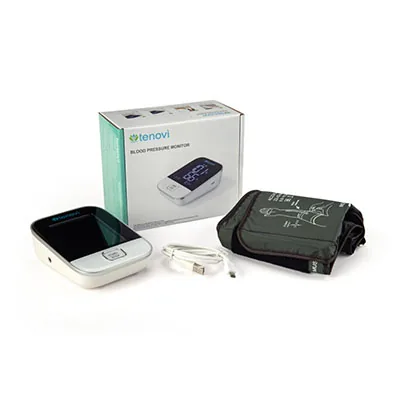
For patients, cellular transmission removes the need to configure home Wi-Fi or pair a phone. It does not remove geography. Nsight’s gateway troubleshooting instructions acknowledge weak cellular signals and suggest moving the hub toward a window. Even an apparently simple product has an address, a power outlet and a signal to contend with.
Behind the device sits a broader service. Nsight’s chronic care management program includes monthly nurse calls, education, help arranging appointments and support with medication adherence. Its platform records interactions and produces billing reports. Behavioral health integration adds assessments and follow-up around mental health needs. Principal care management addresses a single complex condition. The practical unit being sold is a continuing relationship with a care operation.
- 01Enroll
the patient - 02Connect
the device - 03Review
the readings - 04Escalate
when needed
This is also why remote patient monitoring and chronic care management belong together in the story. A device can report a measurement; a conversation can uncover whether a patient understands the care plan or needs help keeping an appointment. Nsight offers both kinds of contact, with the treating provider remaining part of the escalation process.
The billing man builds a care operation
Founder Michael Ciullo came to this problem through the business side of medicine. His earlier company, Nsure Healthcare Services, worked in revenue cycle management. His biography describes reinvesting earnings from previous ventures to build Nsight. Florida records show Nsight Health’s incorporation in August 2021; Inc. also lists 2021 as its founding year.

That background helps explain the packaging. A practice may like remote care and still hesitate over devices, staffing and cash flow. Nsight advertises no upfront provider costs and says its fees follow successful reimbursement. It takes on enrollment and device logistics along with monitoring. The economic pitch and the operating pitch arrive together.
“No upfront cost” needs careful reading. It describes when a provider pays. Patients may still have cost sharing: the patient-facing terms say copayments not covered by secondary insurance can be their responsibility. The fit depends on coverage and the actual service agreement. For a practice evaluating the offer, the relevant calculation is what remains after service costs and collections, alongside whether the care is useful.
The people who already know the practice
Nsight’s 2025 partnerships reveal another choice about how to grow. In March it announced an alliance with revenue cycle company QMACS. April brought UnisLink; May brought medical billing company Zoo Health. These businesses already serve physician practices. Adding remote care gives those existing relationships another service to carry.
The same logic appears in software integration. Elation Health lists Nsight as an RPM and chronic care management partner. PRVNT, Nsight’s platform, has an athenahealth marketplace listing. Connections to existing systems matter because a new source of patient information can also become a new place for staff to look. Integration belongs in the buying conversation as much as the monitoring device does.
“Nsight helped us expand chronic care delivery without over-extending our practice or our staff.”
Dr. Geoff Koff, pulmonologist
Testimonial displayed by Nsight Health
There are alternatives. HealthSnap offers remote monitoring and chronic care management; Cadence combines connected devices with clinical teams. A practice can also assemble its own program. Nsight competes through the completeness of its managed package, including directly employed U.S. clinical staff, round-the-clock coverage and white-label delivery. Buyers should compare the responsibilities each contract actually assigns.
The company’s own workplace habits provide a smaller, telling detail. Inc.’s 2026 Best Workplaces coverage singled out weekly one-on-ones and leadership meetings. Communication is an ordinary management practice. In a business built around moving information between patients, remote staff and provider offices, it is also an apt cultural emphasis.
Growth is a number. So is uncertainty.
Inc. ranked Nsight No. 78 on its 2026 Inc. 5000, reporting 3,476% three-year revenue growth. The company’s current leadership page says its programs support more than 150,000 patients across over 2,000 providers and 560 clinics. Those figures describe different things: one is a ranked growth measure; the others are the company’s account of its footprint.
Three-year revenue growth
No. 78 nationally
The economic evidence deserves its own reading. Nsight describes an Optum retrospective matched-cohort analysis that found directionally favorable medical spending growth across three chronic disease groups. The results did not reach conventional statistical significance and excluded program costs. They support further investigation. They do not establish net savings. Likewise, improvements in internally observed readings should not be confused with proof from a randomized trial.
Buy the handoffs
The useful lesson extends beyond healthcare: list the handoffs before buying the tool. Who gets consent? Who troubleshoots the device? Who calls about a concerning reading? Who closes the loop with the physician? Nsight makes those questions part of its offer.
A practice with dependable internal staffing may want a different arrangement. A patient who rarely takes readings, or a home without usable connectivity, creates a different challenge. The model needs participation, a functioning escalation relationship and workable reimbursement. Its appeal is concrete: somebody has agreed to do the continuing work after the cuff produces its number.
For a prospective customer, the next useful step is a workflow demonstration using the practice’s own circumstances: its records system, patient population, escalation contacts and payer mix. That makes the sales conversation testable. The question becomes whether this particular operation can carry these particular handoffs, month after month.