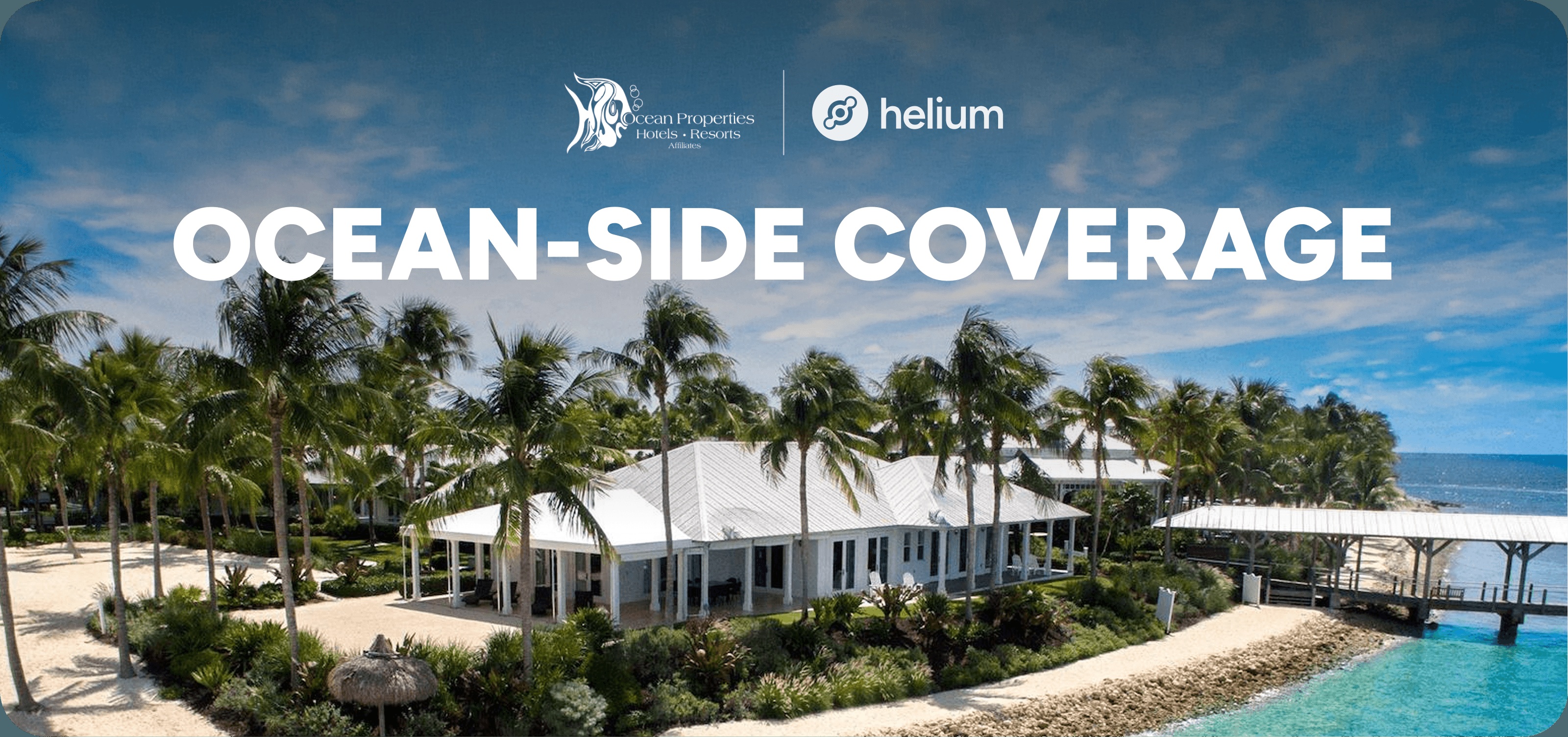
At a hotel, the expensive part of connectivity can already be on the wall. Ocean Properties had enterprise Wi-Fi. Guests had phones. Mobile carriers had the familiar problem of signals struggling indoors. Nova Labs, the company behind Helium, saw an arrangement waiting to happen: let the carrier buy capacity from the hotel’s existing network.
- Businesses can turn compatible Wi-Fi into paid mobile coverage.
- Noble Mobile acquired Helium’s consumer carrier business in June 2026.
- The real test is traffic carriers buy, and what deployers earn carrying it.
Helium’s September 2026 hotel case study reports 72 Ocean Properties venues enrolled through Helium Plus. At the participating properties, phones authenticate automatically, without an app or a sign-in page. No new hardware was installed. The cleverness lies in the second use of something the owner had already bought.
The $495 invitation
To understand that proposition, go back to 2013. Amir Haleem, Shawn Fanning and Sean Carey founded Helium, the company later renamed Nova Labs. Fanning had co-founded Napster, which is a pleasing detail: another venture in which people at the edges supplied something a central organization could not easily assemble alone.
The first problem involved small things. Sensors need to report a location, temperature or reading without behaving like miniature smartphones. Helium’s IoT network uses LoRaWAN, a wireless approach suited to low-power devices sending modest amounts of data over distance. Its customers include developers and organizations connecting sensors, rather than people streaming films.
But a sensor network needs coverage before anyone can sensibly depend on it. Who pays for the equipment while demand is still arriving? In 2019, Helium offered ordinary buyers a $495 hotspot. Connect the box to broadband, contribute wireless coverage, and receive crypto rewards. A household could become part of the infrastructure business without becoming a telephone company.
In a 2020 account of its launch, the team described six years of pilots and customer engagements before arriving at that design. The incentive answered a practical coordination problem: persuade people to build coverage before the users were all there. It also introduced another problem. Equipment deployed and services purchased are different measures.
Coverage needs a customer
Capital arrived enthusiastically. In March 2022, the company announced its Nova Labs name and a $200 million Series D led by Tiger Global and Andreessen Horowitz. Investor NGP Capital put the valuation at $1.2 billion. Those are historical financing figures; they do not tell us what today’s network earns.
Mobile phones offered a different sort of demand from sensors. Carrier offload moves traffic from a cellular network onto Wi-Fi. The carrier gains indoor capacity; the venue gains a reason to share its network; the subscriber should simply remain connected. AT&T’s April 2025 collaboration used Passpoint authentication to make that handoff possible.
In Mexico, a Movistar partnership announced eligibility for 2.3 million subscribers where Helium coverage was available. Eligibility is not the same as daily usage. Still, the partnership supplied something more useful than an enthusiastic hotspot buyer: a route to existing phone customers.
“Helium is on a mission to make connectivity more affordable for the masses.”Mario Di Dio, Movistar announcement, February 2025
Nova Labs also created Helium Mobile, a consumer carrier service launched in 2023. In June 2026, Noble Mobile acquired that business, with terms undisclosed. Nova Labs remained focused on the underlying network. Mario Di Dio became Helium’s CEO and Haleem moved to chairman. The company’s next buyer would increasingly be another connectivity business.
A router is not a business model
Helium Plus, launched in July 2025, lets businesses join through compatible existing Wi-Fi. Its Passpoint requirement matters: spare bandwidth alone does not make every home router suitable. The business needs equipment, access and configuration that can support the service. Managed service providers can help venues make that transition.
The costs have changed with the product. Under an August 2026 program, Helium Plus waived onboarding and connect fees until further notice. The venue still supplies the Wi-Fi and broadband it operates. “No new hardware” is a useful promise for qualifying networks; it does not erase maintenance, capacity constraints or the need for customers.
The reward system is changing too. In September, HIP-150 raised the deployer target minimum from 50% to 80% of payer spending on rewardable data. At the stated $0.10-per-gigabyte base rate, that translated to a $0.08 target minimum. Approved premium sites can receive multipliers up to five. These are conditional mechanics, not a return guaranteed to every box.
Target minimum at the stated $0.10 base pay rate. Rewardable traffic and network rules apply.
HeliumOS, introduced in September 2026, broadens the proposition into subscriber management, analytics and offload software for carriers, virtual operators and venues. Here Nova Labs competes for budgets that might otherwise fund conventional connectivity software, enterprise offload or indoor antenna systems. Its expertise spans wireless integration, software operations and incentive design.
The room where adoption happens
What failed first was the assumption that building coverage would settle the commercial question. In June 2026, the company acknowledged that carrier adoption had moved slower than its economic model anticipated. Subsidized rewards needed adjustment. Getting people to supply infrastructure had proved easier than making every unit of that infrastructure commercially useful.
Then came a sharper reminder. On August 28, Di Dio announced that an integrator-led US carrier pilot would disconnect, reducing daily active users. He described persistent industry mistrust of Wi-Fi. His explanation is the company’s account; the observable lesson is that a carrier relationship can end and a growth chart can retreat.
Credibility also has a legal history. In April 2025, Nova Labs accepted a $200,000 SEC penalty over alleged misrepresentations concerning network users, without admitting or denying the allegations. Other claims were dismissed. The SEC explicitly said that dismissal did not assess their merits.
The idea readers can borrow is concrete: find useful capacity already paid for, connect it to a buyer, and reward the work that buyer actually purchases. It depends on compatible equipment, reliable broadband and sustained carrier demand. A quiet location, weak backhaul or withdrawn integration can spoil the arithmetic. The router may have a second job. Someone still has to hire it.