At Mingus Pointe, an apartment complex in Arizona, the solar problem began with a meter. Then another meter. Then thirty-four more. Each apartment was individually metered, and the project required a separate interconnection for each one. What looked like a single installation became 36 solar systems. The sun, admirably indifferent to paperwork, would illuminate them all. The installer had to make each one work.
- NEP makes the conversion, shutdown and monitoring equipment beneath solar panels.
- Its pitch to installers centres on fewer components and easier diagnostics.
- Apartment rooftops and ageing solar arrays show where those details earn their keep.
Solar Gain installed 108 Wi-Fi-enabled microinverters from Northern Electric & Power, or NEP. Each could be monitored without a separate gateway. That choice addressed a small-system problem repeated three dozen times. It is a useful introduction to a company whose products rarely get the glamour shot: the interesting part is often the box you can remove from the design.
One apartment site. Many independent connections.
Mingus Pointe · Solar Gain installation
The invoice beneath the panel
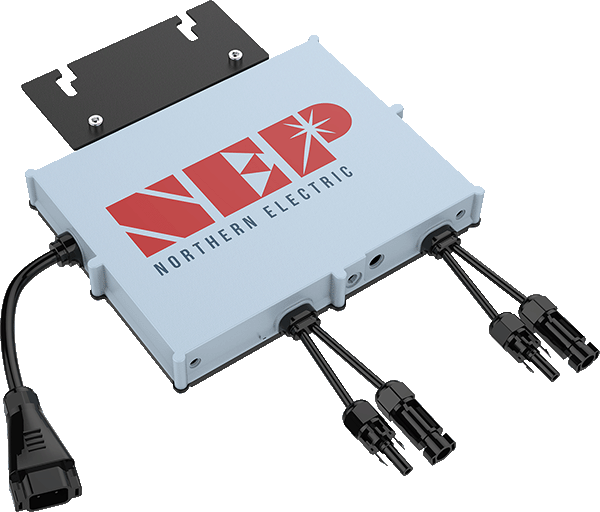
A solar module produces direct current. Buildings and grids use alternating current. An inverter performs the conversion. Put that conversion close to the modules and you have a microinverter architecture. NEP supplies these devices in several configurations, including units serving two or four panels, alongside the communications equipment that tells an owner what the system is doing.
For an installer, the distinction is practical. Every enclosure needs a place. Every connection needs attention. Every monitoring accessory introduces another task. A component’s purchase price is therefore only one line in the calculation. Labour, commissioning, troubleshooting and lost production belong beside it. NEP’s commercial argument is that integration can reduce some of those burdens.
That argument deserves a pencil, rather than applause. Built-in Wi-Fi still needs a workable network. A multi-panel device still needs the right electrical match. The comparison should use a complete installation quote and a service plan. Buying fewer boxes can be sensible; buying the wrong box remains an expensive form of minimalism.
A market taught him where to look
Co-founder and chairman Jing Wang came to the business with a background in electrical research and management, including work at GE’s global research centre and Schneider’s renewable-energy business in China. In a 2023 interview, he described NEP’s early microinverter decision in terms of demand: overseas residential markets, particularly the United States, needed a different architecture from the large central machines common in China.
The company dates its founding to 2010 and its first microinverter launch to 2011. Its published history records a Japanese subsidiary in 2013 and Japanese certification in 2015. Wang’s account makes that market sound deliberately slow: demanding qualification, demanding customers, and a preference for quality that could justify its price. Patience, in this telling, was part of market entry.
Another signal arrived through safety requirements. Wang said changes in US safety expectations prompted a stronger focus on module-level power electronics in 2017. NEP’s history records rapid shutdown certification that year and a concentrated MLPE focus in 2018. The opportunity was expanding from converting electricity to controlling what happened on the roof.
A switch with something to say
NEP’s PVG-Guard rapid shutdown range occupies that second territory. These devices work with compatible system equipment to shut down module-level output. NEP also builds two-way communications into its proposition, giving installers and owners information rather than leaving them with a switch whose only visible achievement is silence.
The diagnostic detail is telling. NEP documents a setting for I-V curve tracing, a test of current and voltage that helps evaluate solar performance. Its demonstration uses Seaward test equipment with an installed inverter system. Finding a defective component while the installation crew is still on site is a rather better schedule than discovering it after everyone has packed the van.
NEP also sells NEPTUNE three-phase string-inverter solutions combining conversion, rapid shutdown and data functions. That matters competitively. Enphase, APsystems and Hoymiles offer microinverter alternatives; SolarEdge and string-inverter-plus-shutdown designs offer other system architectures. NEP’s catalogue gives a project designer more than one route. The appropriate answer depends on the building, rather than brand loyalty.
When the old equipment goes first
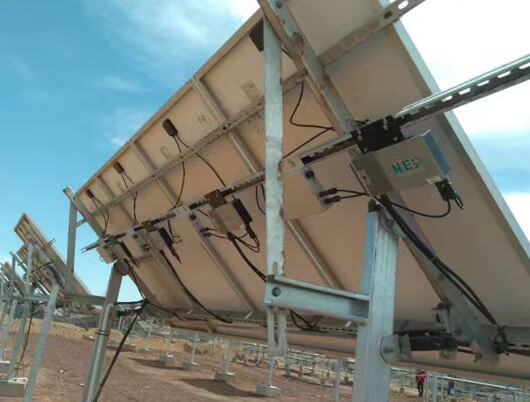
There is a less cheerful route into this market: an existing array whose original electronics have failed. In March 2024, NEP described owners of TenK systems struggling with failures of microinverters supplied by other companies. Its response was a specialised version of the BDM-800 platform, offered through exclusive partner GlobalRAIS for retrofit work and new deployments.
This is where the order of failure matters. The reported trouble concerned original, non-NEP inverters. The business opportunity was to adapt replacement electronics to an installed system, rather than ask owners to begin again. A later company update described seven TenK projects at dialysis clinics repowered with NEP equipment and monitored through NEPViewer.
“The most forgettable inverters ever...”Bryan Pine, installer and developer, in a testimonial published by NEP
The testimonial is a supplier-selected endorsement, not a failure-rate study. Even so, “forgettable” is an unusually apt compliment for infrastructure. Buyers want useful information when something goes wrong and very little drama when it does not. The TenK work makes continuity of service part of the product’s appeal.
Budget for the next visit
NEP sells equipment to installers, distributors and project partners serving homes, commercial buildings and industrial sites. Its US website reports customers in more than 35 countries. A 2024 project announcement describes PVG-2 shutdown devices paired with Sungrow inverters at a 2MW Sharp installation in Thailand. The company’s reach includes engineering, manufacturing and distribution across borders.
In February 2023, its Chinese business reported a Series B exceeding RMB100 million, intended for research, production capacity and market expansion. The US business describes itself as a benefit corporation. Its community programme even includes athlete support, giving this otherwise sober electronics story an unexpected motocross detour.
The lesson a buyer can copy is concrete: draw the monitoring and maintenance workflow before signing the equipment order. Check module compatibility, communications, approvals and the replacement route. Separate hardware prices from labour assumptions. At Mingus Pointe, the useful saving was an architectural choice repeated across 36 systems. On another roof, the arithmetic may favour another design. The person who eventually climbs the ladder deserves a say.