Noah Plewa’s application disappeared into a recruiting company’s software. For someone trying to join a business devoted to helping people get hired, this was an unusually literal introduction to the problem. Paraform had missed his application because of a feature flag. Plewa tried another route: a cold email. According to co-founder John Kim, he drafted ten versions before sending the one that earned a reply.
A call followed. Three days later, he flew to San Francisco. A work trial turned into an offer; the founders’ living room became his first landing spot. Kim’s inventory of the move was brief: three T-shirts, two pairs of pants, a backpack. The wardrobe sounds adequate for a long weekend. Plewa was changing careers.
He had already been a founder. Village, his education startup, tried to make extracurricular learning easier to find and run. At Paraform, he would help build a marketplace for recruiting. The customers changed, along with the stakes and the vocabulary. The underlying question remained familiar: how do you help people find one another, then clear away the administrative obstacles between them?
A childhood with a larger classroom
Plewa grew up in Eau Claire, Wisconsin, with an education that made use of the town around him. Home learning gave way to Wildlands School, a public charter school based at Beaver Creek Reserve, where he attended seventh through twelfth grades. Projects were central to the school’s approach. Learning could begin with something that interested a pupil and travel across conventional subject boundaries.
His mother, Trish Cummins, helped shape that upbringing and later joined Village as director of partnerships. When he discussed the company’s origins, he insisted that her contribution belonged in the conversation. The family experience gave his business idea a personal starting point. It also presented a difficult business question: could software make a carefully assembled education available to families without the same resources?
“How do I scale Trish?”Noah Plewa, 2021
The question has the useful awkwardness of an honest founding idea. A parent’s judgment, persistence and knowledge of local opportunities cannot simply be copied into an app. But some of the practical work can be shared: finding a program, understanding its requirements, completing registration. Village aimed to make those connections easier, bringing families, activity providers and donors into a common system.
That ambition gave his early career a particular shape. He was trying to expand access to experiences he valued himself. The challenge was to preserve the local character of those experiences while building something that could work beyond his hometown. A music lesson remains local even when the software behind its registration serves several states.
Philosophy, with a basketball schedule
At Carleton College in Minnesota, Plewa studied philosophy. A 2021 account of his career places his degree in 2019. He then worked for a Twin Cities software company serving school districts, gaining experience in the education technology business before launching Village. The sequence joined an interest in how people learn with exposure to the systems schools actually buy and use.
College also included varsity basketball. He wore number 53 for Carleton and was one of the senior captains during the 2018-19 season, alongside Joh Farmer and Quinn Johnson. On their Senior Day against Hamline, Carleton lost 71-62. Plewa started and finished with four points and six rebounds in sixteen minutes. A biography can survive an ordinary box score; most lives contain rather more of them than championship speeches.
The basketball record supplies a useful detail without requiring it to explain everything that followed. He belonged to a team, held a leadership role and played through a season whose results were public. There is no need to turn every rebound into a lesson in entrepreneurship. The more interesting fact is that the philosophy student’s college life had room for both abstract questions and a very definite scoreboard.
The marketplace needed a checkout
Village’s early proposition sounded straightforward: bring extracurricular providers and families together online. A town already had coaches, instructors and organizations offering things children could do. Families already wanted activities. The difficulty lay in making those scattered offerings easy to discover and purchase. The company’s first design also included donors, whose support could help families afford participation.
The organization paired a for-profit software business with a nonprofit entity. Investment could support development; charitable contributions could support access. Attorney Allen Bromberger helped establish the structure. In November 2021, Village received $475,000 in funding with participation from Wisconsin venture fund Winnow and other private investors. It was a local education idea being organized to accept several different kinds of support.
That structure brought Plewa into a wider discussion about business design. In February 2022, he was listed as a panelist for the Global Alliance of Impact Lawyers’ launch week, on a session about combined for-profit and nonprofit ventures. Fellow panelists included Richard Newman and Network for Good chief executive Bill Strathmann. The mechanics of the company were part of its work, rather than paperwork to be tidied away afterward.
By late 2022, the product had changed. Plewa had initially expected to connect to providers’ existing software. Many had little suitable software to connect to. Village moved toward supplying the registration and payment tools itself, including roster management and communication with families. Before a marketplace could send more customers, its providers needed a manageable way to serve them.
He compared the proposed tools to equipment that would help good teachers handle the business surrounding their teaching. The image was fanciful; the work was wonderfully mundane. Websites, payments and rosters rarely make a schoolchild’s list of favorite activities. They can determine whether an instructor has time to offer another class.
Village’s 2022 pricing plan took five percent of fees collected through the platform, with no platform fee for free programs. By mid-December, thirty new providers across five states were at different stages of onboarding. Those were early operating details, not proof that the entire ambition had been achieved. They show the idea becoming a product with prices, customers and consequences.
Ten drafts, then a flight
The next chapter began with Plewa looking closely at other founders. Kim describes him spending a summer following companies and considering what to build next. Paraform caught his attention. In November 2024, Kim publicly welcomed him to lead growth, identifying Village as his previous venture. The move placed a former chief executive inside someone else’s founding team.
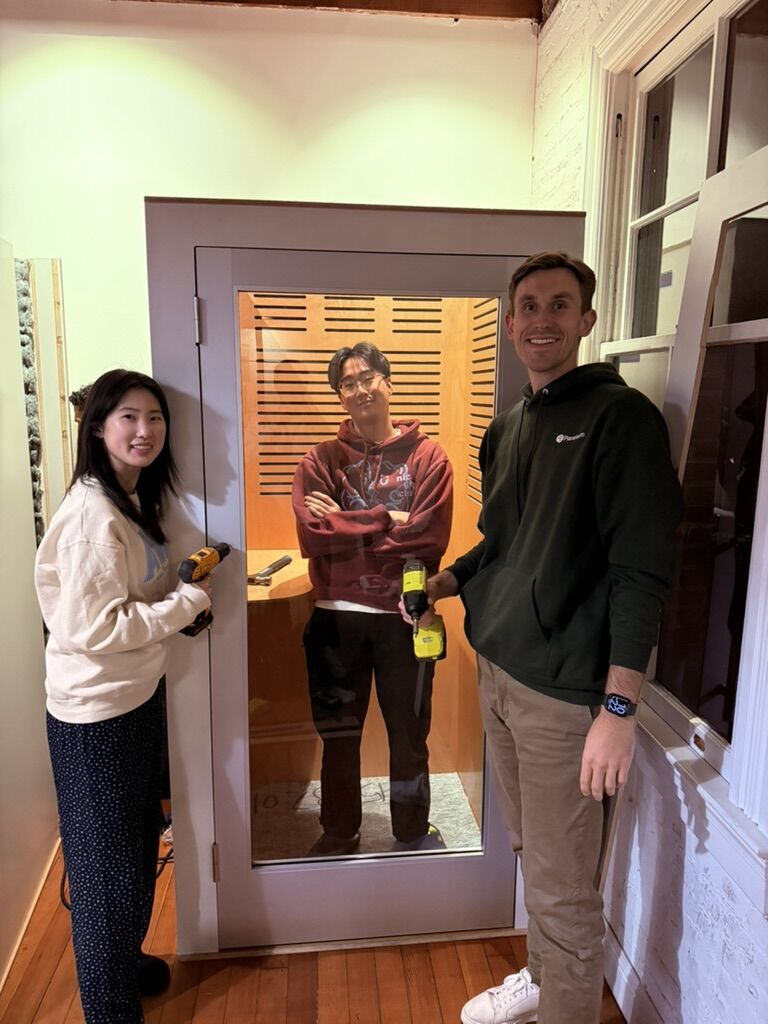
Kim’s account of the hiring process is almost a miniature adventure: the missed application, repeated email drafts, a flight, Fleet Week with the founders, a handshake. Its strongest detail is the first one. Plewa encountered a failed process and worked around it. He had spent his time at Village thinking about the distance between an available opportunity and the person trying to reach it. Now he was crossing that distance himself.
Four months into the job, Kim credited the growth operation Plewa built with $2.5 million in additional revenue and more than 180 demos a month. Those are Kim’s reported figures. They describe a specific early period and a commercial result, rather than the total value of Plewa’s contribution or a forecast of what would happen next.
The move also changed his daily relationship to founding. At Village, he had been responsible for the whole venture. At Paraform, he could bring that experience to one part of a larger company. A founder joining another startup carries experience of making decisions with incomplete information. The new test is whether that experience helps colleagues work together.
The work behind the growth
Plewa’s own later descriptions put other people inside the growth story. Writing about colleague Raine Akiyama-Chen, he recalled late nights working online together to build Paraform’s outbound operation. Akiyama-Chen had worked remotely from Toronto before moving to San Francisco. Plewa described a collaborator whose responsibilities expanded as the company grew.
That account offers a less compressed picture than a revenue announcement. A growth operation consists of people building tools, finding prospective customers, following up and adjusting what happens next. Plewa’s description gives a colleague credit for doing that work alongside him. The numbers may be the part that travels furthest online; the collaboration explains how there came to be numbers to share.
Paraform now combines specialized recruiters with software and custom agents to help companies hire. Its own product description emphasizes both recruiting relationships and the information gathered through searches. For Plewa, the connection to his earlier work is visible in the arrangement: give practitioners infrastructure that lets them spend more time on the part of their work that requires judgment.
He has also written about walking around San Francisco with colleagues, noticing companies advertised on billboards and wondering about working with them. Later, some became clients, and Paraform appeared on billboards itself. It is a modestly comic reversal for a career that once centered on helping local instructors find families. The audience grew; the problem of making useful introductions stayed recognizable.
There is a tidy temptation to describe a founder’s career as a sequence of inevitable steps. Plewa’s contains a better detail: an application that went missing. A system failed to make a connection. He rewrote an email, took a flight and joined the work of building another one.