A graduation photograph is a peculiar piece of commerce. The gown goes back in the cupboard. The ceremony ends. The picture stays out, quietly justifying the expense for years. When Matt Schiller brought his graduation photographs home, his mother loved them. One still occupies the family living room. For her, it was a picture worth displaying. For him, it helped suggest a business worth building.
There was already a business nearby. Schiller and Ed Kearney had co-founded GownTown, an online graduation retailer. They knew the occasion, the customer and the purchases clustered around it. Photography sat within reach. Snappr, the company they started in Sydney in 2016, would make booking a professional photographer part of an ordinary online transaction.
The distance between a proud parent and an enterprise software customer looks considerable. Schiller has spent much of the intervening decade crossing it. His story has graduation gowns, a consulting job, a California launch and a microphone shared with Sam Altman. The recurring concern is less exotic: how do you make a useful service easier to buy?
The picture that stayed in the living room
Schiller grew up on a farm outside Hay, in New South Wales. His education took him to the University of New South Wales, where his studies included philosophy. His working life would include McKinsey, followed by a return to building businesses. GownTown gave him a particularly convenient place to observe customers: a moment when people were already spending money to mark an achievement.
Graduation photography offered a way into a larger market. The occasion supplied an obvious reason to hire somebody with a camera. The next question was whether other occasions could be served with the same ease. A business portrait, a family gathering and a restaurant menu are different assignments, but each requires someone to arrange a person, a place and a time.
That sounds wonderfully straightforward until the messages begin. Availability, price, expectations, delivery: the picture has quite an administrative life before anyone presses the shutter. Schiller’s opening was in those arrangements. He could value the photograph and still find the process of commissioning it unnecessarily cumbersome.
A launch beats another meeting
In June 2016, Schiller described an unusually short trip from idea to working product. Most of Snappr’s initial version had been built in a week. The founders launched on the Friday; customers began arriving through word of mouth and Facebook over the weekend. Recruiting photographers became the next job. A job advertisement brought 500 applications without advertising expenditure.
“We’re big believers in the lean startup principle.”
Matt Schiller, June 2016
The sequence helps explain his approach. The first version had to be useful enough for a real transaction. The longer feature list could wait. A marketplace needs both somebody willing to book and somebody willing to accept the booking. An elegant plan for one side does little for the other. Putting the service in front of people supplied answers that another planning session could only propose.
America was a more unsettling experiment. Before the San Francisco launch, Schiller worried about whether Australian success would travel: the economics, the customers, even the company’s cheeky marketing. He later called the lead-up Snappr’s scariest period. The launch went ahead on February 14, 2017. In his subsequent account, San Francisco became the fastest growing market.
Valentine’s Day is an amusing date to begin matching strangers with photographers. The underlying decision was sober enough. Preparation had reached its limit; the founders needed customers to settle the remaining questions. Schiller’s description leaves room for apprehension inside a story that later looks inevitable.
Piano Man, with an unexpected second voice
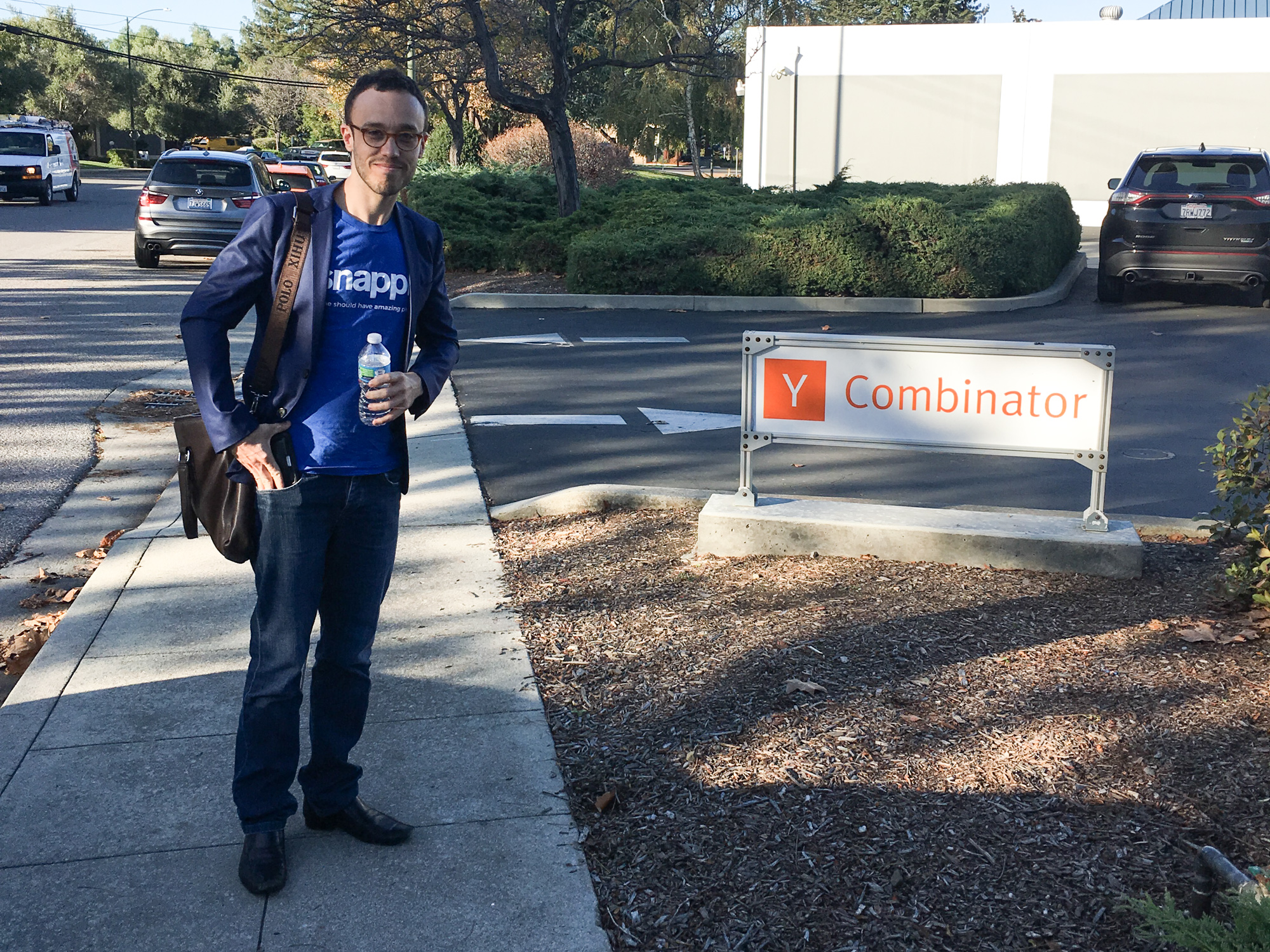
Snappr joined Y Combinator’s Winter 2017 batch. Schiller’s account of the period includes an In-N-Out gift card for Kearney at Christmas and a San Francisco karaoke evening. His chosen song was Piano Man. Altman joined in.
It is a pleasing interruption to the standard accelerator biography. There are introductions that happen around a pitch, and introductions that happen when two people discover they know the same chorus. The photograph preserves the latter: two microphones, a wall of coloured lights, Schiller looking toward the words.

The CEO who also makes little things
The professional introduction can accommodate several Schillers. There is the executive running Snappr, the former consultant, the investor associated with Pioneer Fund and the web developer. His public GitHub supplies a modestly entertaining counterweight to the corporate résumé: hangman, trivia, rock-paper-scissors and a project called Litestrap.
Those projects do not need to be dressed up as clues to a secret management theory. They are simply things he made public. They give the reader something concrete beside the job titles. A CEO can spend his working life on a large coordination problem and still have a repository devoted to a small game.
There is also YCDB, the Y Combinator Database, made by the Snappr team and crediting Schiller as editor. It lets visitors explore accelerator companies through different measures and rankings. Its original version was Product Hunt’s number-one product of the day on September 27, 2017. Earlier, he had founded EasyChem, a free chemistry resource for students. His LinkedIn records its acquisition in 2017.
Directories, educational resources and booking tools have a practical family resemblance: they help people get somewhere with less searching. That is a way to read the projects, rather than a motive Schiller has claimed for every one of them.
When one shoot becomes a production line
By September 2020, Snappr’s financing and product plans pointed toward larger customers. A $10 million Series A, led by Basis Set Ventures, would support enterprise offerings, additional formats and expansion. The company then worked with photographers across 200 metropolitan areas. It also offered an API through which businesses could arrange shoots and manage image files.
Schiller described the value to photographers in terms of access: a single freelancer could not independently cover the hundreds of markets an enterprise customer might need. Snappr could assemble that reach. For the customer, the attraction was coordinating the work across those places. Both sides needed the other; both needed the arrangements to function.
- 01 Brief
- 02 Match
- 03 Shoot
- 04 Edit + deliver
A conceptual workflow, not a measure of processing time.
His published fundraising advice is similarly concerned with protecting the work. In a startup manual, Schiller recommends giving one co-founder near full-time responsibility for a live raise so the others can keep operating the business. He also advises choosing investors with whom the founders connect personally. Money comes with people attached; those relationships can last much longer than the pitch meeting.
It is practical advice with an unromantic premise. A financing round consumes attention. A company still needs to serve its customers while the conversations continue. Assigning that distraction explicitly gives the other founders permission to stay at their desks and keep the product moving.
Acquisitions expanded the operation. Photographers.com.au came first in 2018, followed by Eversnap in 2020 and Pretty Instant in 2021. The last brought an enterprise photography business with experience serving national brands. Snappr committed to continuing to host the original images commissioned by Pretty Instant customers without charging them for that hosting.
The proposition also has to work for the person carrying the camera. In 2019, some photographers described frustrations with pay, communication and client expectations. Others found useful supplementary work. Those experiences matter alongside easier booking: a marketplace keeps functioning only while assignments remain worth accepting. Coordination is a service to both sides, and the quality of that service is tested one job at a time.
A pretty picture has to tell the truth
A later conversation reveals a different Schiller interest: flying. His professional profile lists an American commercial pilot license and an Australian private pilot license. On the Bring a Trailer podcast in October 2025, cars and cameras eventually gave way to aviation. The hosts were pilots too. Some conversational detours require remarkably little encouragement.
The interview also addressed an immediate business concern. Car buyers making large purchases online need accurate, plentiful photographs of the particular vehicle. Schiller discussed keeping AI out of automotive sales photography, while retaining a creator’s involvement when generative tools are used in other contexts.
A convincing image and an informative image serve different purposes. For a buyer, the photograph must help answer questions about the object being offered. Making it prettier cannot be allowed to make that object less knowable. The distinction gives a photography company a demanding brief: understand what the customer needs the picture to establish before deciding how to produce it.
More cities, the same appointment
In October 2025, Snappr announced a $28 million Series B led by Foundry and expansion into 57 additional European cities. Its press page described support for five more languages. Schiller’s stated priorities included product development, AI capabilities and international expansion.
Announcement figures, dated to the expansion.
More territory makes the original promise harder to keep. The photographer must arrive with the right expectations. The customer must receive something usable. Software can organise the instructions, but the appointment still happens somewhere, with somebody who has to do the work.
That is a useful place to leave Schiller: between a family photograph and a geographically complicated business, still concerned with the arrangements. The picture in his mother’s living room has already passed its test. Each new booking has to earn its place.
Keep looking
Follow the projects, conversations and company milestones.
- Snappr website · Company profile
- Matt Schiller on LinkedIn · GitHub · Wellfound
- Schiller’s account of the Y Combinator years
- Explore YCDB · Snappr at Y Combinator
- Listen: cars, cameras and aviation
- Read: Snappr’s move into workflows
- The first product and fundraising · The US launch
- The 2020 financing · The Pretty Instant acquisition
- The European expansion · Photographers’ experiences