At Brooke Hopkins’s breakfast table, object-oriented design was a perfectly reasonable subject of conversation. Her father explained it to her. On Saturdays, he took her to watch planes take off and answered the questions that followed. Engineering arrived as something you could be curious about together, with no need to wait for a classroom or a job title.
Years later, Hopkins would build software for testing self-driving cars at Waymo. Then she would start Coval, a company that tests AI agents before a customer has to discover their mistakes. The family resemblance is easy to see: a fascination with how things work, followed by a fairly persistent interest in what happens when they don’t.
Her father also encouraged an internship in Jordan when she was 17 and celebrated her acceptance to New York University Abu Dhabi. In her telling, autonomy was something practised early. Even a Saturday-night curfew could begin with a question about when she thought she should be home. That is quite a lot of responsibility to entrust to a teenager. It is also useful preparation for becoming the person who has to decide.
Before the car, the workshop
At NYU Abu Dhabi, Hopkins studied computer science and mathematics, graduating in 2018. Her activities extended beyond the degree. In the university’s Engineering Design Studio, she led the WeSTEM special interest group, contributed graphic design work, and helped produce a second version of a data-acquisition project. She was also on a winning team at the 2016 IBM, Cognit and Etihad hackathon.
Those are different sorts of work: organising people, making something legible, building something that runs. Together, they offer an early glimpse of interests that would travel with her into company building. In 2018, she received an NYU President’s Service Award, which recognises contributions to community life, learning and leadership.
After university came Google, followed by Waymo. Her career would eventually bring her back to voice technology, but the intervening work gave her a particular way of thinking about software. An autonomous system could do something impressive once. Whether it could be trusted to do the job repeatedly was a separate engineering question, with a much longer answer.
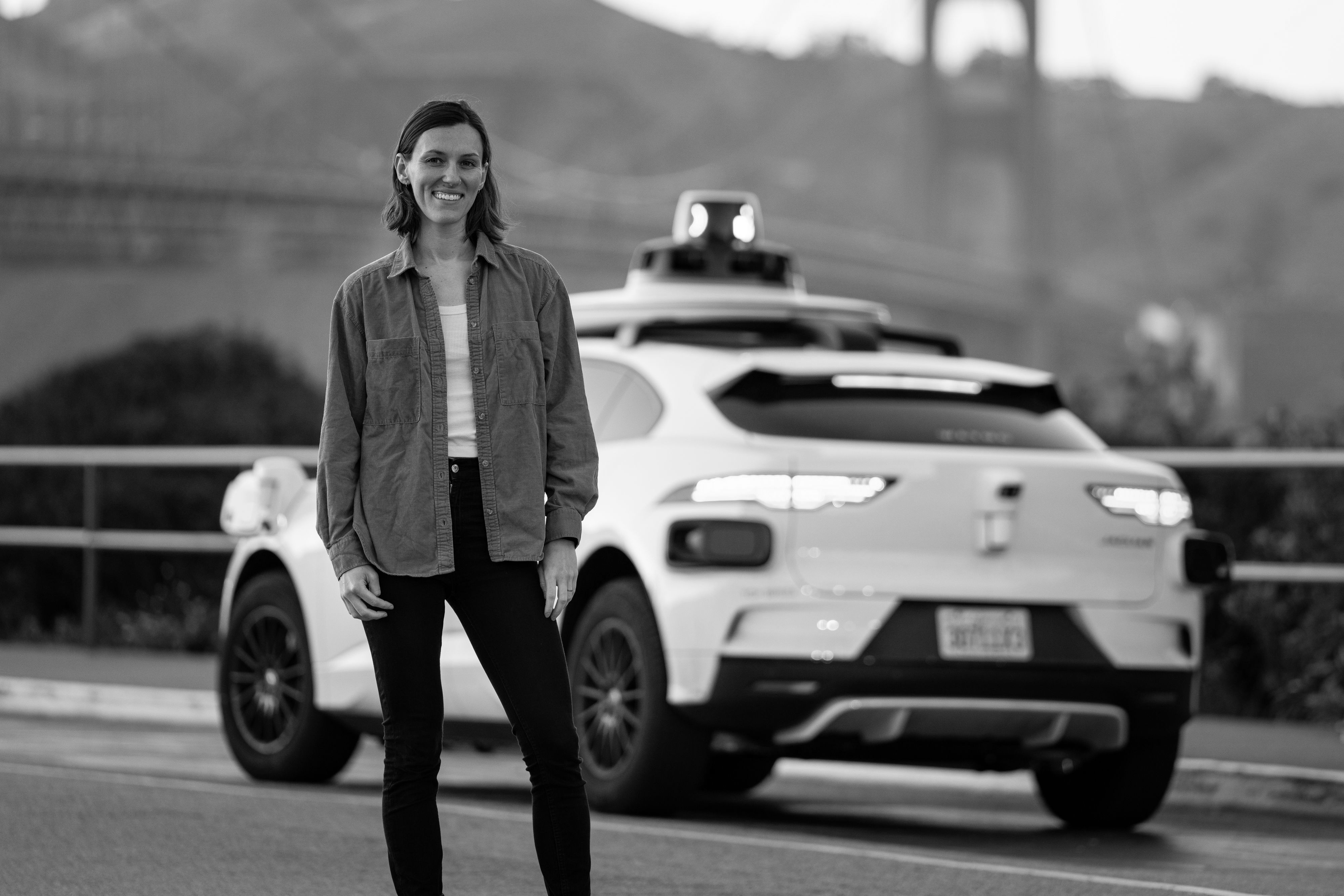
The interesting part is the second attempt
At Waymo, Hopkins led evaluation job infrastructure. She wrote early versions of dataset storage and other foundational simulation systems; her team built developer tools for launching and running evaluations. This was the machinery behind the machinery, the work that let other engineers ask whether a change had helped.
That distinction matters. A self-driving car is the visible product. The systems that organise tests, preserve examples and make results understandable are less photogenic. Yet they shape what a team can learn. Without them, an engineer can have an enormous quantity of data and a remarkably small amount of usable certainty.
Hopkins’s job placed her close to that problem. She worked on the infrastructure through which simulations became something engineers could run and inspect, rather than an abstract promise that testing would happen somewhere. Coval’s account of its beginnings puts equal weight on that technical experience and on making developer tools easy to use. A result that nobody can interpret has limited social prospects.
Her next step was not a straight line into conversational AI. After roughly three and a half years at Waymo, she joined the founding team of Alpha Grid. Its work concerned electrical-grid data and software for reducing uncertainty in electric-vehicle charging projects. The application changed; the interest in difficult infrastructure remained.
A conversation has traffic, too
Hopkins founded Coval in 2024 and joined Y Combinator’s summer batch. Her proposition carried a lesson from autonomous vehicles into another kind of autonomy: software that listens, reasons and acts during a conversation. Before launching, she spoke with hundreds of engineering teams and recognised familiar difficulties in their attempts to evaluate agents.
Manual testing could become a game of chasing failures. Fix one behaviour and another might break. A developer could spend hours talking to an agent and still have little confidence about the range of situations it would meet. The inconvenience became more consequential as agents began taking on real tasks.
The driving comparison helps explain why. A car can approach the same intersection many times and encounter a different situation each time. A support agent can receive the same underlying request in different words, amid noise, interruptions or a change of mind. The destination may be familiar. Getting there is another matter.
Coval lets teams generate and run simulated conversations, then evaluate what happened. Its simulation product allows different voices, languages and background environments, alongside custom measures of success. It also supports comparing prompts, models and vendors against the same tests. The useful question becomes how performance changes across a range of conditions.
There is a human detail inside this technical argument. People rarely speak with the cooperative precision of a demonstration. They hesitate, talk over the answer and remember something halfway through. A telephone call is an unusually effective way of reminding software that the world has other plans.
Hopkins’s work concerns that unruly middle: the distance between an agent being able to talk and an organisation knowing what it will actually do. It is a question that remains useful when the underlying model changes, because the customer still needs the task completed.
The office used to be her living room
Coval began with a more domestic testing environment. Hopkins’s living room served as its early office. When the company moved into its first dedicated space, in San Francisco’s SoMa neighbourhood, she wanted to preserve the casual, creative atmosphere rather than leave it behind with the furniture.
She pointed to Notion’s early headquarters as an influence and argued for the speed of working together in person. An office, in this account, was part of how the work happened. The room was supposed to invite the kind of exchanges that are difficult to schedule.
That preference fits her own description of herself as a “rare extroverted backend engineer.” She valued Y Combinator partly for the company of other founders: people who found building from scratch exciting and could make the difficult parts feel shared. For someone whose product examines conversations, she seems to appreciate the unscripted ones.
Her reading interests make room for the same combination of engineering and creativity. She has recommended Kim Stanley Robinson’s The Ministry for the Future, as well as Creativity, Inc. and books about Steve Jobs and Bob Iger. Pixar and Apple interested her as organisations that brought technical ambition and design together. She wanted to understand how that combination survived inside a company.
“celebrate early and often.”
Brooke Hopkins, on Coval’s team motto
Flowers, glassware and a funding round
In June 2026, Coval announced a $28 million Series A led by Norwest, with participants including Base10 Partners, Twilio Ventures and Y Combinator. Hopkins said the investment would support sales and solutions engineering, richer simulations, integrations, human review and monitoring. The plan extended the work of helping customers get into production and understand what happened there.
Her thank-you message named founding engineers Rhea Bryce Pokorny and Kobi Hudson. Pokorny had joined before there was a customer, code or a proper office; Hudson brought a decade of Waymo simulation experience. The announcement gave the company’s progress a cast of people, each of whom had made an early decision to join.
The celebration happened at Coval’s office. Hopkins arranged the flowers and table settings herself, and chef Kedar Shenoy, a neighbour, cooked dinner. She wanted the team and investors in the place where the company was being built, getting to know one another. When she arrived before the party, engineers were polishing cloudy glasses.
It is a pleasingly concrete scene for a business concerned with quality. There are the flowers, the glasses, the person noticing. Hopkins connected that attention to the care she wanted in product decisions and customer interactions. The office briefly acquired a second shift as a dining room. The standards came along.
Her case for celebrating is equally practical. A startup offers no dependable moment when everything is finished and secure. Waiting for that moment risks waiting forever. She wants milestones acknowledged while they still feel like milestones, giving the team a sense of the progress it made. Investor Brett Wilson supplied a saber for the occasion. Some management tools are more ceremonial than others.
The caller still gets a vote
By October 2026, Hopkins was discussing another consequence of AI on The Tech Trek: how engineers work when they can direct several coding agents, and what hiring should measure as those tools become common. Her interest in evaluation now also touched the people building the evaluators. Problem solving and judgment still required attention, even as more execution could be delegated.
Her longer ambition leaves room for work beyond testing. In conversation with Rachel Chalmers, she described a future in which AI gives more people space to create. Asked to name a hypothetical ship travelling to the stars, she chose Sofya, after mathematician Sofya Kovalevskaya. Coval’s name, she explained, honours Kovalevskaya while also suggesting conversational evaluations.
The breakfast-table questions have become a company’s working questions. What is the system doing? How can you tell? What changes when it meets the world? Hopkins has carried them from planes to cars to conversations. The next caller will, as callers tend to do, supply a fresh complication.