At 7 a.m. in a Krispy Kreme, hairnet on and doughnuts nearby, Nipul Chokshi found the part of enterprise software that no dashboard can quite capture. It was the operation itself: people moving, customers arriving, dozens of small decisions becoming a business day. His note afterward was cheerful and direct. Seeing a customer's operation up close beats another Zoom. For a career spent explaining data systems, this was less a field trip than a return to first principles. The software matters when it meets the shift.
Chokshi is the chief marketing officer of Fourth, whose software helps restaurants and hospitality businesses manage workforces, inventory and analytics. His remit covers global pipeline and bookings, brand, competitive positioning and customer retention. Those are broad nouns. In practice, they collapse into a more interesting question: how do you make a complicated system mean something to the person who must use it?
He has been answering versions of that question for more than fifteen years. The industries and acronyms keep changing. The recurring task does not. Chokshi occupies the crowded seam between product, sales and marketing, where an engineer's exactness, a seller's urgency and a buyer's limited patience all meet. It is not the glamorous edge of technology. It is the useful one.
That middle position explains the unusual range in his public portfolio. One project asks whether a sales forecast can be trusted. Another asks how a global company should talk about an internal social network. A third asks which restaurant locations are drifting from their peers. Each begins as a technical problem and ends as a human choice. Chokshi's work is the bridge between the two, built from language, evidence and enough organizational patience to survive the review meeting.
The engineer never left
Chokshi earned a bachelor's degree in electrical engineering from Cornell, then an MBA from Berkeley's Haas School of Business, focused on general management and the management of technology. On a résumé, that looks like a pivot from circuits to commerce. In his work, it looks more like continuity. He studies systems, inputs and outputs. He wants to know where a signal gets lost.
The early product trail is unusually coherent. In 2007, at Merced Systems, he developed and launched PowerCoach, performance software that helped the company gain airline and logistics customers including Delta Air Lines and FedEx. In 2009 came Right90 Trust Analytics, built to assess the accuracy and reliability of sales forecasts. By 2011 he was helping drive the Marketo Next launch, turning a new release into a product pitch and sales-enablement material.
Then came Yammer. Chokshi helped develop the company's standard sales pitch, competitive playbook and the language of its business benefits. The assignment was not merely to market another collaboration tool. Yammer was defining enterprise social networking, a category that needed to sound essential to executives who did not wake up asking to buy it. Microsoft acquired Yammer in 2012.
Chokshi's recurring translation loop
Years later, when asked whether a new category requires a new buyer title, he returned to Yammer. The company made enterprise social networking relevant to existing roles such as the head of HR, the operating chief and the sales leader. New categories seldom arrive with their own budget line. The marketer must show where the money can come from and why the problem deserves it.
“It's like you're defining the rules of a new sport, defining who'll be in the league and then playing.”Nipul Chokshi on category creation
Point of view before polish
Chokshi's messaging method starts with two things: point of view and positioning. The first explains why a market problem matters and what kind of approach can solve it. The second identifies the product's distinctive value for a specific audience. Only then do the campaign messages appear. It is a bracing order of operations in a profession tempted to begin with adjectives.
He is equally plain about the common failures. Messaging becomes generic when the audience is poorly understood. It becomes inert when it provokes no feeling or action. It becomes inward-looking when a company uses its own vocabulary rather than the buyer's mental model. A platform story fails when it celebrates a feature, such as an app opening faster, without connecting that speed to pipeline, revenue, margin or time returned to a manager.
At DataSift in 2013, that philosophy met machine learning. Chokshi led launch work for DataSift 2.0 and its social-data enrichment capabilities, as well as the corporate pitch, website and sales playbook. A former colleague remembered the breadth: strategic messaging, web, training, customer advocacy, speaking and team leadership. Product marketing, the colleague observed, is a place where everyone wants a piece of you. Chokshi brought tenacity, perseverance and positivity to the scrum.
Another former colleague supplied the less visible half of the picture. She described a compassionate manager who followed through on commitments and treated his team's success as his own. It is tempting to separate the hard machinery of revenue from the soft machinery of trust. His career suggests they share a power supply.
The old idea that learned to scale
At Lattice Engines, Chokshi became a prominent explainer of predictive analytics and account-based marketing. In 2017, when ABM was being discussed as a novelty, he pointed out that sales teams had targeted valuable accounts since the 1990s. What had changed was scale. Digital footprints, large data sets and online marketing made it possible to personalize the approach across thousands of accounts. One Lattice customer was doing it across 500,000.
The economic argument was sharper. Chokshi noted that roughly one percent of leads turn into genuine revenue opportunities. The remaining funnel contains enormous waste. Better data could help a company decide whom to target, what problem to address, which message to use and only then which channel to choose. Tactics came last. Strategy had to earn the right to send the email.
His case for data was not a case for replacing people with scores. He argued that personas become more important as data improves. A B2B purchase is made by a company but negotiated among human beings, each with a role, preference and context. At Lattice, he spoke about operationalizing analytics: integrating predictive signals into systems such as Salesforce, Marketo and Eloqua so a seller could act on them. A model stranded in its own dashboard is a clever ornament.
- 2007 to 2011Merced PowerCoach, Right90 Trust Analytics and the Marketo Next launch.
- 2011 to 2013Yammer's enterprise story, followed by DataSift's machine-learning launch.
- 2016 to 2020Predictive analytics and ABM leadership at Lattice Engines and Dun & Bradstreet.
- 2020 to 2022Data-driven sales management as marketing leader at Atrium.
- TodayGlobal marketing at Fourth, plus participation in the GTMfund operator network.
Where the forecast meets Friday night
The move to Fourth changed the scenery, not the underlying puzzle. In a restaurant, demand forecasting touches labor, food, waste and guest experience. The distance between an insight and its consequence can be measured in hours. Schedule too many people and margin slips. Schedule too few and the dinner rush supplies a swift correction. Inventory does not admire a visionary deck. Lettuce keeps its own calendar.
Fourth says its systems serve 15,000 customers across 100,000 sites and 2.5 million users. Chokshi's job is to connect that operational surface area to a coherent story about workforce, inventory and intelligence. His recent public work stays close to the floor: location-level performance differences, trading patterns around major football matches and visits to customer shops. The vocabulary is still predictive signals and measurable outcomes, but the nouns are now shifts, covers, ingredients and managers.
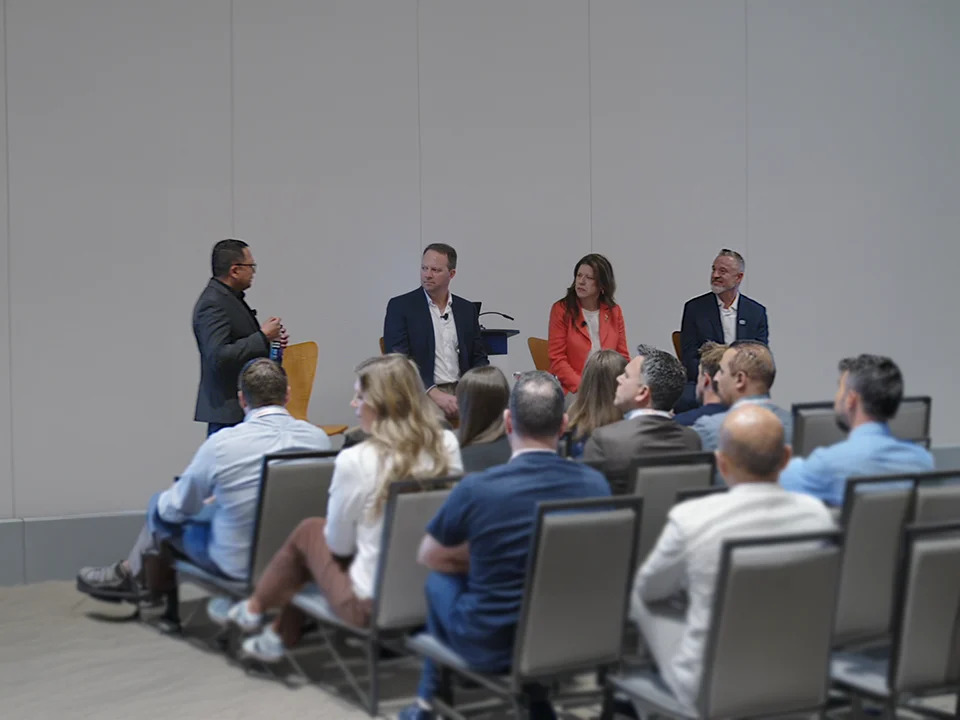
At the 2026 Restaurant Leadership Conference, he moderated a panel with leaders from Brinker International, Quality Brand Group and Fogo de Chão. He advertised three questions: what AI was actually running in stores, where it earned its keep or failed, and what changed when teams used what the company had bought. He also made a small promise that revealed the larger philosophy: no vendor slides.
There is no grand mystery in Chokshi's public advice. Know what you do well. Double down on it. Delegate what others can do better. His own repeated strength is translation, backed by a tolerance for the unglamorous connective work that makes organizations function. Product needs precision. Sales needs traction. Customers need an outcome. Teams need a leader who calls back.
The career began with an engineer learning how performance systems worked. It now operates at the scale of global hospitality, where every day produces more signals than any manager can comfortably absorb. Chokshi's wager has remained steady: the point of data is not to make the world look complicated. It is to help somebody decide what to do next, preferably before the doughnuts cool.