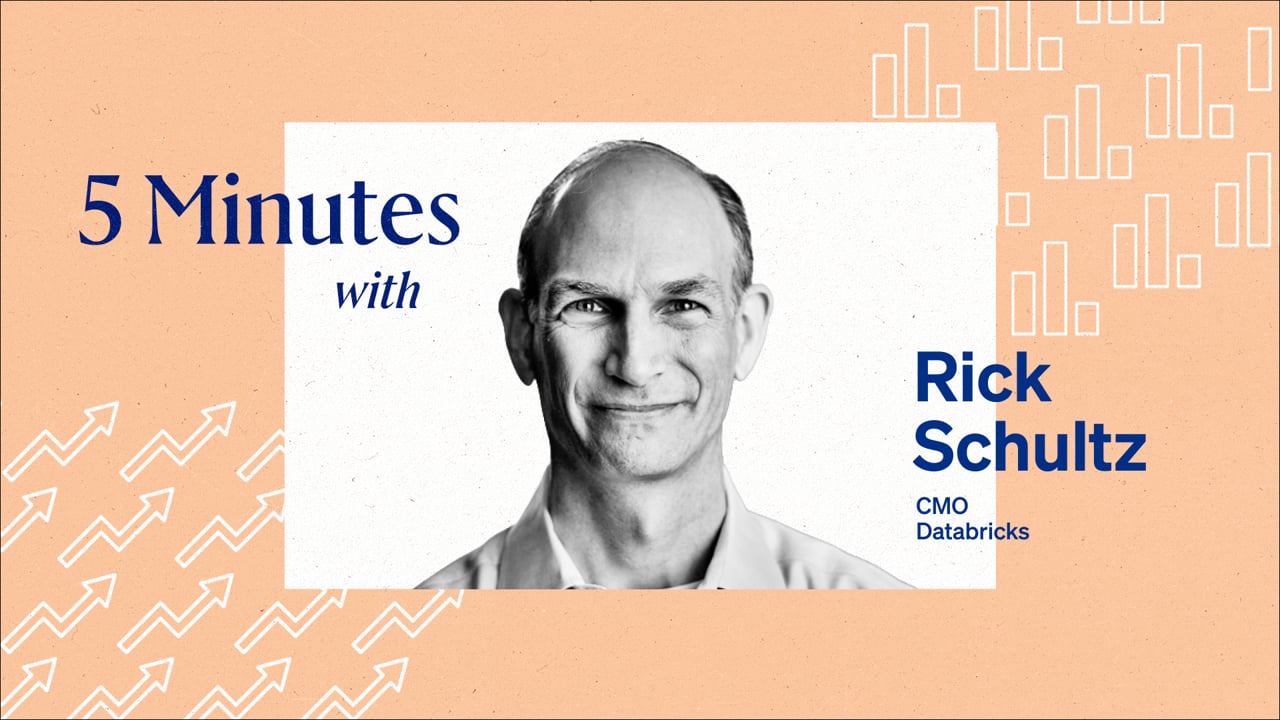
Rick Schultz has spent much of his career marketing things that resist a tidy sentence: middleware, databases, analytics systems, cloud platforms. These products are powerful precisely because they do many jobs, which is excellent for engineers and rather inconvenient for anyone charged with explaining them. His answer has not been a louder adjective. It has been editorial discipline.
There is an early clue in his biography. While earning a finance degree at UC Berkeley's Haas School of Business, Schultz worked at The Daily Californian as a staff writer, sports editor and editor-in-chief. Long before the C-suite, he was deciding what mattered, what could be cut and which words deserved the top of the page. Corporate marketing would eventually give him larger budgets and far stranger nouns. The basic problem remained: make a complicated story clear enough that another person can repeat it.
That skill carried him through the plumbing of the modern software industry. At Sun Microsystems, he led marketing for Java platform and application-server products. At Oracle, he ran product marketing across a technology portfolio spanning databases, middleware, security and analytics, a business then measured in more than $6 billion of annual license revenue. In 2012 he left the vast machinery of Oracle for Alteryx, then an early-stage analytics company with roughly 100 customers.
Java EE and Sun ONE middleware product marketing.
A broad database, middleware, analytics and security portfolio.
From about 100 customers to more than 2,200 as the company approached an IPO.
Worldwide marketing, from positioning to demand, brand, events and community.
A very long dinner, then a very quiet quarter
In 2017, Schultz's first encounter with Databricks was dinner with chief executive Ali Ghodsi. Schultz has recalled it as three hours; an account of his later conference remarks puts it at four. The precise running time is less interesting than the menu of conversation: vision, thinking, approach. This was not a brisk chemistry check. Ghodsi and the other founders had built Apache Spark and believed businesses would move their data to the cloud, then need a unified foundation for analytics and machine learning. Schultz saw a technical team thinking several moves ahead.
He joined as chief marketing officer that March. Then he devoted his first quarter to messaging. No theatrical launch montage, no instant rebrand, just weeks asking what the company did, for whom, and why its answer deserved attention. Databricks brought in an outside agency, kept its founders deeply involved, tested language first with customers who already understood the value, and then moved to prospects.
One research trip to New York supplied the useful humiliation every positioning process needs. Behind two-way glass, Schultz and Ghodsi watched prospects fail to understand the message. Ghodsi grew so frustrated, Schultz later joked, that he nearly jumped through the glass. A roomful of polite nods would have been cheaper emotionally and much more expensive strategically.
“What’s more important than how you position your company when you’re trying to be heard of, stand out, create brand awareness, and drive pipeline, preference, and interest?”Rick Schultz
Four boxes before the corner office
Early Databricks did not aim its story at every executive who owned a laptop. It used a four-box audience matrix: data scientists and data engineers on one axis; practitioners and their direct managers on the other. The company spoke to people making adoption decisions around specific use cases. Chief data officers and chief information officers came later, after revenue had reached hundreds of millions.
The restraint matters. “Line of business” sounds focused inside a planning document, but it can contain a small republic of different buyers. Schultz's team picked people close enough to the problem to recognize it. That choice also mirrored the product's ambition: bring data-science and data-engineering work into one place instead of leaving each group in its own technical province.
The word that carried its own diagram
The original formulation was “Unified Data Analytics.” It was accurate in the way instruction manuals are accurate: every word behaved, yet the phrase did not travel. Databricks had been arguing that the low-cost, flexible data lake and the structured, reliable data warehouse should no longer live separate lives. The eventual name, “Data Lakehouse,” put the architecture into a verbal snap-fit. Two familiar buildings became one new address.
Schultz is careful about category creation. Not every company needs a fresh category, and announcing one does not cause a market to salute. His sequence begins earlier. First, condition the market around the pain. Help buyers recognize that existing arrangements create friction. Show why current options do not resolve it. Only then can a named alternative feel like an answer instead of a vanity exercise.
“You have to condition the market around the pain.”Rick Schultz
The lakehouse met resistance from analysts and established thinkers. Databricks did not swap out the term at the first skeptical eyebrow. Its team engaged critics, explained the architecture, published, presented and kept going. Bill Inmon, widely associated with the modern idea of the data warehouse, initially dismissed the concept; two years later, he co-authored a book about data lakehouses. The important change was not that every critic converted. It was that customers began describing their own strategies with the term. A vendor had supplied language that buyers found useful without the vendor in the room.
Stamina is an operating choice
Schultz calls the discipline “message stamina.” Insiders encounter a slogan in every deck, meeting and campaign review. Fatigue arrives quickly. Buyers, meanwhile, are busy living their own lives and may have seen it twice. If a message typically needs seven to nine encounters to register, the marketing team will become bored long before the market becomes fluent. Changing the words can feel creative while quietly resetting the clock.
Consistency did not mean one channel. Databricks invested in direct demand, digital programs, field events, partner marketing and cloud-provider relationships. It meant those activities pointed in the same direction. Schultz and chief revenue officer Ron Gabrisko also avoided the ritual combat of perfect pipeline attribution. Marketing and sales worked backward from company targets toward the pipeline required and shared the result. Everyone could succeed together, which also meant everyone retained the invigorating possibility of failing together.
His view of brand is similarly unromantic: “Your brand is your reputation.” Visual identity matters, as do language and events, because each is evidence for that reputation. Brand is less the expensive coat a company puts on than what people say about the company after it leaves the room.
The 200-hour hiring problem
Hypergrowth tested this patience elsewhere. Schultz describes executive recruiting as arithmetic. Suppose a proper search demands 200 hours across research, outreach, interviews and references. Spend 20 hours a week and it can finish within a quarter. Spend 10, and the vacancy may survive into a second quarter, an age in startup time. Hurry by cutting diligence, however, and the calendar wins while the team loses.
His hiring principle is to look for long-term company builders: people who stayed, were promoted and built through several chapters. He has admitted that when teams talk themselves into relaxing that standard for candidates with a pattern of brief stops, they usually regret it. The notable feature is not infallibility. It is the willingness to name a recurring mistake plainly.
Former colleagues describe the same combination from the other side: technical knowledge and creative risk, high standards and an interest in employees' success. The profile is of a demanding operator who treats marketing as company construction, not the production of attractive ephemera.
AI still needs an editor
Generative AI gave Databricks a fresh messaging problem. The company had discussed machine learning for years, but the public meaning of “AI” lurched in late 2022. Databricks evolved its lakehouse story into the Data Intelligence Platform and acquired MosaicML, preserving Mosaic AI as a recognizable identity. Once again, product decisions and market language moved together.
Schultz's forecast for marketing jobs avoids the two most marketable extremes. AI will neither erase every role nor turn every marketer into a full-time builder. It should make many people more productive; some jobs will shrink and others will evolve. His practical preference is pairing subject-matter experts with the organization's most AI-fluent people.
The constraint is context. An AI system can access a warehouse of material and still misunderstand the business. It needs to know which data is trusted, where it came from, how customers are moving through a journey, what outcome a campaign seeks and what the brand is supposed to mean. More output does not rescue a vague position. It merely distributes the vagueness with impressive efficiency.
That brings Schultz's story back to editing. A finance student works late on a campus newspaper. A product marketer makes Java and databases legible. A startup CMO watches through glass as his sentence fails. Then comes the revision, the repetition and the wait. Technology keeps inventing new complexity. His durable bet is that clear language, held long enough, can still organize it.