The photograph was taken at a fuel station. Nimantha Baranasuriya and his co-founder had been hurrying between factory meetings in Sri Lanka, and the car was nearly out of petrol. Across five days they had covered 474 kilometres, moved one pilot into live deployment and added two more to the pipeline. For a company working on fuel efficiency, it was an unusually well-timed reminder to check the tank.
Baranasuriya included the detail in his account of the trip. He also mentioned a preference for whiteboards over PowerPoint. After years of building industrial technology, he is still going to see the people who might use it, listening to their objections and finding out what happens between the production plan and the end of a shift.
Today, he is co-founder and CEO of ThermoTune, which develops production-planning technology for factories that consume substantial amounts of heat. He remains co-founder and non-executive director of Ackcio, the Singapore wireless-monitoring business he previously led. There is a familiar question running through both ventures: what useful information is already there, waiting to reach the person who can act on it?
A founder’s account of one customer trip. Progress measured in visits and deployments.
The introduction his father could make
Before the factory visits came construction sites. In 2016, Baranasuriya joined Entrepreneur First in Singapore knowing he wanted to start a business, without having chosen the business. A conversation with his father, a civil engineer, gave that ambition somewhere practical to go. His father introduced him to former colleagues working in construction in Singapore.
Those conversations exposed the difficulties of collecting monitoring readings on worksites. Baranasuriya and Mobashir Mohammad, another NUS researcher, found a problem suited to their technical backgrounds. Prospective customers offered advice, equipment and access to sites. The people who would eventually have to use the system were helping decide what it should do.
That beginning gives the familiar phrase “university spinout” some texture. Research supplied the technical possibilities. An introduction supplied the setting. Contractors supplied the constraints. The founders had to turn all three into something that would work beyond a demonstration.
“I joined the cohort without a startup idea”
Nimantha Baranasuriya, on joining Entrepreneur First
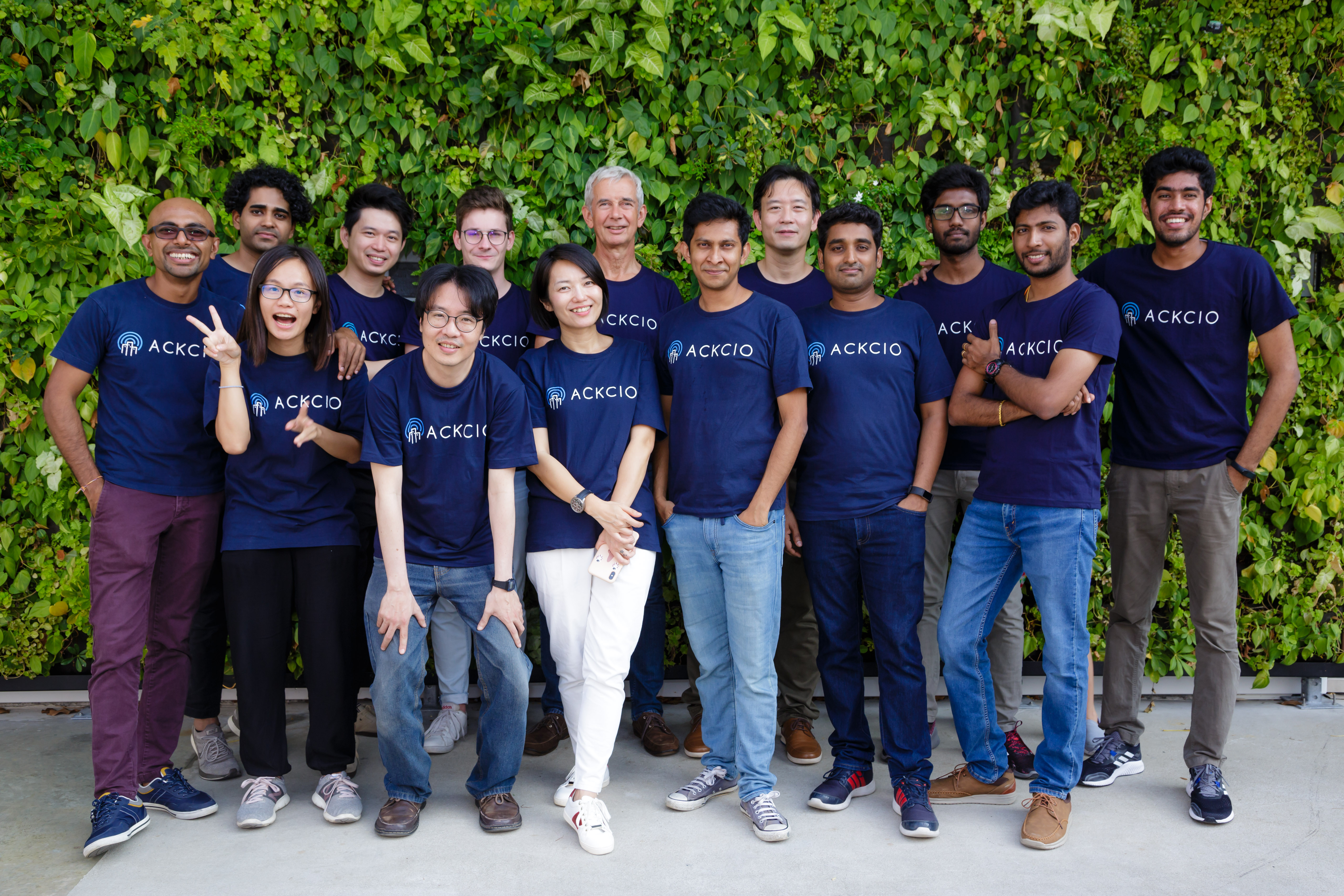
Ackcio was registered on 22 December 2016. Early work with instrumentation and monitoring contractors produced a long-range wireless mesh system for tiltmeters, instruments used to measure changes in inclination. In 2017, the first Ackcio Beam systems reached construction sites in Singapore. Three full-time employees joined the founders at a coworking facility in Block 71, one-north.
The company began exporting to Australia, Indonesia and Thailand in 2018. It had started with a specific task in a small home market, but the task travelled. A construction project elsewhere could have the same difficulty getting a dependable reading from an awkwardly placed instrument.
A doctorate in finding the hold-up
Baranasuriya had arrived in Singapore in 2011 for doctoral study at the National University of Singapore. His earlier degree was in computer science and engineering at the University of Moratuwa in Sri Lanka. He received a gold medal for the highest overall grade-point average in his graduating discipline, alongside university tennis colours. He had made room for both the examination hall and the court.
At NUS, his work concerned communications over wireless networks. He also spent time as a research intern at Microsoft Research India. These were years spent asking why information sometimes moves badly through systems designed to carry it.
One research result, QProbe, addressed a frustration familiar to anybody who has watched a phone struggle to load a page. A slow connection does not immediately reveal where the problem lies. The congested link might be the cellular connection, or the bottleneck might be elsewhere along the network path. A speed test alone could leave the important question unanswered.
Baranasuriya co-authored the work with Vishnu Navda, Venkata N. Padmanabhan and Seth Gilbert. Their study involved more than 600 users on 51 operator networks in 33 countries. QProbe used characteristics of cellular scheduling to help locate the bottleneck. The paper received the best short paper award at CoNEXT 2015.
There is a pleasing continuity between that question and his later work. Before improving a system, establish where the hold-up actually is. In a network, that requires measurement. In a factory, it can also require a visit and a conversation with the people running the machines.
A US patent granted in December 2019 names Nimantha Thushan Baranasuriya and Padmanabhan as inventors of a ping-pair technique for detecting wireless congestion. Ackcio also credits some of his doctoral research with improvements to Skype call quality. His work had reached people who would never need to know his name.
A summoning spell, with a sales channel
Ackcio borrowed its name from “accio”, the Harry Potter spell for summoning things. Bringing distant sensor readings to an engineer was a reasonable industrial adaptation. The fictional version has the advantage of requiring rather less battery management.
By November 2022, Ackcio had clients in 36 countries. Baranasuriya described mining as an unexpected opening: a customer approached the company, and the equipment proved useful in mines as well as construction. The same devices could serve the new setting without customisation. Listening to a buyer had expanded the map again.
Growth also required the less picturesque work of selling and supporting equipment. Ackcio established a Canadian subsidiary to serve the Americas, announcing it in February 2022. Its plans included sales, service, fulfilment and a larger local team. Sending equipment across an ocean is one transaction; being available when a customer needs help is an ongoing commitment.
- 2011Doctoral study
at NUS - 2016Ackcio
is founded - 2018First overseas
exports - 2024ThermoTune
launches
For Baranasuriya, that international footprint also meant building an organisation around the product. The Canadian operation was intended to give customers timely service and support, with plans for a fulfilment centre and more business-development and operations staff. A reliable reading depends on engineering; a reliable supplier needs people close enough to answer the next question.
Looking back at Ackcio’s fifth anniversary, Baranasuriya recalled a prototype that could read only a limited type of current-loop sensor and transmitted through a simple long-range radio. The later Beam system supported a broader range of geotechnical and structural instruments and software platforms. It is a useful reminder that a product family can begin as a fairly restricted box.
He also wrote about hard work, changed direction and the support of employees, customers, partners and investors. At that point, Ackcio supported projects in more than 25 countries across six continents. The account gives growth its working parts: a succession of improvements, backed by people willing to keep using and supporting the result.
The next problem runs on steam
ThermoTune began in 2024 under Singapore’s Economic Development Board Corporate Venture Launchpad programme. Baranasuriya founded it with Radershan Suguneswaran and the teams at IMI Venture Studio, Wright Partners and MING Labs. He is working again where industrial routines meet technical possibilities, this time around the energy needed to make things.
The company’s products include TexTune for textile manufacturing and TyreTune for tyre manufacturing. Their work connects production scheduling to heat demand. Which machine runs when can affect how a plant uses steam, how frequently equipment must be changed over and how much fuel a boiler consumes.
ThermoTune describes a process that starts with a factory’s enterprise resource planning schedule, generates machine allocations, incorporates operators’ progress updates and sends the boiler team guidance on operating settings. The proposed improvement lives inside an ordinary working day. Someone still has orders to finish and machines to keep running.
In December 2025, Baranasuriya described a recurring gap after visits to textile and tyre factories in Sri Lanka. Companies planned machines, materials and manpower, while energy often remained a consequence of those decisions. He was asking how the same production plan could use less energy. Existing operating data could help, provided it became useful soon enough for someone to change the plan.
By July 2026, he and Suguneswaran were visiting textile factories around Jakarta. Cafés became temporary offices between appointments, places to send follow-ups and make product decisions before the next visit. It is a recognisable sequel to the construction conversations of 2016: leave room for the customer to explain something the founders have missed.
Learning the language, twice
There is another education continuing at home. Baranasuriya and his wife, Dilini, moved from Sri Lanka to Singapore in 2011. They are raising two daughters, and he enrolled in Chinese lessons hoping to help with schoolwork. His teacher gently suggested that the daughters would probably be teaching him. The doctorate offered no exemption from being a beginner.
His recollections of settling in include looking for the engine room on a driverless MRT train and an awkward pause at a pedestrian crossing, each side waiting for the other to move. These are small details of learning a place, memorable precisely because nobody puts them in a relocation plan.
His interests have included photography, teaching and cooking Sri Lankan dishes for friends. He has also listed tennis, books, cycling and a fondness for Harry Potter among his pleasures. That makes the company name feel less like a branding exercise and more like something its founder might actually enjoy saying.
He has described wanting his daughters to stay connected to Sri Lanka while growing up in Singapore. The business journeys and the family journeys share the calendar. There are factories to visit, relatives to see, lessons to attend. And, occasionally, a fuel stop that becomes the most revealing photograph of the week.