Nicole Reinhart has spent much of her career in rooms where the language is dense and the stakes are real. Hospital finance people can discuss reimbursement, patient collections, denials and net revenue with a precision that rewards long attention. Marketing usually enters the room later, carrying a request for three bullets and a cleaner headline. Reinhart entered through a different door. She was the person asking the questions, taking notes and deciding what a reader needed to know first.
Before she became chief marketing officer of Kodiak Solutions, she was a healthcare writer and editor. She worked in industry publications including Modern Healthcare, and in roles at Tribune Media and the American College of Healthcare Executives. She learned the trade from the audience inward: understand the beat, respect the practitioners and do not confuse simplification with making something simple.
That editorial apprenticeship now sits inside an executive job. Kodiak makes software and provides specialist services for healthcare finance, revenue cycle, reimbursement, risk and compliance. Reinhart's assignment is to make that work recognizable without turning it into alphabet soup. Her career suggests a useful operating principle for technical companies: the person who can explain the work must first become genuinely interested in it.
The editor in the executive chair
Reinhart studied magazine journalism at Ball State University. Her early professional development reads like a snapshot of journalism before the social feed swallowed the front page: a computer-assisted reporting boot camp at the University of Missouri, a selective Poynter seminar called “Words That Click,” and awards from the American Society of Business Publication Editors for breaking-news and general-excellence newsletters. In 2015, Ball State's journalism department gave her its Young Alumnus Award.
The credentials matter less as ornaments than as evidence of a method. Data reporting taught her to look beneath the anecdote. Editing taught her to find the spine of a piece. Trade publishing taught her that readers with deep expertise are unmoved by slogans and quick to notice a missing caveat. She also wrote about the central tension of the industry. Her 2012 article in Healthcare Executive, “The Ethics of Mission and Margin,” examined a phrase familiar to healthcare managers: no margin, no mission.
Then she crossed the traditional line between covering an industry and working inside its commercial machinery. At Crowe LLP, Reinhart led market and customer advancement for the healthcare consulting practice for nearly a decade. She added an Executive MBA from Loyola University Chicago, where her activities included Beta Gamma Sigma. The reporter's questions acquired an operator's constraints: budget, portfolio, customer experience, growth and the unglamorous coordination required to keep them pointed in one direction.
“It’s critical that thought leadership and subject matter expertise be owned by those who are the masters of their craft.”Nicole Reinhart · Kodiak Healthcare Summit, 2024
A new name for an experienced business
In 2023, the practice Reinhart had helped advance became Kodiak Solutions. TPG Growth acquired a majority stake in Crowe Healthcare Consulting and established it as an independent company; Crowe retained a minority interest. The new brand inherited work that dated to 2005, including Revenue Cycle Analytics, software designed to help provider organizations understand net revenue and performance.
For a marketer, this was a peculiar and interesting brief. Kodiak was new on the nameplate but experienced in the field. It needed the energy of a launch without pretending the people, products and customer relationships had materialized that morning. Reinhart stood at exactly the useful intersection. She knew the practice's history, understood its customers and had spent years translating its specialists.
The through-line is not promotion. It is translation. A hospital CFO does not need marketing to make denial data sound exciting. The CFO needs someone to surface why the pattern matters, which operator can explain it and how another team might act on it. Reinhart's version of marketing behaves like a good newsroom with a commercial mandate. The experts remain the experts. The editor creates the conditions for their knowledge to travel.
Let the craftsperson own the craft
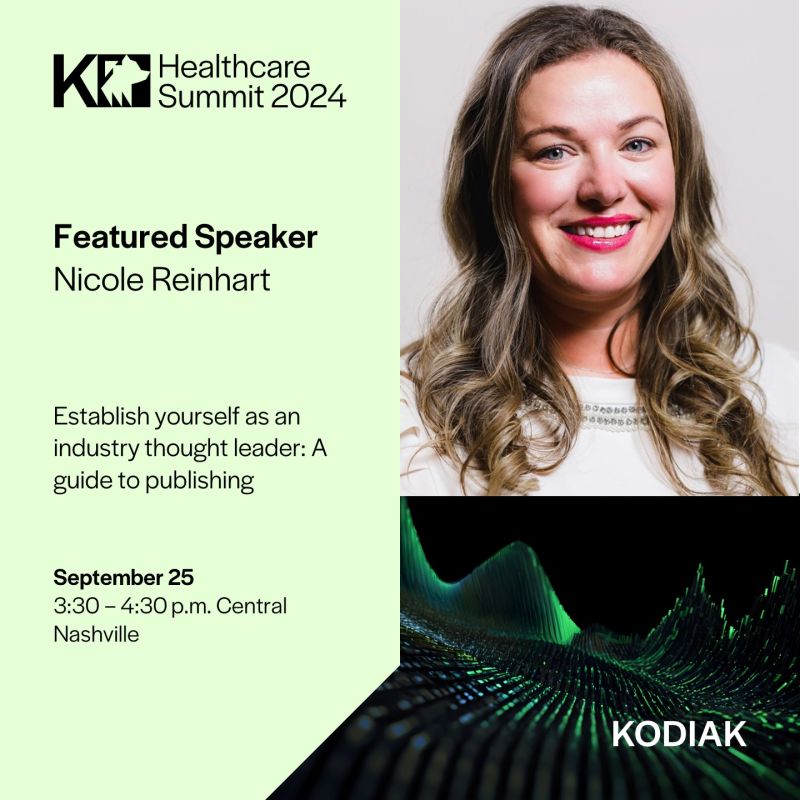
At Kodiak's 2024 Healthcare Summit, Reinhart co-led a session with Belle Ruiz and Ritika Strauss called “Establish yourself as an industry thought leader: A guide to publishing.” The topic brought her career into a neat loop. Healthcare finance leaders who were accustomed to analyzing operations were learning to turn their observations into public work. The workshop covered publishing formats, social platforms, personal brands and a three-part standard: useful thought leadership should be interesting, informative and present.
Reinhart had supported the Summit from behind the scenes for ten years. Stepping forward was not a sudden reinvention as an influencer. It was an editor admitting she had something practical to teach. Her line about expertise belonging to the masters of the craft is also a compact correction to a common corporate habit. The marketing department need not manufacture an executive's opinions. It can notice what a specialist has learned, ask the follow-up question and shape the answer without stealing its fingerprints.
WHO learned this through practice?
WHAT can another operator use?
WHY does it deserve attention now?
This is especially useful in a business where trust accumulates slowly. The claims are technical. The audience has heard promises before. A precise observation from someone who lives with the problem carries more weight than an adjective polished in a campaign meeting. Reinhart's job is not to remove complexity until nothing remains. It is to arrange complexity so a busy person can enter it.
The useful conversation after the agenda
Reinhart's public writing is often most revealing when it turns away from the official program. After an annual Healthcare Financial Management Association gathering, she described a customer dinner where people traded their healthcare “origin stories.” One guest had taken a back-office revenue-cycle job in college so he could stop bartending; it became a career spanning decades. Others arrived through accounting or operations. Reinhart, naturally, came through publications and associations.
The anecdote shows what she notices. Titles dissolve and the route into the work becomes the story. It also explains why customer events matter beyond the stage. At a Kodiak Revenue Circle, she highlighted a guacamole competition, stargazing and a visit to the San Diego Zoo Safari Park alongside the formal learning. People disclose more of what they know when an event makes room for them to be people.
Her humor is small-scale and observant. In one post, Reinhart introduced “Driveway Economics 101.” While she worked during the summer, her older son made bracelets and necklaces, set prices and greeted neighbors as if each were his most important customer. His sign spelled necklace “neckless.” Reinhart elected to call it a branding decision. The joke contains a miniature marketing department: product, price, service, copy and the mature judgment to know when an imperfection gives the whole thing charm.
“Sometimes the most memorable conversations aren’t on the agenda.”Nicole Reinhart
Cultivation, not content
Away from work, Reinhart describes herself as an amateur horticulturalist. She reads, listens to podcasts and travels internationally. Gardening supplies an almost suspiciously tidy metaphor for her professional style, but it is worth risking: expertise cannot be assembled on demand like flat-pack furniture. It grows through seasons of practice. The editor can improve the light, remove clutter and help the strongest thing become visible.
Her community work follows the same patient rhythm. She volunteered nationally with Chi Omega for thirteen years, including editorial-board and Chicago alumnae roles. She spent seven years on the Ball State University Club of Chicago board. Her professional affiliations have included the American Marketing Association and Healthcare Financial Management Association. These are not dramatic plot turns. They are the connective tissue of a career built inside an industry rather than merely adjacent to it.
Now the executive title sits at the top of the biography, but the old habits remain underneath. Find the person who knows. Ask what changed. Look for the stubborn detail. Give the reader a reason to care without shouting at them. In a field animated by enormous datasets and narrow operational questions, Reinhart's contribution is a human one: she helps the people who understand the numbers explain what the numbers are trying to say.
The newsroom is still a useful machine
There is a practical model here for any company selling work that requires a glossary. Treat the organization as a network of beats. Product leaders cover the roadmap. Customer teams hear the objections before anyone else. Analysts see patterns forming in the data. Consultants know which tidy framework breaks when it meets a real operating room. Marketing can connect those desks, test the significance of what they are hearing and publish only after it has found the person with standing to say it.
That model requires restraint. An editor does not improve a story by placing herself in every paragraph. She improves it by asking for the missing number, spotting the unsupported leap and protecting the sentence that carries the voice. Reinhart's public emphasis on expert ownership implies the same division of labor. The specialist supplies earned judgment. The marketer supplies form, timing and distribution. The reader gets an idea with both fingerprints and utility.
It also produces a different kind of listening. Customer success stops being a downstream department and becomes a reporting bureau. Events stop being stages with coffee and become opportunities to collect the language people use when they are no longer reciting a job description. A dinner-table origin story can explain a profession's pull. A colleague's conference presentation can reveal the work a team is proudest of. Even a driveway jewelry stand can refresh a CMO's sense of what makes a customer feel seen.
Reinhart's route from newsroom to boardroom is therefore less a career switch than a widening aperture. The subject stayed remarkably consistent: how the business of healthcare works, who understands it and what the rest of the industry should hear from them. The publication changed. First it was a magazine or newsletter. Now it is a company, its events, its customer relationships and every useful explanation it can send into the world.