Fashion is exceptionally good at entrances. The curtain parts, the box opens, the model turns, the new season appears with the confidence of a person who has never met a returns portal. Nicolas Capuono has built a career around everything that follows. The card may fail. The parcel may dawdle. A blouse that looked decisive online may, under the honest light of a bedroom, look as though it has its own small grievance. Then the customer meets the company for real.
Capuono is now listed as chief executive of DAILYLOOK, the Los Angeles personal-styling business that sends women a selection of clothes to try at home. Before that, his public career ran through the customer organization at Adore Me, the digital intimates company acquired by Victoria's Secret & Co. at the end of 2022. Earlier still came Webhelp and the world of outsourced service operations, where success is counted in queues, response times and what happens when Valentine's Day produces considerably more calls than romance.
It is a useful route into fashion because it begins with consequence. Marketing makes a promise; operations discovers whether the promise was properly dressed. Capuono's subject, across interviews and case studies over several years, has remained remarkably consistent: customer experience is not a decorative layer. It is the arrangement of choices, systems and human judgment that lets a shopper feel informed rather than managed.
The fitting room moved home
DAILYLOOK's proposition is simple to describe and difficult to execute. A client completes a style profile. A stylist selects seven to twelve pieces. The box arrives; the client tries everything on, keeps what works and returns the rest. Later feedback is supposed to sharpen the next selection. The fitting room has moved into the home, but the retailer must somehow preserve the useful part of a shop assistant while dispensing with the awkward hovering.
The merchandise matters, naturally. Yet a styling service is also a memory business. It must remember that “not this” may mean the cut, not the color; that budget is not an aesthetic failure; that a life containing school runs, office days and dinner plans cannot be reduced to “casual.” Each box is an argument made in fabric. Each return is an editorial note.
A professional biography credits Capuono with leading DAILYLOOK through a fivefold increase in revenue over three years, reaching $150 million, while maintaining profitable growth. The striking word is not fivefold. It is profitable. In 2022, amid the exuberant hangover of easy ecommerce money, he said hypergrowth without profitability was no longer relevant. It was a blunt sentence, delivered by someone who had seen the machinery behind a beautiful storefront.
A career measured in frictions removed
Capuono attended HEC Paris from 2005 to 2009. His early work at Webhelp placed him on the service-provider side of the table, managing a portfolio of major accounts. That experience left him with a maxim he now teaches: much of a partnership's success is settled in the first negotiation. The statement lacks the glamour of a keynote revelation, but it has the virtue of being true before the champagne and after the invoice.
At Adore Me, he moved from customer-relationship leadership to vice president of customer engagement and then chief customer officer. The titles grew broader because the problem did. A shopper does not divide her experience into the departments printed on an organization chart. She sees one brand. A slow refund cannot be excused by an excellent advertisement. A charming service agent cannot permanently rescue a confusing membership. If the checkout, warehouse, call center and product page tell four different stories, the customer hears noise.
Capuono's public comments show an operator trying to make those stories agree. He spoke about keeping payment choice useful but not overwhelming. He described returns as a pair of trust decisions: whether to refund before the item reaches the warehouse, and whether to let a customer reorder without paying twice while the first purchase travels backward. He discussed responding to product reviews, including negative ones, and feeding what shoppers said back into design and fit.
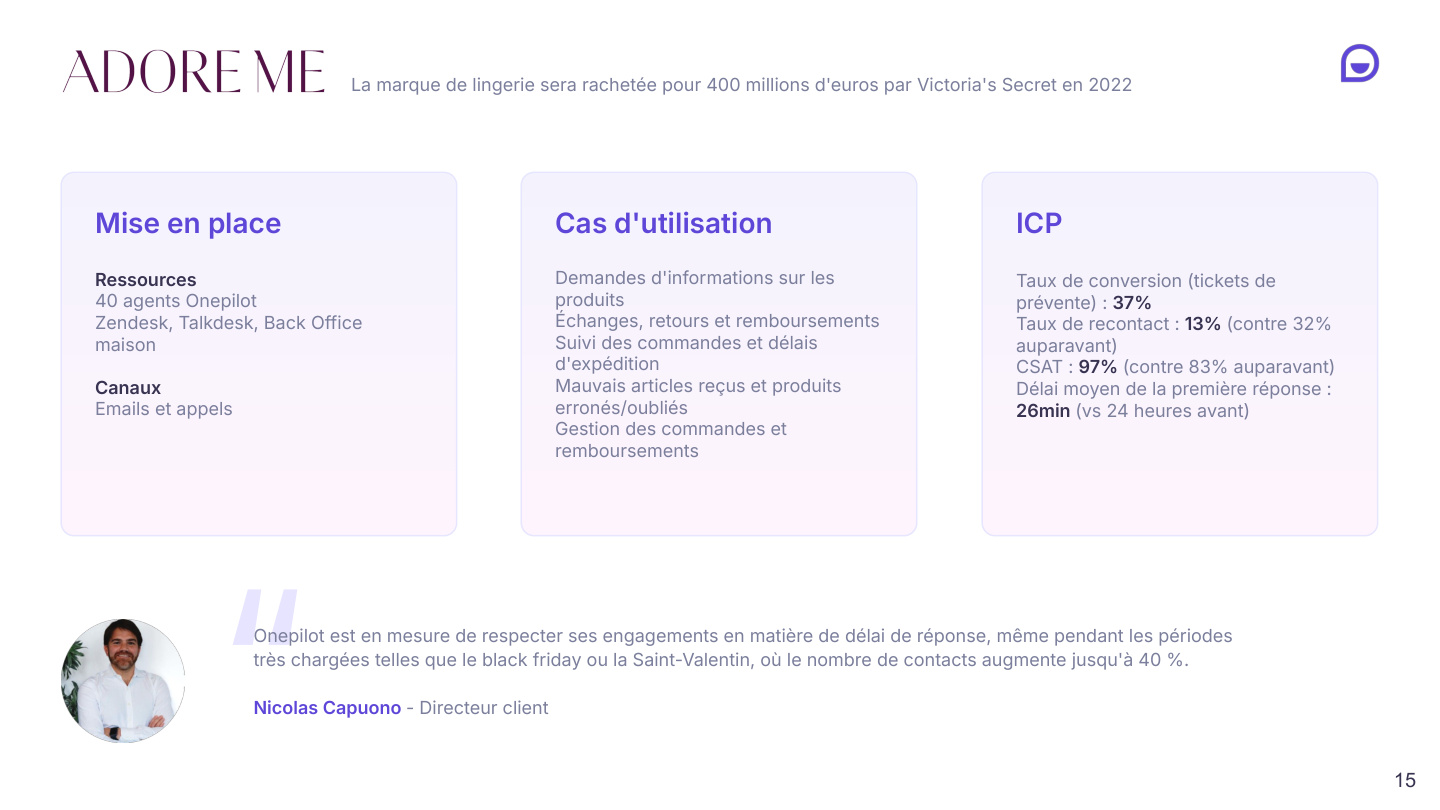
One service-partner scorecard attached to his Adore Me work makes the philosophy concrete. It recorded customer satisfaction rising from 83 percent to 97 percent, first response falling from 24 hours to 26 minutes and repeat contact dropping from 32 percent to 13 percent. Those numbers are not a personality profile. They are evidence of a system becoming less annoying.
The human being in the livestream
In 2022, Capuono described Adore Me's experiments with live shopping. During a broadcast, he said, the format could account for 10 to 20 percent of revenue at that moment. The surprising lesson was not about cameras. It was about expertise. The host did not need to be a professional presenter. The useful host was someone who knew the product and could explain why it had been made.
That preference reveals something about his idea of personalization. It is less about performing intimacy than supplying context at the instant context is useful. A shopper wondering how a garment fits does not need an influencer's life story. She needs a candid answer. The technology earns its place by shortening the distance between a question and someone qualified to answer it.
The same restraint appears in his view of delivery. Ecommerce spent years training customers to expect speed as if every parcel contained a spare heart. Capuono argued for something more adult: clear options, explicit tradeoffs and an experience that feels dependable. Slower shipping may be compatible with sustainability; premium speed may deserve a fee. The important thing is that the customer understands the bargain.
This is customer centricity with its sleeves rolled up. It is easy to declare affection for shoppers in a values statement. It is harder to decide which promise the warehouse can keep on a wet Tuesday, how much choice a checkout can bear, or when trust is cheaper than verification. Those decisions accumulate. Eventually they become what the customer thinks the brand is.
Growing inside a much larger wardrobe
Adore Me's growth provided an unusually public test of these ideas. Capuono joined to take over customer care while the company was expanding quickly. A current teaching biography says he accompanied its climb from roughly €30 million to €300 million in revenue. By fiscal 2022, the company generated an estimated $250 million in profitable sales. Victoria's Secret & Co. completed its acquisition that December in a transaction carrying an approximately $400 million cash purchase price.
It would be neat, and wrong, to turn one executive's function into the whole explanation for that outcome. Companies are ensembles. Capuono's contribution is more specific: he helped build the customer machinery during the climb. Retention, outsourced call centers, post-purchase journeys, payments and service are not the poster. They are the frame that keeps the poster on the wall.
DAILYLOOK now gives him a variation on the same challenge. The service promises a dedicated stylist and a better wardrobe without the expedition to a mall. That requires technology, but technology in the supporting role. The stylist must have enough information to exercise taste; the client must have enough control to reject it; the company must learn without becoming creepy; the economics must survive free shipping both ways. Personalization is a lovely word. Reverse logistics is what happens when it becomes real.
The sale after the sale
Capuono's career offers no grand theory of fashion, which may be its charm. It offers a practical theory of loyalty. Give people choices, but not a maze. Use data, but return it to human judgment. Make the return as considered as the sale. Let the person explaining the garment actually know the garment. Measure the queue because waiting is an emotion with a timestamp.
There is also a quiet rebuke here to the industry's fixation on acquisition. The first purchase is expensive to win and easy to celebrate. The second is earned in less photogenic ways: a refund that arrives when promised, a stylist who remembers the note, a box that is better than the last one, a service reply that sounds as though someone read the question. The customer comes back because the company did.
Fashion will keep staging entrances. It should. Drama is part of the pleasure. But somewhere behind the velvet rope, the more durable business is being built in ordinary minutes after checkout. Nicolas Capuono has spent years there, among the parcels and preferences, making the case that the end of a transaction is merely the beginning of a reputation.