On a night in 2000, Nick Bauer put a few Volvo oil filters on eBay. They belonged to the inventory of Foreign Car Parts of Groton, the Connecticut shop his parents, Harry and Kathy, had owned since 1986. The filters sold. Then more parts sold. Bauer had discovered that a dusty shelf in a local store could face the whole country, twenty-four hours a day, without asking anyone to ring a bell at the counter.
There was no stirring garage revelation, no napkin covered in venture-capital hieroglyphics. There were oil filters, a dial-up-era marketplace and a young operator willing to see whether strangers would buy something as stubbornly practical as routine maintenance. The experiment worked so well that Bauer soon graduated from listing parts in his free time to doing it on company time. In 2001 he registered fcpgroton.com. By December, the website was selling more than the physical store.
The moment looks obvious only from the far side of history. E-commerce was young, and automotive parts were hostile material for it. A shirt is small, medium or large. A control arm may depend on the model, production date, engine, suspension and the caprice of an engineer in Stuttgart. Selling parts online meant translating the accumulated judgment of a good counterperson into data a website could understand.
The first operating system
A childhood spent behind the counter
Bauer had been learning that judgment since he was 12, helping around his parents' store. In his teens, he improved how the shop organized and cataloged automotive information. His father also made him tear down and rebuild a vehicle. Years later, Bauer supplied the reassuring postscript with a grin: yes, it got back on the road.
The experience did not turn him into a founder eager to play master mechanic. Bauer has described cars as a small passion and called himself more businessman than mechanic. What he loved was running a business for car enthusiasts. It is a revealing distinction. The machine that absorbed him had customers, inventory, fitment records, warehouse aisles and cash flow.
“Cars are a small passion of mine, but what I really love is running a business for car enthusiasts.”Nick Bauer
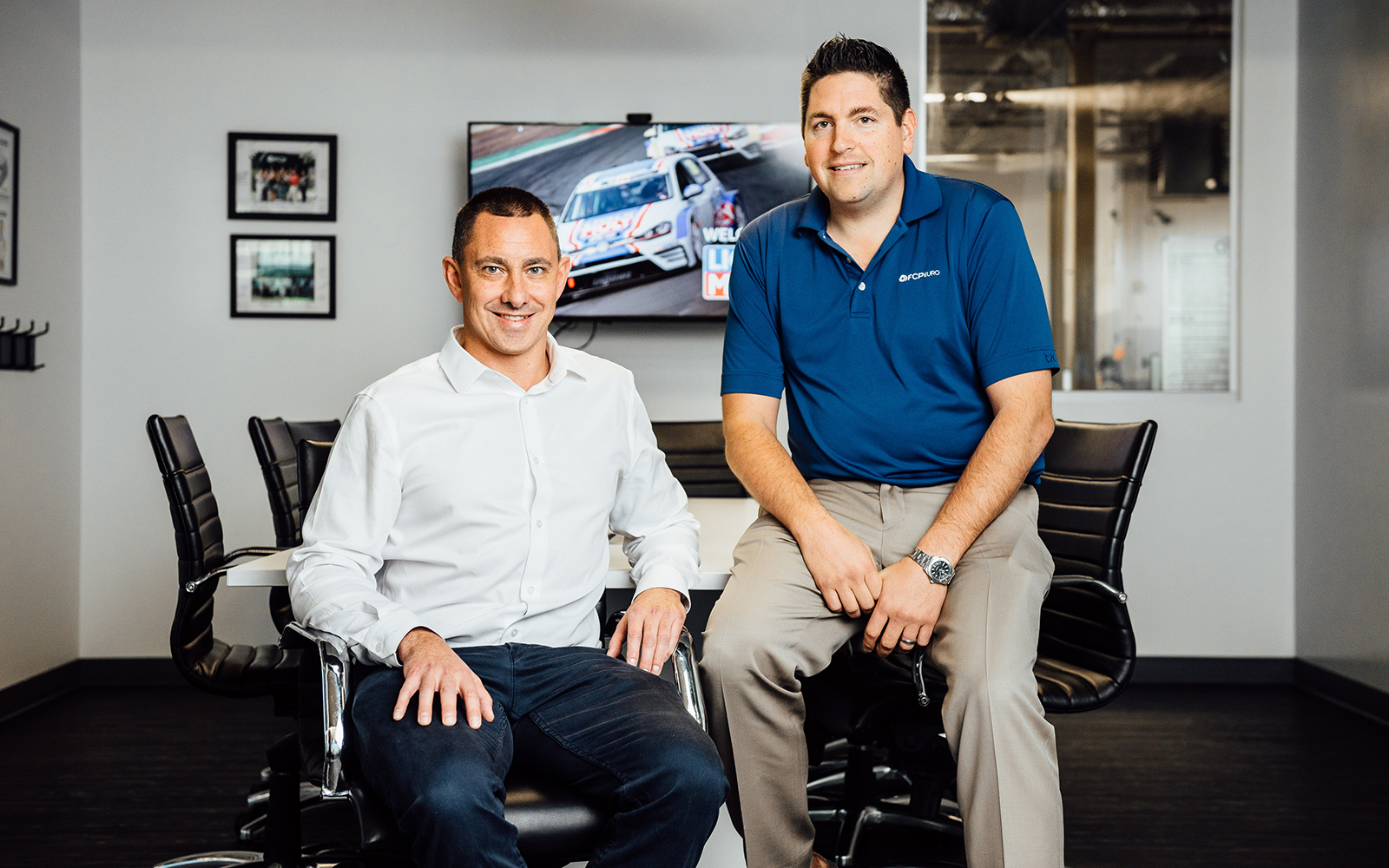
Scott Drozd, Bauer's best friend since the two were 12, became the other essential piece. Drozd's first employment at the family business in 1998 ended with a wrecked delivery truck and a resignation, a brief career with the comic proportions of a sitcom pilot. He came back in 2002. Drozd concentrated on eBay while Bauer developed the website. They had five employees, two computers, a 2,000-square-foot office and a tractor-trailer loaded with stock.
They did not merely place individual parts on digital shelves. They built kits around actual repairs, grouping what a customer would need to finish the job. They participated in enthusiast forums. They expanded the catalog around Volvo, Saab and BMW, then other European marques. The work was repetitive, exacting and difficult to summarize at a cocktail party. It was also the work.
A repair kit carried a small but consequential idea: the seller should understand the customer's afternoon. A water-pump job may require seals, bolts or fluid that are easy to forget when every item sits on a separate product page. Bundle them correctly and the box contains fewer surprises. Describe the fitment precisely and a driveway does not become a waiting room for a second shipment. This was the old counterperson's craft rendered in fields, relationships and search results. FCP Euro's early advantage came from doing that translation patiently, then allowing the same knowledge to serve the next customer without making the first customer repeat the question.
Growth without magic
The warehouse keeps getting smaller
By 2003, the operation had moved into an adjacent building. In 2007, after reaching $8 million in annual sales, it moved again, this time to a larger facility in Old Saybrook. Bauer and Drozd invested in warehouse and order-management systems and hired people to carry the knowledge that had once lived behind the Groton counter.
The two friends brought different appetites to the same table. Drozd gravitated toward personnel and customer service. Bauer was stronger in analytics. Their partnership gave the company both a host and a calculator. When Drozd predicted in 2008 that the business would one day top $100 million, Bauer's father looked at him as though he had proposed delivering parts by zeppelin.
Twenty-three years in four turns
The prediction eventually proved conservative. Yet the line from $8 million to $200 million was not smooth, and Bauer has never needed to pretend otherwise. One episode in 2010 matters more than a shelf of awards. Seeking better margins, the company sourced parts from China. Several ball joints in a BMW E38 center link separated. One of the parts had been sold to Drozd's sister.
FCP Groton filed a recall through the National Highway Traffic Safety Administration. Bauer later called the recall the company's worst day. It was a painful admission with a useful consequence: the company hardened its rule on quality. If the team would not put a part on its own car, it would not sell the part to a customer.
“If we wouldn't put it on our car, we won't sell it to you.”
Corporate values are often polished until they reflect nothing. This one retained the scratch that produced it. The recall transformed quality from a preference into a boundary. FCP narrowed its attention to European vehicles, closing its original store and its Japanese-focused FCP Import operation in 2013. A purpose-built Milford headquarters followed in 2014, the same year Bauer and Drozd bought out Harry and Kathy Bauer and allowed the first generation to retire.
A promise with a balance sheet
Replacing the reason to leave
FCP Euro's lifetime replacement guarantee became the public expression of that inward discipline. Eligible parts could be returned for replacement after use, including familiar consumables such as brake pads and wiper blades. On first hearing, the policy sounds like a dare issued by someone who has misplaced the finance department.
Its logic is calmer. A customer who trusts the guarantee has fewer reasons to restart the shopping process elsewhere. The policy makes the next sale easier, but it only works when the catalog is accurate, the product is sound and the service team answers the awkward questions. The guarantee is therefore less a stunt than a public audit of the system behind it.
Education became another part of that system. FCP Euro built a library of repair articles and videos for do-it-yourself owners. By 2023 the company said its YouTube channel had accumulated 63 million views and 290,000 subscribers. The retailer had become a repair school with a warehouse attached, helping customers understand the job before offering to fill the box.
“I would tell UConn business students that you have to take risks in life. But above all, you have to have passion about what you're doing.”Nick Bauer
Then came the race cars. A small sponsorship in 2016 expanded into an in-house effort, and staff from shipping, service, procurement and other departments helped build a Mercedes C300 in the distribution center entrance. The car won its first race. By 2018, FCP Euro was running two Volkswagen GTI TCR cars in professional competition.
Racing gave the company a form of proof that a banner advertisement could not. Parts were being tested where failures are expensive and excuses look silly. Employees signed the cars. Vendors became sponsors. Customers encountered the company in the paddock, where an enthusiast can distinguish participation from costume at twenty paces.
The counter travels west
Scale, with the old store still inside it
In October 2023, FCP Euro announced a $25 million minority Series A investment for geographic expansion. The company reported more than 1.2 million customers, over 240 employees and a decade-long compound annual growth rate of 30 percent. Its Mesa, Arizona, distribution center added 146,000 square feet to the network and made faster western deliveries possible.
Bauer's public language at that moment returned to continuity. He and Drozd would keep leading what they had started more than two decades earlier, he said, with the customer and employee first. In 2026, marking FCP Euro's thirteenth appearance on the Inc. 5000, he credited investments in people, inventory, content and brand. Growth remained a collection of operating nouns.
The company is larger, the shelves are taller and the delivery radius is wider. Still, its central proposition would be understood by Harry and Kathy at the old Groton counter: know what fits, sell something worthy of the car, and remain available after the receipt prints. Technology allowed that proposition to travel. Bauer's contribution was to notice the journey could begin with something as ordinary as an oil filter.