A founder's succession brief contains an awkward instruction: remove the founder. William “Bill” Donovan had spent nearly four decades at the helm of the Pennsylvania advertising agency bearing his name. He knew how to clarify a message, choose a channel and ask an audience to act. The final audience was himself. The action was to step aside without watching the enterprise step backward.
By the time Donovan began planning an exit, his firm had accumulated the layers that long-lived agencies tend to acquire. Donovan Advertising worked across brand development, trade communication, consumer promotion, public relations, media planning, digital marketing and social media. Its current menu stretches into events, retail, analytics, creative work and web development. The tools had changed since the agency's early years. The responsibility had not: clients still expected someone to turn a commercial problem into a useful idea.
Donovan was considering a valuation and the familiar routes out, including a sale or merger. Then the pandemic made the usual arithmetic unreliable. Buyers, forecasts and appetites changed at once. A plan intended to settle the future suddenly belonged to a past set of conditions.
The answer was already on the payroll
Ryan Donovan had worked at the agency for years. By this point he was taking on broader general-management duties, serving as chief operating officer and overseeing the staff. He did not arrive with a glossy acquisition deck. He asked his father four words: “What about me?” In a business built on pitches, brevity finally won.
The question was simple; its consequences were not. Family-business transitions make two conversations occupy the same room. One is about competence, capital, authority and risk. The other is about parents, children, identity and the private meanings attached to a surname. A stranger can be evaluated against a job description. A son brings an entire history to the interview.
Bill's answer was that Ryan was ready. Father and son invited family-business adviser Lizette Dubacher of Compass Point into the process. The decision therefore became more than a handshake across the dinner table. It became a 28-month operating project with explicit goals: a scalable and profitable company, a smooth handoff, a stronger leadership team, disciplined processes and a path for the founder to leave.
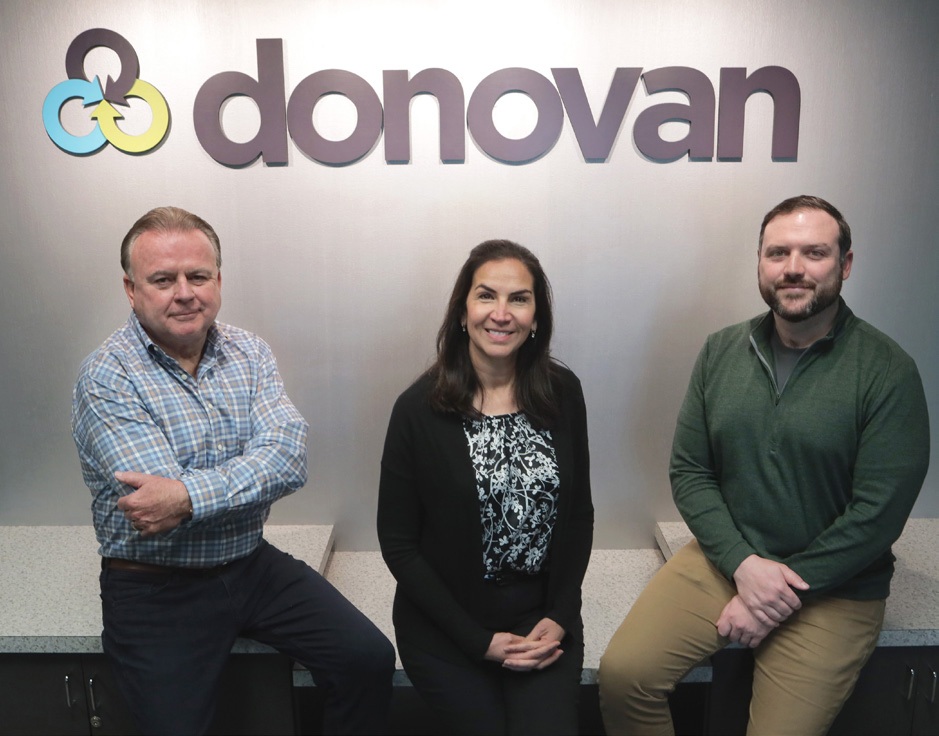
A surname is not a succession plan
The work focused on what an organization needs when authority moves. Middle managers received wider responsibilities, filling gaps that a founder can otherwise cover by instinct. The leadership group worked toward clearer alignment. The business adopted a more focused, goal-oriented rhythm for running and growing the company. An employee survey later described the culture as solid and the leadership team as positive, happy and motivated.
These details matter because succession is often narrated as a ceremonial exchange of keys. In practice, keys are the easy bit. Judgment has to be distributed. Colleagues must know who decides, and the new chief executive must be allowed to decide differently. The old chief executive has to resist becoming an unofficial court of appeal. When staff members can still walk past the founder's office, the org chart alone cannot settle the question.
The founder's brief
Leave a company, not a dependency
- Create a clear exit path
- Protect family interests
- Improve profit and resilience
The operating answer
Put authority where the work happens
- Develop the leadership team
- Expand middle-management roles
- Use goals and repeatable rhythms
The reported numbers give the handoff a sharper outline. Between 2021 and 2023, net profitability tripled while revenue stayed flat. The agency also closed several new-business deals and described its pipeline as strong. Flat revenue paired with rising profit suggests an operating change rather than a fortunate sales spike. The public account does not break out the calculation, so the honest conclusion is the narrow one: during the transition period, the business reported becoming much more profitable without becoming larger at the top line.
2021 to 2023
The profit was in the plumbing
The threefold profit figure changes the texture of this story. A family handoff can be treated as sentimental, the commercial equivalent of passing down a watch. Here, the work reached into how the place ran. Responsibilities moved outward. Organizational gaps were named. Goals became more explicit. Those are unphotogenic improvements, which is precisely why they are easy to miss. A new logo announces itself in a day. A manager who knows exactly what she owns may take months to show up in the accounts.
Advertising agencies make this problem particularly vivid. Much of their value lives in relationships, judgment and accumulated context. A founder often remembers why a client dislikes a certain color, which promise was made during a difficult quarter, or how a team performs when the deadline gets mean. None of that arrives preloaded with a successor's title. It must be shared, documented or relearned. The Donovans' 28-month timetable gave the organization space to move that knowledge while Ryan was already running staff and taking on general-management work.
The process also tested whether the agency's identity could stretch. “Donovan” was both the company name and the founder's name. Under Ryan, it would remain his name too, but the signature on the door could not substitute for confidence from employees or clients. Bill's agreement answered the family question. Wider authority for managers, a more disciplined cadence and a functioning leadership team answered the business question.
There is a modest discipline in reporting flat revenue alongside rising profit. Growth stories usually prefer the loudest number available. This one points toward efficiency and management. The agency did not claim that a flood of sales solved succession. It described a company learning to make more of the business it already had while preparing new deals. For a founder deciding whether the operation can live without him, that is unusually relevant evidence.
The useful half of a legacy
Donovan's long career began with an education in communication. He attended Syracuse University from 1974 to 1977 and publicly identifies himself as a Newhouse School alumnus. The agency he later built remained rooted in Lancaster County rather than migrating toward a larger advertising capital. Its home is Lititz, a small Pennsylvania borough where the distance between a founder's office and his successor's could be measured in doors.
That local attachment also appears in Donovan's civic résumé. His professional profile lists service with the Lancaster Conservancy and Lancaster YMCA, a past presidency of the Lancaster Ad Club, a state communications role for the Hugh O'Brian Youth Foundation, and a vice chair position connected to a Junior Achievement invitational. The list reads like the geography of a working life: advertising, community, youth and the county around the agency.
Longevity can turn an agency into a museum of its own habits. Donovan's firm instead kept adding disciplines. Its present work runs from physical retail and experiential campaigns to performance analytics and social media. Its portfolio includes packaging and launch work for a Coleman Natural and Budweiser collaboration, a community food-truck launch for Rocky and Rosie, and a launch for the plant-based food company Everything Legendary. The examples are contemporary, retail-minded and far removed from a shop preserved in amber.
That adaptability gives the succession its point. Keeping a company in the family only works if “keeping” does not mean freezing. Ryan's preparation came from expanding his role inside the operating business. Bill's contribution was to recognize that preparation, submit the choice to a structured process, and allow responsibility to spread beyond father and son. Family continuity was the outcome; management depth was the method.
There is also a pleasing piece of advertising logic in the story. A good campaign makes the product less dependent on the people who conceived the ad. It gives the idea a life in the audience's mind. A well-made company should be able to do something similar for its founder. It can retain his name, standards and accumulated trust while no longer requiring his hand on every decision.
The brief after the brief
By August 2024, the transition of leadership and ownership to Ryan was described as successful and on track. Bill was identified as the former chief executive; Ryan as the current one. The agency remained family-owned. That status carries no guarantee, only a useful test. The second generation now has to earn from clients and colleagues what the first generation once built from scratch.
For Bill, the measurable achievement sits beside the less measurable one. Profitability improved, the pipeline filled, and new business closed. Meanwhile, a founder accepted that preserving his work required him to stop being its central operating fact. Many leaders enjoy the language of legacy because it sounds like possession. Donovan's version involved relinquishing possession in a controlled and deliberate way.
His son's original question still supplies the neatest line in the account. “What about me?” contained ambition, but it also forced a decision that spreadsheets could not make. Bill Donovan had spent a career helping brands identify the audience already in front of them. When his own plan broke, he finally did the same.
Continue reading