She was at Google, leading global marketing for Android Wear and Google Fit, and the path ahead was completely visible. Not exciting - visible. "Almost like a step-by-step recipe to success," she would later write. That predictability was the problem. Anne-Laure Le Cunff didn't burn out from overwork. She burned out from knowing exactly what came next.
Paris-born, London-based, and constitutionally allergic to jargon, Le Cunff built Ness Labs in 2019 the way a scientist builds an experiment: with a hypothesis (writing helps you learn), a method (weekly newsletter), and no fixed idea of what success would look like. Within two months, 3,000 strangers were reading her. Within a year, she had quit her day job. Within five years, she had 124,000 paid Substack subscribers, a doctorate from King's College London, and a book published by Penguin Random House.
None of this followed a formula. That was, in a precise sense, the point.
The newsletter began as a study tool. She was applying "The Generation Effect" - the neuroscience principle that writing about something helps you retain it - to her own enrollment in an MSc program in Applied Neuroscience. The newsletter wasn't a product launch. It was a learning experiment that accidentally became a business. By March 2020, during the first pandemic lockdown, readers started asking for community. She gave them one. By October, Ness Labs was generating $10,000 a month in recurring revenue. By December, she had gone full-time. No co-founder. No investors. No pitch deck. No product-market fit deck. Just a community of people who wanted to think better.
Between 2020 and 2024, she ran Ness Labs while simultaneously pursuing a PhD at King's College London's Institute of Psychiatry, Psychology and Neuroscience. Her research was not theoretical: she used EEG headsets and eye-tracking technology to study cognitive load in neurodivergent versus neurotypical learners in online education environments. The project, NeurOnlinEd, asked a practical question - are we building online learning for the wrong brain? - and answered it with data published in peer-reviewed journals.
2024 was, by any measure, an unusual year. She completed the PhD. She wrote the book. She quit alcohol. She bought a house. She froze her eggs. She swam with whale sharks. "I danced a lot," she noted in her annual review, "and felt quite lost sometimes." The combination of achievement and candid uncertainty is distinctly hers. She has no interest in presenting a polished version of the journey.
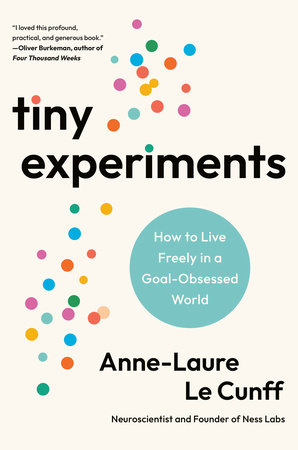
March 4, 2025: Tiny Experiments: How to Live Freely in a Goal-Obsessed World hit shelves published by Avery (Penguin Random House). The argument, shaped by years of neuroscience research and her own serial experimentation, is direct: the goal-setting industrial complex has it backwards. Life is not a project with deliverables. It is a series of experiments with findings. Failure is data. Uncertainty is not a problem to solve but a space for metamorphosis. Oliver Burkeman called it "profound, practical, and generous." Adam Grant called it "thought-provoking." Ryder Carroll, who invented the Bullet Journal, called it one of the best productivity books he'd read. She narrated the audiobook herself.
The same year, she gave the opening keynote at SXSW EDU 2025, delivered a TEDxNashville talk - "How tiny experiments can set you free" - and continued publishing research notes on Hypercurious, her second Substack, which launched in September 2024 and grew to 124,000+ subscribers faster than almost anyone expected. The Hypercurious beat: ADHD, curiosity, and what evolutionary neuroscience tells us about minds that don't quite fit the world we've built for them.
She is now a UKRI-funded postdoctoral researcher in Professor Eleanor Dommett's ADHD Research Lab at KCL, studying the evolutionary neuroscience of curiosity alongside the spectrum of traits associated with ADHD. She publishes academic papers and newsletter issues with equal regularity. She is also, when pressed, still the founder of Ness Labs - a bootstrapped community that has never taken a dollar of external funding and remains, seven years in, a going concern.
In a 2025 Microsoft WorkLab podcast, she reframed the entire goal-setting conversation in one sentence: "Success is not reaching a desired outcome. Success is learning something new." This is not a platitude. It is the operating system she has run on since she left Google with no plan and no runway and started writing about what she was learning because writing was how she thought clearly.
She still does. Every week, without exception.