Before Neill S. Wright started looking for overlooked founders, he watched a banker leave for work. His father ran Beneficial National Bank in Wilmington, Delaware. Years later, Wright remembered the daily example: “I watched him get up every day and go to work early.” Its appeal lies in the ordinary scene: someone keeping regular hours in the business of other people’s ambitions.
Wright grew up in Wilmington and attended Sanford School in nearby Hockessin. He graduated from William & Mary, then built a career in corporate finance. At JPMorgan and Citigroup, his work involved middle-market businesses across North America: arranging transactions, structuring investments and managing the consequences after the paperwork was signed. The sequence matters. He came to entrepreneurship through the machinery that finances companies, with its attention to how a business actually operates.
He later helped found Harbour Place Capital, advising growth businesses in energy, technology, media and telecommunications. That widened the range of companies on the other side of the desk. A software founder and an energy executive may have different vocabularies, but both eventually have to explain what the money will do. Wright had spent years listening to those explanations before he began writing early venture checks.
The bank behind the investor
First Tuskegee Bank brought the work closer to the ground. Wright became its chairman, president and chief executive, and also led Birthright, the holding company that owned it. His father had acquired and rebuilt the institution, whose history reached back to a bank established by Booker T. Washington in 1894. For Wright, the assignment joined a family undertaking to a much older tradition of financing Black enterprise.
He led the bank through the Great Recession. In his account of that period, the significance of lending extended through business owners to their customers and communities. That is a practical way to learn economic development: a small company’s financing decision can affect people who will never meet the banker. Running the institution also meant operating inside a regulated business, where an attractive idea still needs a workable balance sheet.
After nearly a decade leading First Tuskegee, Wright helped navigate its sale. The next chapter began with conversations about technology and regional development with John O. Hudson III, then working in economic development at Alabama Power. Their shared interest was the financing gap facing young companies. Wright’s move toward venture capital would keep the community focus of banking while taking him earlier into a business’s life, before conventional financing was likely to arrive.
A first check in Birmingham
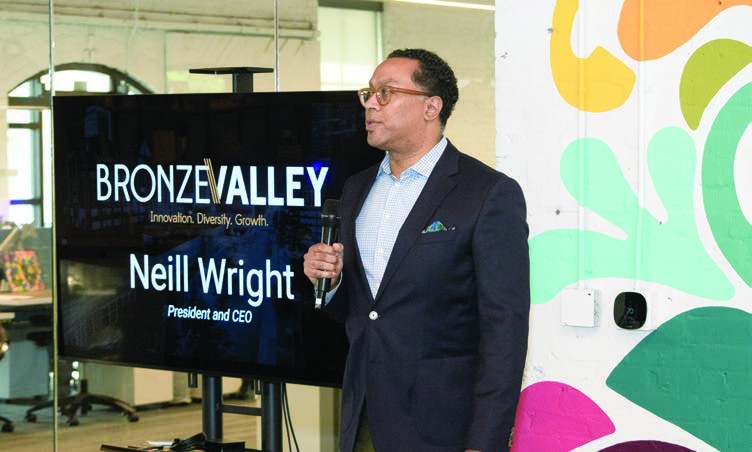
Bronze Valley launched in late 2017. Wright moved from Montgomery to Birmingham in 2018, as the city’s technology ambitions were attracting attention. Target’s $550 million acquisition of Shipt supplied a conspicuous example of what a local startup could become. An acquisition, however, does not automatically furnish the next founder with an investor’s telephone number. A city can celebrate an exit and still leave its beginners outside the conversation.
The organization’s first investment, in November 2018, went to Mixtroz, the event-technology business founded by Kerry Schrader and her daughter Ashlee Ammons. The company helped people make useful connections at gatherings. There is a pleasing symmetry in that choice: an investor concerned with access backing a company concerned with introductions. Mixtroz moved from Nashville to Birmingham, with Bronze Valley among the relationships that helped draw it there.
The broader purpose was to reach entrepreneurs whom established venture networks were missing, including women and founders of color. Bronze Valley operated as a nonprofit venture organization and earned Community Development Financial Institution certification in 2019. The structure placed startup investment alongside an economic development mission. For Wright, the question of a company’s prospects could sit beside another question: what might its growth make possible in the place where it was being built?
- WilmingtonA banking family
- New YorkCorporate finance
- TuskegeeRunning a bank
- BirminghamBuilding Bronze Valley
- DelawareExpanding VentureLab
Five companies, twelve weeks
In 2020, Bronze Valley partnered with gener8tor to create VentureLab. The collaboration acknowledged a recurring difficulty for early founders: receiving capital and knowing how to use the next six months are separate accomplishments. Advice about customers, pricing, product decisions and fundraising can influence whether the investment gets a useful chance to work. A check clears quickly. A reliable sales process tends to be less punctual.
The programs now address different starting points. gALPHA supports the development of ideas and teams. The seven-week gBETA pre-accelerator offers coaching without taking equity. The investment accelerator works with five-company cohorts over twelve weeks, with each selected business receiving $100,000 in exchange for 5 percent equity through a Simple Agreement for Future Equity. Participation is in person in Birmingham or Wilmington.
The offer includes mentor and investor introductions and access to experienced operators. Those details give the mission a schedule and a cost. A founder can distinguish a free preparation program from an investment carrying an ownership stake. Small cohorts also give advisers fewer companies to divide their attention among. The arrangement reflects an operating decision: make the help specific enough that a founder can put it to work.
The road goes back to Wilmington
Delaware brought Wright’s career back toward its beginning. Bronze Valley launched its first VentureLab cohort there in 2023, with programming connected to Delaware State University’s Riverfront Wilmington campus. Wright’s personal ties helped explain the destination. So did the presence of universities, corporations and financial institutions, alongside founders who still found venture funding difficult to reach.
At that summer’s gBETA showcase at CSC Station, five startups presented their businesses. Program leader Darren Stephenson helped connect Bronze Valley with the local community; gener8tor cofounder Joe Kirgues came from Wisconsin for the occasion. The gathering put people from different regions into the same room around companies preparing for another stage of growth. Returning home, in this instance, involved bringing a few useful acquaintances.
The continuing university relationship makes the expansion more than a traveling pitch event. Bronze Valley’s current VentureLab figures list three Delaware gALPHA cohorts and 540 student participants. The point of reaching students is to encounter talent before it has necessarily learned the language of venture capital. Someone can have a promising idea long before knowing what an institutional investor expects to see on slide seven.
A room, and a place at the table
In 2024, Bronze Valley and gener8tor opened Tech Row in Birmingham, creating a shared workspace for portfolio companies and early-stage investors. It gave the programs a physical setting and founders somewhere to spend time together between the formal appointments. The room is a modest but concrete expression of Wright’s approach: make it easier for people working on related problems to find one another.
His connections also extend into Alabama’s civic and business institutions. He is listed on the boards of the Economic Development Partnership of Alabama and TechBirmingham. The 2021 Alabama Innovation Commission report lists him among its members. These roles put a venture investor in conversations that also involve employers, universities and public officials. Startup development depends on those relationships as well as the relationship between an investor and a founder.
Metallum Ventures adds another part of his investing work. Wright is its founder and general partner, with a seed-stage focus. Pennsylvania’s economic development department announced a $2.25 million investment on its behalf in 2023 and identified Wright, Robert Crutchfield and Anthony Abney as its founders. Together, the activities show a career moving across private finance, startup support and regional institutions, with the practical business of getting capital to companies running through each.
The next problem is selling
By September 2026, Wright was discussing another obstacle: companies with products and early revenue that still lacked a repeatable way to sell. “Great products or services don’t sell themselves,” he said. Bronze Valley’s partnership with GrowthX offers a sixteen-week revenue accelerator, followed by a longer working relationship, for founders at that stage. The work turns from preparing a company to seek investment toward making its commercial activity more dependable.
Bronze Valley says more than 27 portfolio companies have completed the GrowthX accelerator, representing fifteen rising cities. Its examples include City Detect, Brevity and LiQUiD. A founder’s personal ability to win an early customer can get a business moving; building a process that colleagues can repeat is another assignment. Wright’s willingness to keep adding support addresses the less photogenic stretch of entrepreneurship after the announcement and before the business runs reliably.
Another 2026 example is Feedcoyote, the freelance collaboration platform led by Stevens Bonhomme. Bonhomme returned to Alabama through the Bronze Valley Investment Accelerator, and the company became headquartered at Tech Row. His path connects several pieces of Wright’s work: an entrepreneur with Tuskegee ties, an accelerator offering resources and relationships, and a Birmingham workspace where the business could continue developing. The sequence gives the regional strategy a person and a company to follow.
“Great products or services don’t sell themselves.”Neill S. Wright / September 2026
What he chooses to count
Bronze Valley’s current impact dashboard reports 72 investments, more than $150 million in follow-on capital raised, more than $253 million in startup revenue and over 998 startup jobs. These are the organization’s reported portfolio outcomes. They measure different things and cannot be added into a single return. Their usefulness is in showing the kinds of results Wright’s organization chooses to keep in view.
In August 2026, he also supported Delaware’s launch of Innovate Delaware, emphasizing collaboration among people and institutions. It was a familiar concern in a new announcement. His work has repeatedly involved getting investors, advisers, founders and regional organizations to act in relation to one another. The challenge changes as a company grows: first an introduction, then financing, then customers, then a team that can serve them.
Wright’s career offers a patient answer to the excitement surrounding a first investment. The wire transfer has a date. The work around it continues. From a family bank to a five-company accelerator cohort, he has kept returning to the institutions that let someone else take a commercial chance. That leaves plenty to do after the photograph, the handshake and the announcement. Fortunately, his earliest example was someone who went to work every day.
Dashboard checked October 21, 2026. Organization-reported outcomes, not investment returns.