It is easy to mistake venture capital for a money business. Bronze Valley has spent eight years arguing, in effect, that the scarce product is access. A founder outside the familiar coastal circuit may need cash, certainly. The founder may also need someone to explain the next financing instrument, make a credible introduction, pressure-test a sales plan and put five useful people in a room on the same Tuesday. One wire transfer cannot do all of that.
Bronze Valley began in Birmingham in late 2017 with a deliberately uncomfortable question: what happens to talented founders who do not look like the industry's inherited picture of a venture-backed entrepreneur? The nonprofit focused on people and places conventional capital networks had missed, particularly women, founders of color and entrepreneurs building away from the largest technology hubs. Its first public act was not a fund announcement but a 2018 conference that gathered business leaders, policymakers, investors and entrepreneurs. Its first investment followed later that year, in Mixtroz, an event-technology company led by mother-and-daughter founders Kerry Schrader and Ashlee Ammons.
The investment mattered. Mixtroz relocated to Alabama in part because of it. But the more important discovery came after the check: money did not magically manufacture a network. Founder and CEO Neill S. Wright, a former bank chief and corporate finance veteran, later put the lesson plainly: Bronze Valley “quickly saw that we would need to be more than a bridge to early-stage capital.” That is the sentence that explains the company better than any portfolio list.
The first product was capital. The durable product became a route through the system.
The useful ideaA ladder, not a lottery ticket
In 2020, Bronze Valley joined with accelerator operator gener8tor and began assembling the pieces into VentureLab. The structure is unusually legible. gALPHA helps students and university affiliates shape ideas and teams. gBETA is a seven-week, equity-free pre-accelerator for young, venture-backable companies. The Bronze Valley Investment Accelerator is the paid-for leap: a 12-week program built around five-company cohorts, with each startup receiving a $100,000 investment.
The Bronze Valley on-ramp
The investment terms are refreshingly specific. Selected teams receive $100,000 for 5 percent of the company through a Simple Agreement for Future Equity, or SAFE. Gener8tor says founders can receive more than 60 targeted mentor introductions, more than 30 investor introductions and on-demand access to executives and operators. The small cohort is the point. In the inaugural national intake, five companies were chosen from more than 800 applications. This is closer to a five-table dinner than a convention hall.
12 weeks
5 companies per cohort
Hands-on mentor and investor access
What does it cost? For gBETA participants, no equity. For the investment accelerator, 5 percent. The less visible price is time: the flagship program is in person, intensive and expects founders to participate in Birmingham or Delaware. In the fall 2024 class, all five selected companies moved to Birmingham for the program. That trade can be attractive when a founder needs concentrated help, but it is not frictionless. A mature company with a working institutional network, or a founder unable to relocate, may reasonably prefer a conventional check.
The Birmingham experimentGive the network a street address
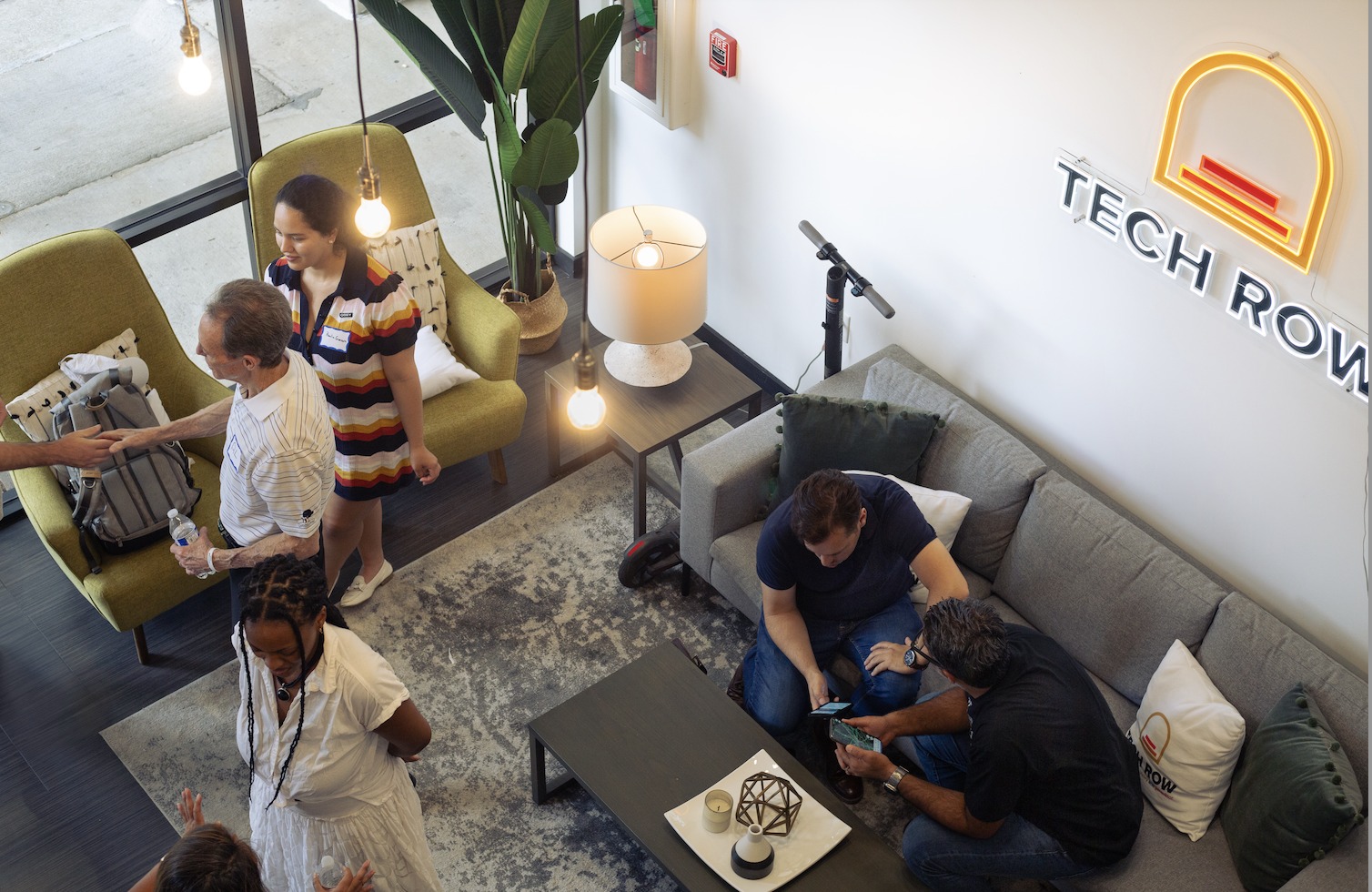
Tech Row, opened in downtown Birmingham in 2024, made the strategy physical. The coworking and innovation space hosts accelerator teams, portfolio founders, investor conversations and community events. A “Brew & Connect” coffee meetup sounds modest because it is. That is also why it can work. Startup ecosystems are often built from repeated, low-stakes collisions before they produce a term sheet.
The room also corrects a weakness in remote-first ecosystem building. Geography may no longer prevent a software company from hiring or selling, but networks remain stubbornly local. A founder can join a video call from anywhere and still lack the person who will make an unprompted introduction after the call. Bronze Valley's answer is not to imitate Sand Hill Road. It is to increase the density of useful encounters in Birmingham, then connect those encounters to national capital.
The scoreboardReturns measured in rounds, revenue and jobs
Bronze Valley is a nonprofit and a certified Community Development Financial Institution, a structure that gives the word “return” more than one job. The fund still backs high-growth businesses and owns equity. It also measures whether capital produces economic activity in communities the venture market routinely passes over. Bronze Valley's current dashboard reports 66 investments, more than $121 million in follow-on capital raised by portfolio companies, more than $206 million in startup revenue and 919-plus jobs.
Those are self-reported portfolio impact figures, not audited investment returns, and the distinction matters. They nevertheless reveal what the organization chooses to count. Its dashboard says 83 percent of backed founders are under-resourced and 52 percent of portfolio companies are female-led. In its 2024 activity, Bronze Valley said 96 percent of investments landed outside traditional tech hubs. The mandate is not only about who gets funded. It is about where venture-backed growth is allowed to happen.
Its customers, in the practical sense, are early-stage founders. Its financial supporters are a different constituency: public agencies, foundations and companies that want economic development with a measurable venture mechanism. Public filings show the model clearly. Bronze Valley Corp reported $3.92 million in fiscal 2024 revenue, with 97.1 percent coming from contributions. The U.S. Treasury's CDFI Fund awarded it $617,000 through the 2021 Rapid Response Program. Alabama Power, Regions, Spire, Innovate Alabama, the Alabama Department of Commerce and others have supported programming.
That blended model separates Bronze Valley from a standard ten-year venture partnership funded only by limited partners. It can run equity-free programs before a company is ready for investment. It can define success partly through jobs and regional activity. It can also make a conventional venture bet when a startup reaches the investment accelerator. The catch is equally clear: the engine depends on continued philanthropic, corporate and public support as well as portfolio outcomes. A region that lacks committed anchor institutions cannot copy the visible program and expect the same machinery underneath.
What gets backedA portfolio tied by access, not industry
There is no tidy sector box. Bronze Valley has backed financial software, healthcare, education, artificial intelligence, cybersecurity, consumer goods, climate tools, marketplaces and enterprise software. The roster includes Acclinate, which works on diversity in clinical trials; FilmHedge, a financing platform for film and television producers; Kai XR, an immersive education company; Pay4Me, a cross-border payment service for international students; and City Detect, which uses computer vision to help municipalities understand property conditions.
The selection logic lives one level above the product category: scalable, technology-enabled companies led by overlooked founders and often built in overlooked regions. This can look unfocused beside a specialist fund devoted only to biotech or payments. It is more coherent when read as a sourcing advantage. Bronze Valley is searching where generalist venture firms have historically spent less time. Its expertise is early underwriting, finance, founder preparation and ecosystem construction, rather than pretending to know every vertical better than a specialist.
The portfolio supplies evidence and caution in equal measure. Major Care, a maternity support company, was acquired by Pacify in 2024, giving Bronze Valley a first reported exit. Acclinate raised a $7 million Series A. City Detect raised a $2 million seed round. Other portfolio entries are marked inactive. That is venture capital behaving like venture capital: a few companies travel far, some stall, and the portfolio absorbs the difference. Mission does not repeal startup mortality.
The copyable partsStart with the handoffs
The tempting thing to copy is the demo day. The useful thing is the handoff. Bronze Valley gives an idea-stage founder somewhere to begin, a young company somewhere to prepare and an investable company a clear next step. Each program has a job, a time limit and a defined cost. Local institutions underwrite the pipeline. A national accelerator contributes operating muscle and a broader network. The venture fund can then invest in companies it has watched at close range.
The second copyable move is to keep cohorts small enough that introductions can be specific. “Mentorship” becomes wallpaper when it means a lecture to 100 founders. Five companies allow an operator to diagnose an actual pricing problem, not perform wisdom on a stage. The third is to publish outcomes that matter to both sides of the model: follow-on financing for investors; revenue and jobs for civic partners.
The conditions matter. This model asks for patient funders, a credible local convener, experienced investment judgment, an accelerator operator and enough promising founders to sustain the funnel. Remove two or three of those, and a staged program can become a calendar of workshops with no durable capital behind it.
Bronze Valley's own expansion offers a test. It entered Delaware in 2023, working with gener8tor and Delaware State University. By spring 2026, its Delaware gBETA cohort had selected five startups from more than 100 applicants for seven weeks of coaching, culminating in an “Investor Swarm” with more than 25 curated investors. The geography changed. The sequence did not.
There is a neat irony here. Venture capital celebrates contrarian thinking, yet often clusters around the same cities, schools and introductions. Bronze Valley's wager is that the overlooked are not a charitable side market. They are an investable market whose transaction costs have been allowed to remain too high. Its work is the unglamorous business of lowering those costs, one check, one warm introduction and one crowded room at a time.