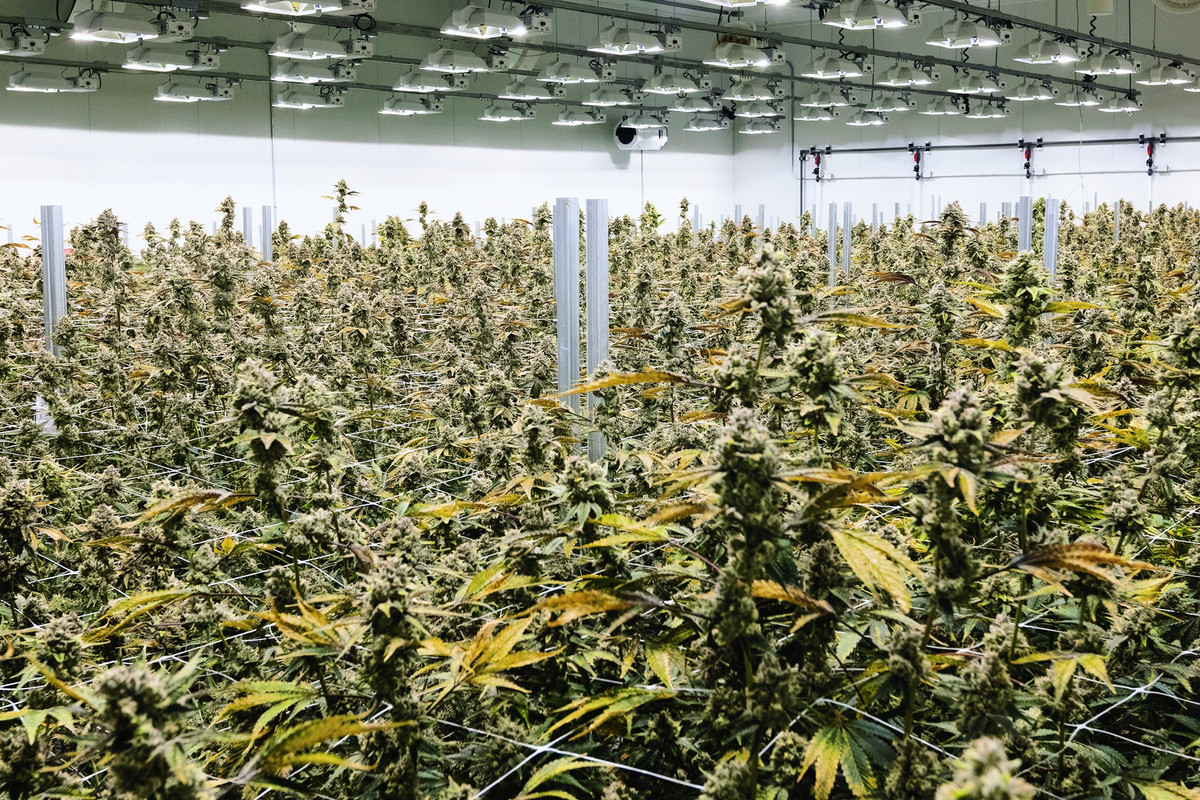
The first surprise inside Natrabis is the noise. Not club music, not the soft burble of a boutique grow, but the industrious hum of people turning a plant into inventory. At the Society C facility in Orion Township, Michigan, workers trim flower by hand, tag it, track it, bag it and stack it for a trip to dispensaries across the state. Nine flowering rooms hold roughly 15,000 plants. The building runs around the clock. Recent reporting puts the output near 450 pounds a week.
That makes the company's favorite word - craft - sound almost cheeky. Craft is supposed to arrive in small jars from small rooms tended by a person who remembers every plant's childhood. Natrabis operates from a 54,000-square-foot facility with an on-site extraction lab. Yet the useful thing about this company is not that it has escaped the contradiction. It has designed the business around it.
The company behind the C
Natrabis is the cultivation-and-processing engine behind Society C, a Michigan cannabis brand selling flower, pre-rolls, concentrates and vapes. Its founders - childhood friends Nick Simpson and Ben Puraj, joined by Mike Thomas - came through Michigan's medical-cannabis caregiver market. Simpson serves as chief executive. The three spent time learning the trade beyond their home state, then broke ground in Orion Township in 2020. A ribbon cutting followed in 2021, with the first harvest about six weeks later.
The physical bet was expensive. A third-party brand profile places the facility investment at about $25 million, including a reported $2 million extraction lab. Public financing records show AFC Gamma added $5 million to Natrabis' credit facility in March 2022, taking the lender's total position to roughly $15.5 million. This was not a founders-with-a-grow-tent story. It was a regulated manufacturing launch involving real estate, specialized lighting, environmental control, testing, security and enough working capital to wait for plants to finish being plants.
The business model is conventional in outline and unusually demanding in practice. Natrabis grows and processes the product; Society C supplies the name, packaging and consumer story; licensed retailers handle the final sale. Revenue therefore depends on wholesale relationships, sell-through at the dispensary and the ability to keep a compliant product moving through Michigan's tracking system. Cannabis does not tolerate the breezy inventory habits of an ordinary consumer startup. Each batch is tested, labeled and recorded before a customer can buy it.
That makes operational expertise the actual product behind the product. The grow team must manage genetics, irrigation, light, climate, pests, harvest timing and curing. Post-harvest workers must protect the flower while making it retail-ready. The lab must turn the same agricultural input into predictable concentrates. Sales must then forecast demand far enough ahead for cultivation to act, despite the inconvenient fact that a crop cannot be summoned from a warehouse overnight. Society C may appear on the package, but coordination is what gets the package onto a shelf.
A product line with dirt under its nails
Society C's shelf starts with indoor-grown flower, sold across familiar dispensary formats from single grams to larger bags. The same cultivation feeds pre-rolls and an on-site processing operation that makes live resin, rosin, water hash, badder, diamonds and sauce, cartridges and disposable vapes. Keeping flower and extraction close together gives the company control over the input material and lets it market concentrates as single-source rather than assembled from anonymous wholesale biomass.
The buyer is an adult Michigan cannabis customer who wants something more dependable than bargain flower without paying for a precious weekly drop. Licensed dispensaries are the real route to that buyer. The brand reported crossing 300 retail partners in its review of 2025; an independent visit in May 2026 counted products in more than 200 stores. Those figures were captured at different moments and by different methods, but both describe a genuinely statewide footprint.
What failed first? The romantic products
The clearest look at Natrabis' operating brain comes from the strains it stopped growing. Each candidate is checked for appearance, terpene profile, yield and THC percentage. The team is openly uneasy about the industry's fixation on THC, a number that cannot describe the full experience. It uses the number anyway, because Michigan shoppers use it. Idealism gets a vote; the shelf gets a veto.
The cultivar gate / an editorial model
Ambrose Sour looked gorgeous and delivered the aroma and effects the production team wanted. It still missed the market's THC threshold and disappeared. Spritzer presents the sharper lesson. It won the adult-use indica flower category at the 2023 High Times Michigan Cannabis Cup, yet Natrabis later retired it because the plant was too unwieldy to cultivate at scale. An award could not make the crop easier to schedule, more productive per light or friendlier to a standardized room.
What changed their mind was not a branding workshop. It was production data. Every square foot occupied by a temperamental winner was a square foot unavailable to a reliable strain. In software, a beloved feature can survive because its marginal cost is tiny. In agriculture, affection has a utility bill.
The awkward middle is the market
Michigan is a rough place to test this thesis. The state has hundreds of licensed growers, heavy supply and persistent price pressure. Large multistate operators have pulled back. Small growers chase scarcity. Budget brands chase volume. Society C has occupied the shelf between them - positioned as accessible premium, with a reported consumer price around $85 an ounce in 2026.
Society C sits in the difficult middle: consistency over exclusivity
That position solves a plain problem. A customer can find recognizable genetics and processed formats without treating the purchase like a sneaker drop. A retailer gets products that can be reordered. The promise is less thrilling than rarity, but more useful: the next batch should resemble the last. Awards supply proof at the top of the funnel. Repeatability keeps the wholesale account.
The receipts include first place for Spritzer and a third-place finish for Pastries Live Rosin at the 2023 High Times competition, then a first-place hybrid-flower award for Gastro Pop at Best in Grass in 2024. Society C later highlighted first-place finishes for LA Purple Pop Rocks and Blue Runtz among its 2025 results. The company's latest public plan calls for new genetics, improved cultivation techniques, more Michigan retail partners and an online merchandise shop.
What another operator can copy
Most readers cannot copy the building, and probably should not. They can copy the decision system. Natrabis preserves the expensive, customer-visible elements of craft - selection, plant care, hand trimming and control of extraction inputs - while standardizing the invisible machinery around them. It does not confuse scale with keeping every SKU alive.
Write the kill criteria early
Judge every product on customer appeal, quality, throughput and demand before the team falls in love with it.
Keep the craft customers notice
Spend labor on the steps that affect the experience. Automate or standardize the rest.
Own the sensitive handoff
When input quality determines output quality, keep production and processing close enough to share accountability.
Make reorderability a feature
A retailer values the product it can buy again. Consistency can be a stronger moat than novelty.
There is also a less glamorous lesson. Regulated manufacturing punishes administrative misses. Michigan regulators cited Natrabis entities over late financial reporting and, in June 2026, imposed fines across several cultivation and processing licenses for reporting-related issues. Compliance is not clerical garnish. When a business depends on multiple state licenses, the paperwork is part of production.
When the model does not travel
This playbook works when a company has enough local demand to fill a large facility, a retail network that values predictable quality, and operators able to translate small-batch judgment into repeatable rules. It is weaker when energy costs spike, wholesale prices fall faster than yields improve, or consumers choose only the cheapest THC number. A fully integrated grow also locks capital into one state's rules. Cannabis cannot move through ordinary interstate commerce, so success in Michigan does not turn the Orion Township building into a national supply hub.
Nor does hand trimming magically make an industrial operation artisanal. At hundreds of pounds a week, “craft” is a claim that needs evidence each harvest. Natrabis' best evidence is not the polished language on a package. It is the willingness to remove a celebrated strain, accept the market's irritating constraints and keep the quality test attached to the economics.
That is the company in one image: a room full of living plants under artificial suns, tended with caregiver attention and judged with a factory spreadsheet. The plants do not care about the brand tension. Customers do. Natrabis has built its business in the narrow space where both still get a say.
For adults 21 and older. Cannabis laws and product availability vary by jurisdiction; use only as permitted by local law.