At a Fourth of July gathering in Water Mill, Isaac Ross noticed a friend’s father wearing old navy-and-white swim trunks. They had been bought at Club 55 in St. Tropez decades earlier. Faded fabric, familiar stripes, no apparent wish to impress anybody. Ross wanted a pair. When he could not find them, he decided to make them. In his 2014 account of the encounter, the starting point was wonderfully modest: one pair of shorts worth wearing.
- Started with men’s trunks; women’s shopping changed the business.
- Swimwear became the entrance to a larger holiday wardrobe.
- Collaborations carry the aesthetic to new audiences; fit still decides the purchase.
The trunks that refused to retire
Solid & Striped arrived in 2012 with a proposition that could be understood across a swimming pool. Swimwear could be quiet. Ross’s experience at WME and M&C Saatchi had taught him about marketing; now he wanted to handle the product. His early interviews describe a gap between the trunks he admired and the choices he could actually buy.
The details mattered. He worked with a designer and a pattern-maker, fitted friends, and followed an old garment’s Moroccan manufacturing label to a factory. The first misstep was the calendar: he tried selling a resort collection in September, after buyers expected to see it. As he recalled in 2015, learning the business included learning when somebody else needed your samples.
“How did leather get on a bathing suit?”
Isaac Ross, speaking to Bonberi in 2014
The customer standing next to him
The revealing request came from the Beverly Hills Hotel. Solid & Striped supplied custom pink-and-white men’s trunks. Women wanted a version for themselves. Ross enlisted Morgan Curtis, the designer behind Morgan Lane, to develop women’s swimwear. A customer standing beside the intended customer had become an opportunity.
By September 2015, women accounted for 70 percent of the business. That is a historical snapshot, but a striking one for a label launched around men. Michelle Copelman, previously at J.Crew, joined as design director that year as the assortment moved further into apparel. The original product had established a taste; it had not established the limits of the customer.
Women’s share of the business in 2015.
A turning point, not a current sales breakdown.
A swimsuit needs somewhere to go
Think about how a swimsuit is seen. On a hanger it is a small quantity of fabric. In a holiday photograph it comes with sunshine, friends and somewhere agreeable to have lunch. Ross understood that setting. “The product needs context,” he told The Daily Front Row in 2016.
Poppy Delevingne became a collaborator after discovering the women’s line around her Coachella bachelorette trip. By 2016, Glossy was reporting sellouts and appearances in celebrity Instagram feeds. Those photographs connected a recognizable product to a recognizable social world. They offered a picture of where the clothes belonged.
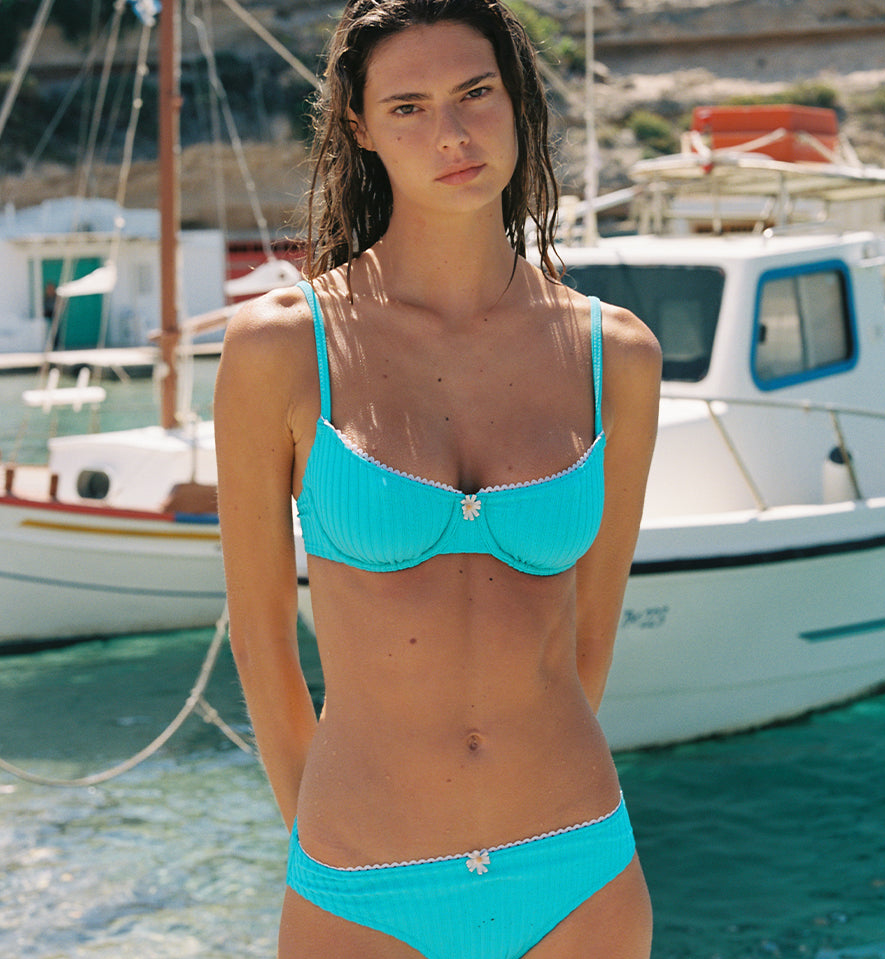
That world could also feel narrow. In 2018, Mic reported criticism of the Swim Team collaboration’s lack of racial and body diversity. Ross apologized for its failure to represent a more diverse group of women. The episode exposes a weakness in aspirational marketing: casting communicates who belongs as plainly as the clothing does.
The wardrobe gets a second act
Recognition did not settle the business forever. Nicole Heim Studio’s account of its rebrand work describes years of declining sales before a reset launched with Spring 2024. That is the studio’s account, rather than a published set of company accounts, but it makes the next collection more interesting than a celebrity appearance.
Sofia Richie Grainge helped shape the collection and refreshed branding. The company described influences from Montecito, architecture and contemporary art. The offer included ready-to-wear as well as swim. Vogue identified Chris Burch as majority owner at the launch. The ambition was a wardrobe with more occasions to wear it.
The studio reports gains of 43 percent in retail revenue and 30 percent in wholesale revenue, without stating the measurement period. Those figures support a cautiously encouraging reading of the reset; they do not establish current annual revenue. By 2025, a The Summer I Turned Pretty capsule added another setting, the fictional Cousins Beach, to the brand’s holiday map.

What goes in the bag, and on the bill
Today the company sells women’s swimwear, beachwear and everyday apparel. Its own store offers the full brand setting; retailers such as Anthropologie provide another route to the customer. Dresses and knits sit beside swimsuits, making the label useful to someone assembling coordinated vacation clothes rather than buying a single replacement suit.
The Summer 26 assortment makes the price point concrete. An Anne-Marie one-piece in Symi Stripe is listed at $148. A seersucker Iris stripe top and bottom cost $98 each, or $196 together. A Marley knit dress is $298. These are observed list prices, not a promise about tomorrow’s checkout.
Listed in Summer 26 when researched October 6, 2026. Bikini pieces sold separately.
Capital and shopping bills are different sums. CB Insights records a $1.7 million Series A in December 2016 backed by Burch Creative Capital. That reported financing amount should not be mistaken for what the company cost to launch, its valuation or its sales.
A useful lesson, with a fitting-room test
The practical lesson is to expand toward a request you can answer well. Ross found adjacent demand and brought in a designer with relevant expertise. Another founder can copy the listening, the narrow starting product and the search for capable collaborators. Access to fashionable friends is rather less portable.
For shoppers, the test is personal. The Taylor collaboration one-piece lists adjustable straps, underwire cups and moderate coverage; those details are more useful than a poolside pose. Choose by support and coverage, and check the individual size guide. A triangle top chosen for minimal tan lines will not answer every bust’s needs. Nor does holiday styling establish suitability for competitive swimming. The photograph proposes a life. The garment has to fit yours.