A bra can create an awkward little problem. If it is beautiful, you may want someone to see it. If it is underwear, convention suggests that almost nobody should. Fleur du Mal has spent its life investigating the space between those two propositions. A glimpse of embroidery beneath a shirt becomes a styling decision. A slip becomes a dress. The garment has acquired another destination.
- Luxury lingerie conceived as part of a visible wardrobe.
- A founder trained at both Kiki de Montparnasse and Victoria’s Secret.
- A business shaped by inventory costs, fewer styles and new buying occasions.
01 / The interesting part goes underneath
Jennifer Zuccarini founded the New York label in 2012. She had already co-founded Kiki de Montparnasse and worked at Victoria’s Secret, an unusually useful education in the distance between rarefied luxury and mass retail. In a 2013 Fashionista interview, she said she raised just under a million dollars to start her company. Desire needed a financial forecast.
The idea was more approachable than her earlier luxury venture, while retaining a recognisable aesthetic. Here was lingerie for a customer who cared about fashion and wanted to incorporate it into ordinary dressing. Zuccarini told Fashionista in 2018 that the business plan had taken roughly six months or longer. Even the fantasy had homework.

The French name came from Baudelaire’s poetry, encountered while she was travelling in Argentina. That literary ancestry supplies a useful hint of mischief. But the practical offer is straightforward: lingerie, clothing, swimwear, lounge pieces and pleasure products, sold online, in boutiques and through selected retailers. Customers can buy something to conceal, reveal or wear as the outfit itself.
02 / Silk has a cash-flow problem
Around two years after launch, the romance encountered the bank balance. In her 2025 founder interview, Zuccarini recalled nearly exhausting the company’s money. She borrowed from investors, paying interest, and delayed payroll by two days. She estimated that almost 80% of her small team subsequently left.
Fashion makes this predicament possible even when sales are increasing: production must be financed before the goods produce cash. Her account exposes two costs at once, the price of inventory and the damage uncertainty does to a team. It is a useful warning for anyone who thinks an attractive product will automatically finance its own success.
“I think people just got tired of that one note of what sexy is.”Jennifer Zuccarini, Glossy, 2019
The product argument also needed precision. A customer buying a lace bustier wants a particular look; a customer buying an everyday bra may put fit and price first. Fleur’s answer has been to work across those occasions while keeping enough visual continuity that both purchases belong to the same wardrobe.
03 / Flowers with a price tag
The Lily range makes the proposition visible. Large floral embroidery sits across sheer fabric, giving the bra a motif that can participate in an outfit. The collection stretches across demi bras, thongs, garter belts and other shapes. It also includes a men’s thong and a post-surgical bra. The flower has been asked to do considerably more than decorate a window.
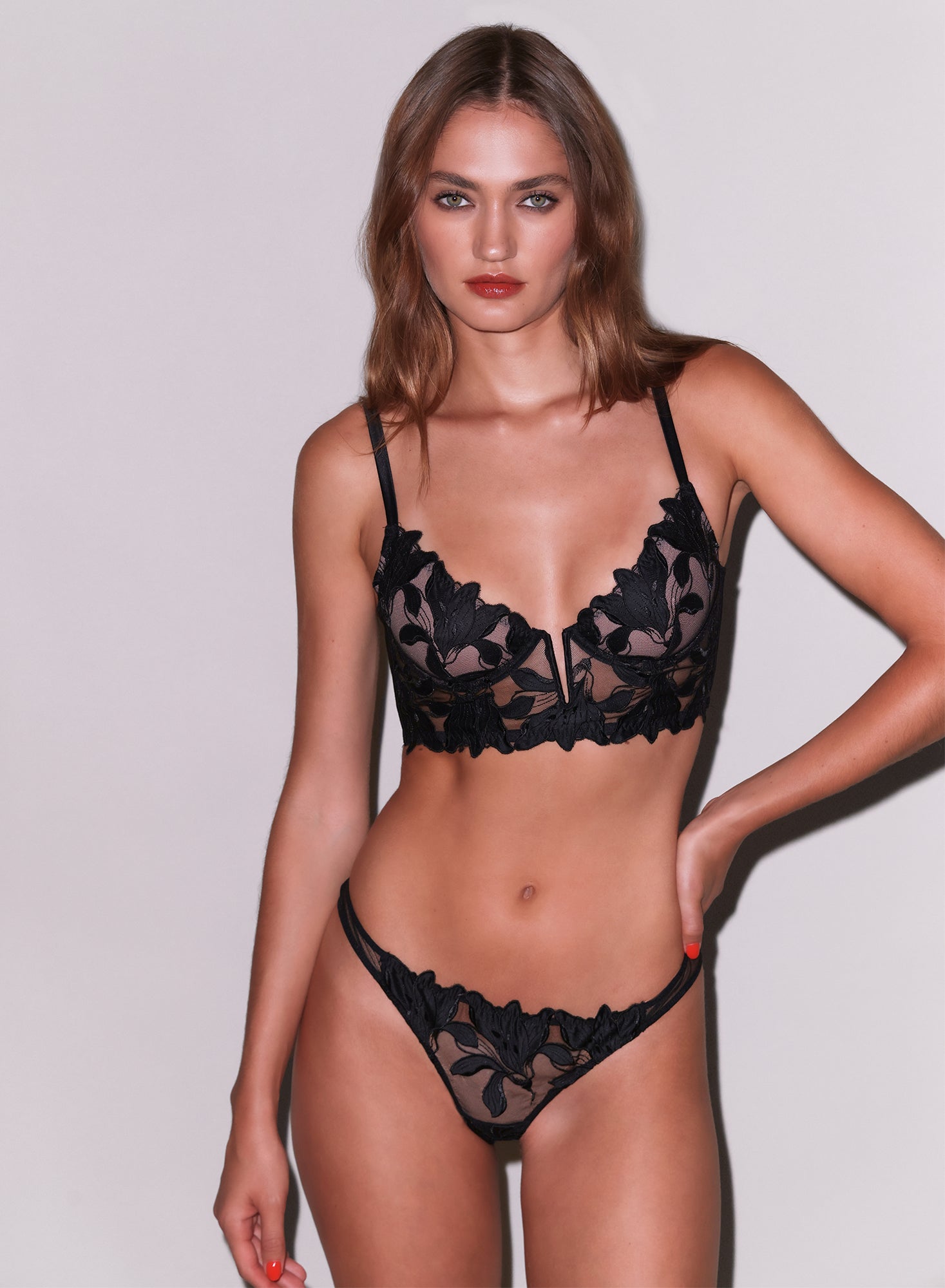
The prices make clear where the company sits. The black Lily plunge demi bra is listed at $138, its hipster thong at $68 and its garter belt at $98. Together, that is $304 before tax or shipping. This is discretionary fashion spending. Its nearest luxury comparisons include Kiki de Montparnasse and Agent Provocateur; customers shopping broader lingerie brands have different price and styling trade-offs.
A prospective buyer can start with the intended outfit, then check coverage, composition and sizing. A visible floral bra solves a different problem from an unobtrusive T-shirt bra. Boutique fit guidance helps make that distinction concrete. The styling proposition works best when the wearer actually wants the lingerie to enter the conversation.
The materials deserve the same scrutiny as the silhouette. Fleur’s sustainability page describes a Portuguese-made organic cotton range, recycled Italian jersey and recycled-paper packaging. These are specific choices within the assortment, rather than evidence that every piece has the same environmental credentials. Buyers can read the composition of the garment they want instead of treating the brand name as a substitute for a label.
04 / Fewer styles, more occasions
In 2020, Zuccarini described cutting collections by more than half. Wholesale buyers wanted breadth; the company could not properly support every style. Pandemic disruption sharpened an existing concern about producing too much. The transferable lesson is mundane and valuable: an assortment must fit the business that finances it.
Meanwhile, purchasing occasions kept shifting. Fashionista reported strong online demand for lounge pieces and lingerie during the pandemic, while Fleur’s Los Angeles opening was delayed until April 2021. The official boutique directory now lists four locations. Physical retail gives customers somewhere to resolve questions that a photograph leaves unanswered.
The website makes the direct relationship commercially useful: customers discover a collection, choose a size and complete the purchase in one place. Stores add styling and fitting; wholesale adds access to another retailer’s audience. Fleur also recruits fashion creators through an affiliate programme advertising a 15% commission on direct sales. A wardrobe suggestion can therefore be both editorial inspiration and a paid route to purchase.
Collaboration supplies another route into a customer’s life. Galia Lahav’s getting-ready assortment includes Fleur du Mal bridal pieces: slips, bustiers, robes and tailoring. The partnership has a clear occasion attached. A 2019 Precious Lee capsule followed the launch of Fuller Cup sizing in 2018, extending the wardrobe argument to more bodies.
05 / An idea allowed to leave the bedroom
Expansion can be tested before it becomes a manufacturing commitment. Zuccarini described selling other makers’ pleasure products before developing Fleur’s own vibrator. Separately, she noticed that customers bought special-occasion lingerie from Fleur but went elsewhere for everyday bras, and developed more accessible everyday options. Both moves began with a buying habit rather than a new slogan.
The next category is activewear: Fleur du Sport carries lingerie details into sports bras, leggings and track pieces. Vogue Business reported in April 2026 that Fleur was profitable, with 25% annual growth. The experiment remains whether customers want its aesthetic in another setting.
There is a sensible way to borrow the idea: identify what customers already love, give it another useful occasion, and test the purchase before enlarging the commitment. It requires fitting expertise, inventory capital and customers willing to pay for the distinction. Fleur du Mal’s enduring question is pleasingly specific: where else could this beautiful thing go?