Before there was a company to name, there was a handbook that people needed to read. Naira Musallam was a doctoral student at Columbia, helping bring conflict-resolution scholarship into Arabic. The work required more than finding equivalent words. A useful argument had to survive the journey from one language, and one intellectual setting, to another. Years later, she would encounter a related difficulty in research software: having access to knowledge and being able to use it are separate achievements.
Her career has taken an unusually literal route through that gap. There have been classrooms, consulting assignments, a mountain in Alaska, and a company first called Frontier7. Today it is SightX, the consumer research platform she co-founded with Tim Lawton. Along the way, the object of the work changed. The problem of getting something valuable into somebody else’s hands remained remarkably persistent.
The question before the company
Musallam grew up in Ibillin, in Galilee, as a Palestinian citizen of Israel. At the Mar Elias Institutions, students from different religious communities shared a school organized around tolerance. Her later account of that upbringing resists tidy camps. Different worlds could coexist within the same person; understanding them required the patience to hear more than one explanation.
She came to Teachers College in 2003 with a U.S. State Department scholarship. A course with Peter Coleman in conflict resolution helped focus her interest on problems at a larger social scale. It also placed her in a field where the distance between scholarship and practical use was particularly consequential. Knowledge could be carefully developed and still fail to reach the people doing the work.
The Arabic handbook project made that distance concrete. Working with Coleman, Musallam supervised translation and wrote a preface connecting the material to the region’s own traditions of resolving disputes. Translation meant considering the audience’s existing knowledge. The reader was arriving with a history, a vocabulary, and experience of their own.
There is a useful parallel here with the software she later helped build. A specialist can make a tool available and still leave the intended user outside it. The difficult work lies in making the expertise usable while preserving what makes it valuable. Musallam had been dealing with that question well before a research platform became her business.
“I want to reach millions of people.”
Naira Musallam, 2016
A partnership with an altitude test
Musallam and Lawton reached Denali’s summit on June 30, 2015. Their partnership had grown from a shared interest in climbing, and they were already developing Frontier7. The climb took two attempts that season. At the summit, they displayed a flag carrying a message of peace in Arabic, Hebrew, and English.
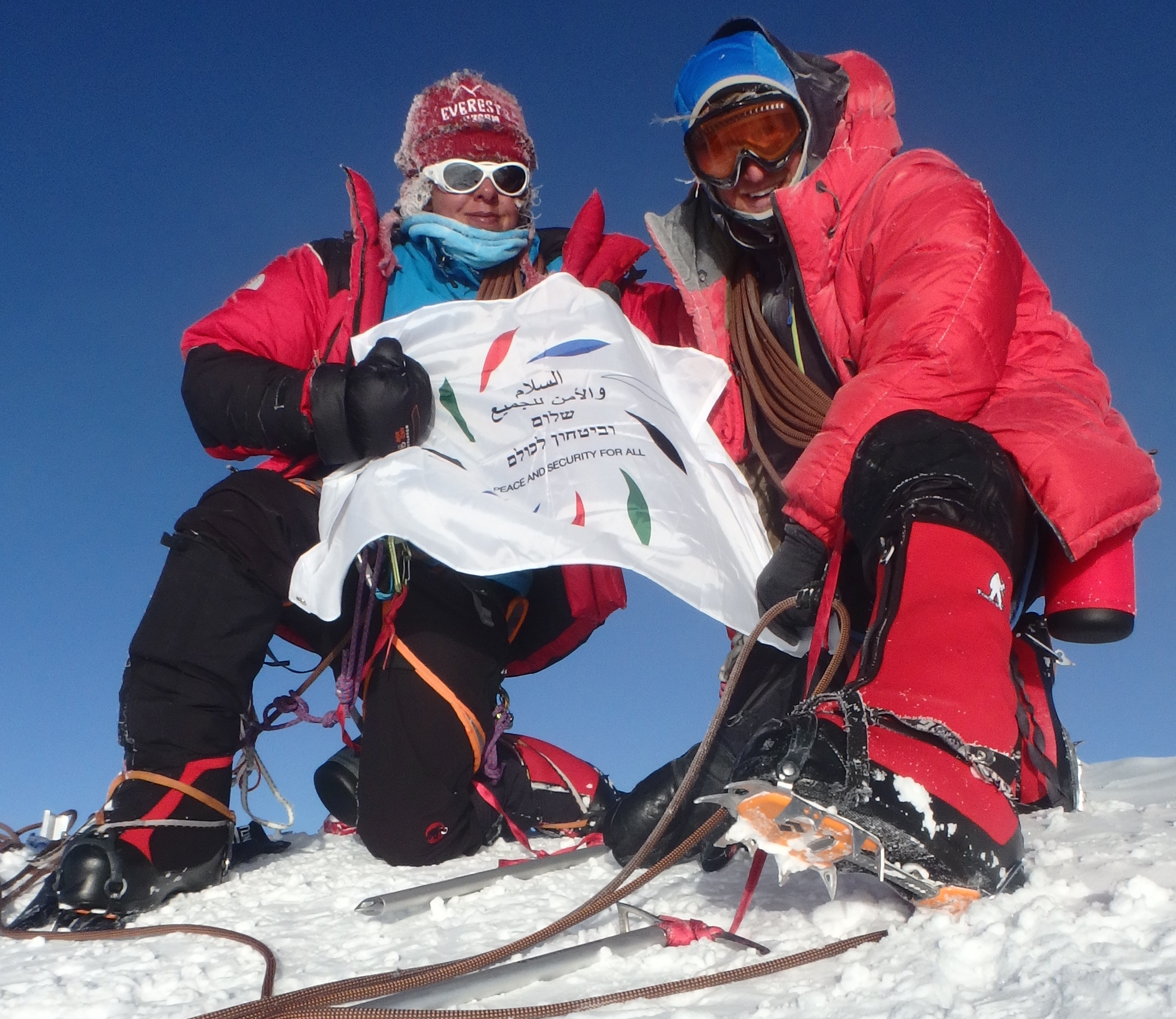
Their account of working together emphasized trust, complementary abilities, and a shared vision. These are familiar business virtues. Mountaineering gives them a practical examination. Your partner’s competence matters before there is an investor, customer, or job title to reassure you. The relationship has already had to function when the plan becomes difficult.
It would be convenient to turn the mountain into an all-purpose explanation of the company. Businesses require their own forms of patience. Still, the partnership had a substantial foundation outside work. The founders could bring different experiences to the same problem without first having to establish whether they could rely on each other.

The professor meets the workflow
Musallam’s professional preparation included research leadership at YSC, a business psychology consultancy, where she headed R&D for North and Latin America. Her work spanned industries and involved survey design, evaluation, analysis, and presenting findings. The common requirement was to make research useful to an organization facing an actual decision.
Teaching added another view of the same difficulty. She taught graduate-level research and statistics at Columbia and NYU, with work in global affairs as well. Teaching methods means returning to the steps an experienced researcher can take for granted. What is the question? What evidence would answer it? What does the result allow someone to say?
A classroom can slow down to examine those steps. A business often wants the answer promptly, preferably in time for the next meeting. Musallam’s background placed her near both expectations. She knew the care a method required and the practical impatience surrounding its use. The opportunity was to reduce the procedural burden around the research.
In a 2019 conversation with Jamin Brazil, she described the trouble with a process scattered across tools: collection, cleaning, formatting, restructuring, and uploading elsewhere. Each handoff demanded attention before the researcher could concentrate on the question that justified the study. Sophisticated analysis had acquired a rather elaborate entrance procedure.
- 01Ask
- 02Collect
- 03Analyze
- 04Decide
Her answer was to connect those stages. The ambition also involved expertise: people were expected to deliver deeper findings quickly, even when the tools made the journey cumbersome. Making the path easier would let a researcher spend more attention on what the evidence meant. That is an appealingly concrete use of automation. The spreadsheet, after all, has never objected to receiving more of your afternoon.
The unknown variable gets a name
Frontier7 became SightX in 2019. Musallam explained the new name through the language of statistics: X represented the unknown variable being investigated. The company’s identity now described its purpose more directly. A research question begins with something a person cannot yet see clearly; the platform is meant to help bring it into view.
The name also suited the company’s integrated approach. Research methods and analysis would sit within a process people could actually navigate. This is a product-design problem with methodological consequences. If a user cannot work comfortably with a sophisticated method, putting it on a menu does little to expand its usefulness.
In November 2023, SightX introduced Ada, a generative AI consultant. The announced capabilities included suggesting experiments and audiences, analyzing findings, and producing executive summaries. The product extended the effort to shorten the distance between a question and a useful result. A researcher could ask for assistance within the workflow rather than start another round of moving material between tools.
That development also made judgment more visible. Someone still has to decide whether the proposed experiment suits the question, whether the audience fits the decision, and whether the summary captures the important qualification. Faster production raises the value of reviewing what has been produced. A polished paragraph can be an excellent place for an assumption to hide.
When the answer complicates the story
Musallam’s own research offers a more concrete picture of what those decisions involve. In 2025, she presented a SightX study of perceptions of American brands across ten markets. It used audience segmentation and key driver analysis to examine trust and purchase intent. Treating international consumers as a single audience would have missed the point.
The findings complicated some comfortable expectations. Canada was among the markets with a substantial concentration of brand skeptics. Quality emerged as a leading predictor of trust and purchase intent. Price sensitivity did not automatically imply less willingness to buy. An audience could care about price and still be comparatively enthusiastic about American brands.
These are findings from a particular study, rather than rules for every brand or buyer. Their value lies partly in the distinctions. A geographic neighbor can require a different strategy. A stated preference can have a different relationship with purchase intent than a team expects. Research earns its place when it makes the next decision better informed, even if the answer proves less convenient.
“Curiosity. Flexibility. A hunger to learn.”
Musallam on the qualities she values in emerging data scientists
That advice fits a career in which the tools have changed repeatedly. In her conversation with Priscilla McKinney, Musallam discussed using AI for qualitative material while retaining established statistical formulas for quantitative work. The distinction turns a broad technological promise into a set of specific choices about what a system should do and how its work can be trusted.
The distinction also recalls the teacher’s task. A result has to be explained well enough for someone else to question it. When software takes over more preparation, the remaining conversation can become more demanding: why this method, why these respondents, why this interpretation? Those questions give the expert a continuing responsibility. A simple interface makes that responsibility easier to reach; it does not make the underlying decisions disappear.
The next handoff
In April 2026, Rep Data acquired SightX. The combination brought the research platform together with infrastructure for response quality, including Research Defender and ReDem. The practical concern was the quality of the information entering the workflow. Efficient analysis depends on responses worth analyzing; speed alone cannot supply that condition.
Musallam continued the discussion in public research events after the acquisition. She appeared on Rep Data’s Quirk’s London panel about confidence in modern research and joined Steven Snell for a connected-workflows webinar. The subjects extended the question she had been pursuing at SightX: how do the steps of research work together well enough for someone to act on the result?
The person who once helped translate scholarship into Arabic now works on another means of reaching people with specialized knowledge. The audience and machinery have changed. Her career keeps returning to the practical distance between knowing something and helping another person make use of it. That distance has given her plenty to do, on the mountain and back at her desk.