The hard part of selling a brain-sensing headband is not finding an impressive noun. There are plenty available: electrodes, algorithms, signals, oxygenation, feedback. The hard part is helping a person understand what any of those words will change about a Tuesday afternoon. Nadia Kumentas has built her career in that narrow space between an invention and the sentence that makes it useful. At Muse by Interaxon, where she is chief marketing officer, her remit covers brand strategy, product marketing, growth, and the company's position in both consumer and business markets. Her real product, though, may be legibility.
Kumentas did not take the standard route into a technology marketing department. She studied health science at Western University, graduating in 2009 with the Gold Medal awarded to the student with the highest GPA in the section. She then completed four years at the Canadian College of Naturopathic Medicine. By the time she enrolled in a digital marketing program at BrainStation in 2016, she had already worked in clinical settings and co-founded small wellness ventures. The sequence looks eclectic on paper. In practice, each stop trained the same muscle: observe what people need, translate technical information, and design a next step they will actually take.
The discipline before the deck
Long before product roadmaps and launch calendars, there was a pool. Kumentas captained Western's women's varsity swimming team in the 2007-2008 season. She was named the team's MVP in 2007 and received the Gordon Risk Athletic Award. These are not decorative facts from an executive biography. Competitive swimming is a useful model for the kind of work she later chose: progress assembled from repeated, often invisible corrections. A start gets cleaner. A turn costs fewer tenths. A complicated product explanation loses one unnecessary phrase.
Her early professional years had a founder's density. Kumentas co-founded Affect Health, worked at Zen Beginnings, helped build the health-and-wellness blog An Avocado a Day, and later co-founded Mingo. She also ran pre-op and post-op programming at a Toronto medical center. The individual ventures differed, but the recurring subject was behavior. Information is only the opening move. The real question is whether a person trusts it, remembers it, and changes what they do next.
One career, widening surface area
Muse gave that question a harder setting. The company makes wearables that read electrical activity from the head and turn it into real-time feedback. The technology can be described precisely and still leave a customer lost. Kumentas joined as director of brand marketing in 2018, became vice president of marketing in 2019, took on a combined product-and-marketing role in 2022, and moved into the CMO seat in 2024. The promotions trace an expanding responsibility: from explaining the object, to shaping the experience, to defining the category around it.
“Education is your growth engine.”Nadia Kumentas, reflecting on the Muse S: Athena launch
The sellout was the beginning
On March 18, 2025, Muse introduced Muse S: Athena, a consumer wearable combining EEG with a second sensing method, fNIRS. The launch asked customers to learn unfamiliar technology and a new way of thinking about cognitive performance. The first run sold out. Muse restocked. It sold out again. Kumentas later wrote about the moment with the sobriety of an operator who knows that demand can create its own failure mode: “Selling out isn't a win if it stops your sales flow.”
Her team treated the gap in inventory as part of the customer experience. They explained what was happening before silence could create doubt. They built restock communication and a nurture sequence designed to remain useful while people waited. That detail matters because launches are usually narrated as bursts of attention. The actual work continues through inventory, customer questions, support messages, and the uncomfortable days when the original plan no longer applies.
Kumentas distilled the launch into five lessons. Demand for direct brain data was rising. A sellout needed an operational answer. Education drove growth. Clarity beat hype. Cross-functional alignment held it all together. The list is practical because it refuses to separate the campaign from the company. Marketing, product, development, operations, and customer experience planned together, changed direction together, and kept the same promise from preorder through delivery.
Teach the category
Answer the customer's basic questions before reaching for the dramatic claim.
Design for surprise
Inventory and communication are parts of the launch, especially when demand breaks the forecast.
Move as one team
Product, marketing, operations, development, and support should tell one coherent story.
Choose trust
Useful answers compound. Buzzwords spend attention without necessarily creating understanding.
Proof in the small details
Kumentas's public explanations often land on ordinary constraints. At CES in 2019, while Muse was showing a sleep-focused soft headband, she offered a simple setup suggestion: if someone did not have an Alexa-enabled device, they could keep a speaker nearby instead of wearing headphones. It was a small comment from a crowded trade-show floor. It also revealed the useful end of product marketing. The technology story matters, but so does the bedside table.
The same instinct appeared in Muse's brand and e-commerce work. Kumentas led an outside team through creative direction, a rebrand, new photography, marketing materials, and a global store rebuild. The resulting site doubled conversion. Her account of the engagement praised transparency, thoughtfulness, precision, and care. Those words describe a working style more than an aesthetic. A high-converting page is the visible residue of many less visible decisions: which promise leads, which question gets answered, which detail earns the next click.
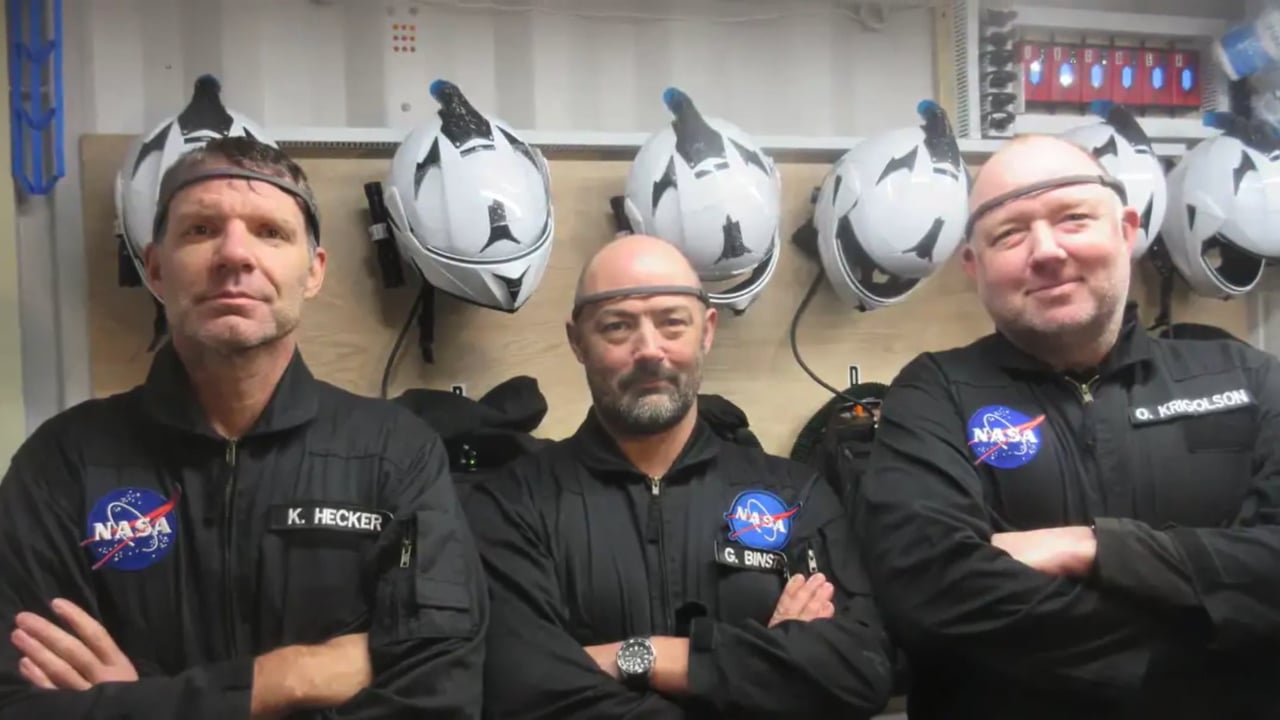
Her Vimeo account contains another form of explanation: a nine-minute film called “Does Muse Actually Work?” The title is almost defiantly plain. It asks the question a customer would type, not the phrase a company would place in an awards entry. Its thumbnail shows three crew members wearing Muse bands in a NASA field setting, with white helmets lined up behind them. The image does more category work than a page of abstractions. It places a slim consumer device in a demanding environment and lets the viewer begin with curiosity.
“Simplicity and trust beat buzzwords, every time.”Nadia Kumentas
A translator in the C-suite
There is a familiar temptation in emerging technology: make the vocabulary sound as advanced as the engineering. Kumentas argues for the opposite discipline. When Athena launched, she wrote that the most effective material did not shout about innovation. It answered concrete questions. What is being measured? What does the signal mean? When should a person act? The work of simplification is not the removal of substance. It is deciding which substance a customer needs now and which can wait.
That approach also shapes the kind of company she says she wants to help build. In her recent writing, Kumentas has pushed beyond the era of passive dashboards and universal scores. Her stated direction is toward experiences that offer context, guidance, and options. The marketer's job grows with that ambition. A label can name a metric. A useful experience has to explain why it appeared, how much confidence to place in it, and what choices follow.
Her support for mentorship fits the same pattern. In a Muse International Women's Day feature, Kumentas described the support she received from women and men throughout her move into technology, and said she tries to return it. Translation is social work. People cross into a new field because someone makes the norms visible, explains the acronyms, and signals that they belong in the room. The generosity that helps a customer understand a product can also help a colleague understand an industry.
The through-line in Kumentas's career is not a tidy ascent from one specialty to another. It is the accumulation of adjacent languages: science, clinical practice, entrepreneurship, behavior change, branding, commerce, product, operations. Muse happens to sit where those languages collide. Its hardware must be credible to researchers, understandable to customers, and coherent across an app, a box, a store, a support reply, and a headline.
A former colleague's public recommendation fills in the human machinery behind that range. He described a leader who acts first, expects improvement, and pairs broad marketing knowledge with empathy for customers and coworkers. Kumentas's own account of the Athena launch points in the same direction. Her list gives the credit outward: engineers, researchers, marketers, product teams, operations, and customer experience. The pattern is more revealing than a polished leadership maxim. She appears most interested in building the conditions for many specialties to arrive at one clear result. Category creation, in her telling, is a team sport with a demanding editor.
That makes the CMO less a megaphone than an editor of the whole system. Kumentas's best line about the job is also her most portable: education is the growth engine. For anyone building an unfamiliar product, it offers a hard test. If the customer needs a lesson, who owns the curriculum? If the first run sells out, who owns the waiting period? If every department tells a slightly different story, who puts the language back together? Her answer is implicit in the career she has built. The work belongs to everyone. Someone still has to make it clear.