Nader AlSalim had a perfectly respectable reason to stay where he was. Fourteen years in investment banking had given him a career, an understanding of risk and ample opportunity to observe what happens when people underestimate it. Starting a company offered a fresh opportunity to do precisely that. He went ahead anyway. The amusing part is that he had never particularly wanted to be an entrepreneur.
“I frankly had no aspirations to be an entrepreneur,” he said in 2021. He regarded founders as people attempting to beat unpromising odds. Then a problem close to home began to look like something he could work on. The professional sceptic became the person asking other people to believe. Gaia was the result, and the former banker found himself on the other side of the fundraising conversation.
His account of the change contains remarkably little theatrical destiny. There is no childhood vow to run a company, no claim that every previous job was secretly preparation for this one. He describes a gradual arrival at an idea. That makes the subsequent decisions more interesting: he had to choose the unfamiliar without pretending he had always belonged there.
A banker changes the question
Before Gaia, there was Citi, then Goldman Sachs, then VTB Capital. His roles included executive director at Goldman and head of Middle East at VTB. These were jobs inside established financial institutions, with the vocabulary and professional habits that go with them. A startup required him to carry those habits into a setting where the institution itself still had to be built.
The continuity was his interest in risk. In banking, uncertainty is something to examine, structure and price. At Gaia, he brought that way of thinking to a company organised around helping people build families. His expertise supplied a starting point; his experience as a customer supplied the questions. The combination explains the career change more convincingly than the usual injunction to follow a passion.
AlSalim calls himself a “very, very accidental entrepreneur”. Accidental describes the arrival of the idea, though hardly the labour that followed. Registering a company, persuading investors and recruiting colleagues involve rather more administration than an accident usually permits. Companies House records his appointment as a Gaia director on 21 May 2019. By then, the idea had acquired paperwork.
The phone call above his pay grade
One episode catches his approach particularly well. Unable to find an underwriter willing to support his proposed product, AlSalim cold-called the chairman of Lloyd’s. It is a satisfying escalation: when the usual doors remain closed, try the person whose name is on the building’s organisational chart.
“He was very helpful,” AlSalim recalled. The response is almost comically restrained beside the audacity of the approach. He eventually secured insurance through Lloyd’s Lab, the programme that connects new businesses with people inside the insurance market. Access to the right conversation mattered as much as the initial idea.
Later, his description of the accelerator was practical. It gave Gaia a structured setting in which to test a product with a substantial group of people, and brought it into contact with a cohort willing to consider unfamiliar products and distribution arrangements. A grand introduction had to be followed by patient testing.
There is a useful business lesson in the sequence, without turning it into a universal recipe. A cold call can get attention. A programme can create introductions. Neither substitutes for a proposition that other people can examine and work with. AlSalim’s account gives both the bold gesture and the quieter institutional work their due.
“Information for information’s sake has little value.”
Nader AlSalim, 2021
Starting alone, assembling company
AlSalim founded Gaia without a co-founder. He has subsequently advised prospective founders against delaying a business simply because they have yet to find one. The distinction matters. Having a suitable partner can be valuable; treating the search as a compulsory preliminary can become an elegant way of postponing everything else.
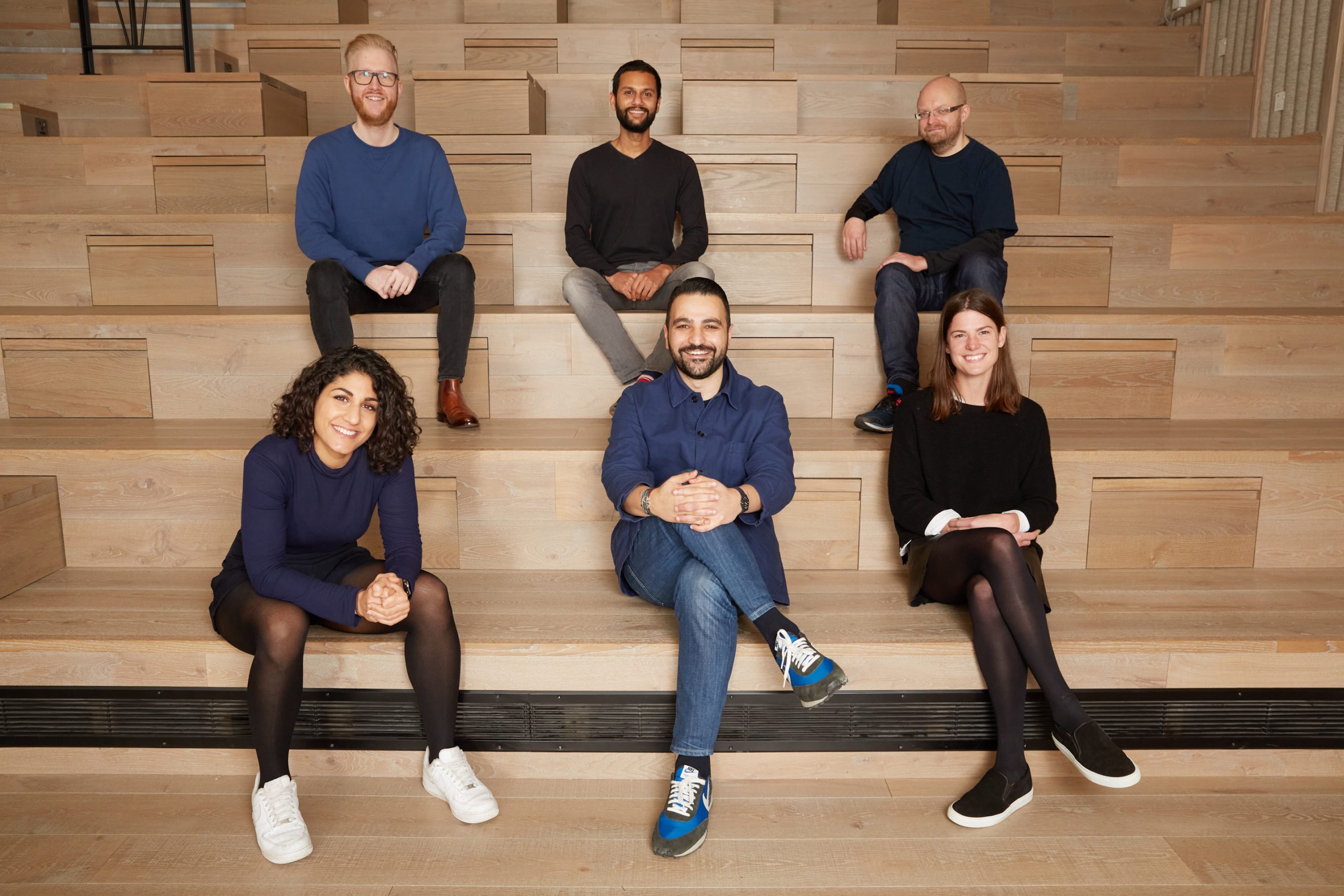
His own support came through colleagues, investors and relationships with the people the business served. That makes the early team photograph more than office decoration. A sole founder still needs other minds in the room. In Gaia’s early public appearances, chief operating officer Ines Cheaib was among the people helping turn the proposal into an organisation.
By October 2024, Gaia had 38 employees and operated in both the UK and the US. The solo beginning had become a collective undertaking. AlSalim’s advice also came with a warning about advice itself: an excess of other people’s opinions can become overwhelming. A founder must decide which suggestions deserve influence, a task that grows harder as the circle of interested people expands.
This is a refreshingly awkward position to occupy. Build relationships, then retain enough judgement to disagree with some of the people in them. Seek help, then make a decision. Entrepreneurship would be a much tidier occupation if every useful maxim did not arrive with another useful maxim pulling in the opposite direction.
Purpose has to survive the payroll
In 2021, AlSalim wrote about the relationship between purpose and recruitment. People joining Gaia, he argued, were attracted to difficult problems and a clear reason to solve them. The mission helped the young business attract talent before it could offer the reassurance of a long corporate history.
He also discussed differences between American and European appetites for joining early startups. In his account, a compelling mission could help people consider the risk. This was purpose doing a specific organisational job: giving prospective colleagues a reason to exchange an established path for a company whose future remained uncertain.
His discussion of social entrepreneurship extended beyond recruitment. He argued that large social challenges require policy and incentives at a systemic level, alongside private investment. It is an interesting qualification from a founder. Even while building his own company, he acknowledged that a business operates within arrangements it cannot remake by enthusiasm alone.
Put beside his banking background, these views give his ambition a particular shape. Profit and social usefulness belong in the same conversation, and the surrounding incentives deserve scrutiny. A mission may persuade someone to join. Keeping that person, paying them and organising their work still require the less quotable machinery of a functioning business.
Individual financing announcements. A debt facility is borrowing capacity, separate from equity investment. Bars show announcement amounts, not revenue or company value.
From London beginnings to American scale
The financing history charts a change in scale. In February 2021, Seedcamp announced its participation in a $3 million seed round alongside Kindred Capital and Clocktower. A year later came a $20 million round led by Atomico. On Valentine’s Day 2022, the announcement placed Gaia in front of a broader business audience. Romance had acquired a capitalisation table.
A further $14 million investment led by Valar Ventures was reported in January 2025. Then, in May 2026, Gaia announced a $100 million debt facility from Viola Credit to support its US expansion. The company’s reported equity funding stood at $37 million. The distinction between investment and borrowing capacity matters: these numbers describe different ways of financing a business.
By that May, Gaia reported more than 1,100 memberships and had added an employer offering to its distribution channels. AlSalim’s company had moved well beyond the first task of convincing someone that the idea deserved a hearing. It now had to operate across a larger network, with more relationships to maintain and more moving parts to coordinate.
Gollum gets a policy
For a glimpse of AlSalim away from financing announcements, consider a question put to him at the Insurtech Insights conference in London in 2024. Which fictional character would he design a personalised insurance product for? His answer was Gollum, with extra valuables cover for the ring.
It was a joke almost perfectly suited to the room: a fantastical creature, a notoriously problematic asset and an insurance opportunity. The more revealing detail came afterwards. AlSalim publicly credited Natalia Lavric for the answer. Having delivered the line on stage, he made sure its author received the applause in the comments.
The anecdote is small enough to resist becoming a leadership parable, which is part of its charm. Founders are often photographed as solitary sources of invention. Here was one admitting that even a good joke had arrived through collaboration. Gollum, who was not famously generous about sharing precious things, might have disapproved.
The work after the origin story
AlSalim has described wanting his son to understand why Gaia exists and the part his arrival played in it. It gives the business a personal horizon beyond its next financing announcement. The aspiration concerns what the company enables other families to attempt, and how he will explain the work at home.
His origin story remains useful because it explains the choice he made. It cannot perform the work that follows. The former banker has had to become a recruiter, a spokesperson, a negotiator and the leader of an expanding organisation. Each role asks for a different kind of judgement. There is no single conversion moment after which the business runs itself.
That is what makes his accidental beginning worth remembering. He started without a lifelong ambition to hold the title and without waiting for a co-founder to appear. He brought an existing skill to a question he cared about, then began assembling the people and capital required to pursue it. The accident was the introduction. The rest has required him to keep showing up.
Follow the conversation
Company, public profile and further reading.