The most revealing thing about MutableAI is what it stopped trying to be. In 2022, the young company arrived as a broad coding assistant: autocomplete in VS Code, natural-language instructions, documentation, type hints and early refactoring. Useful, certainly. Distinctive, not quite. The market already had GitHub Copilot looming over every blinking cursor. MutableAI’s more interesting move was to look away from the empty file and toward the unruly, already-existing repository.
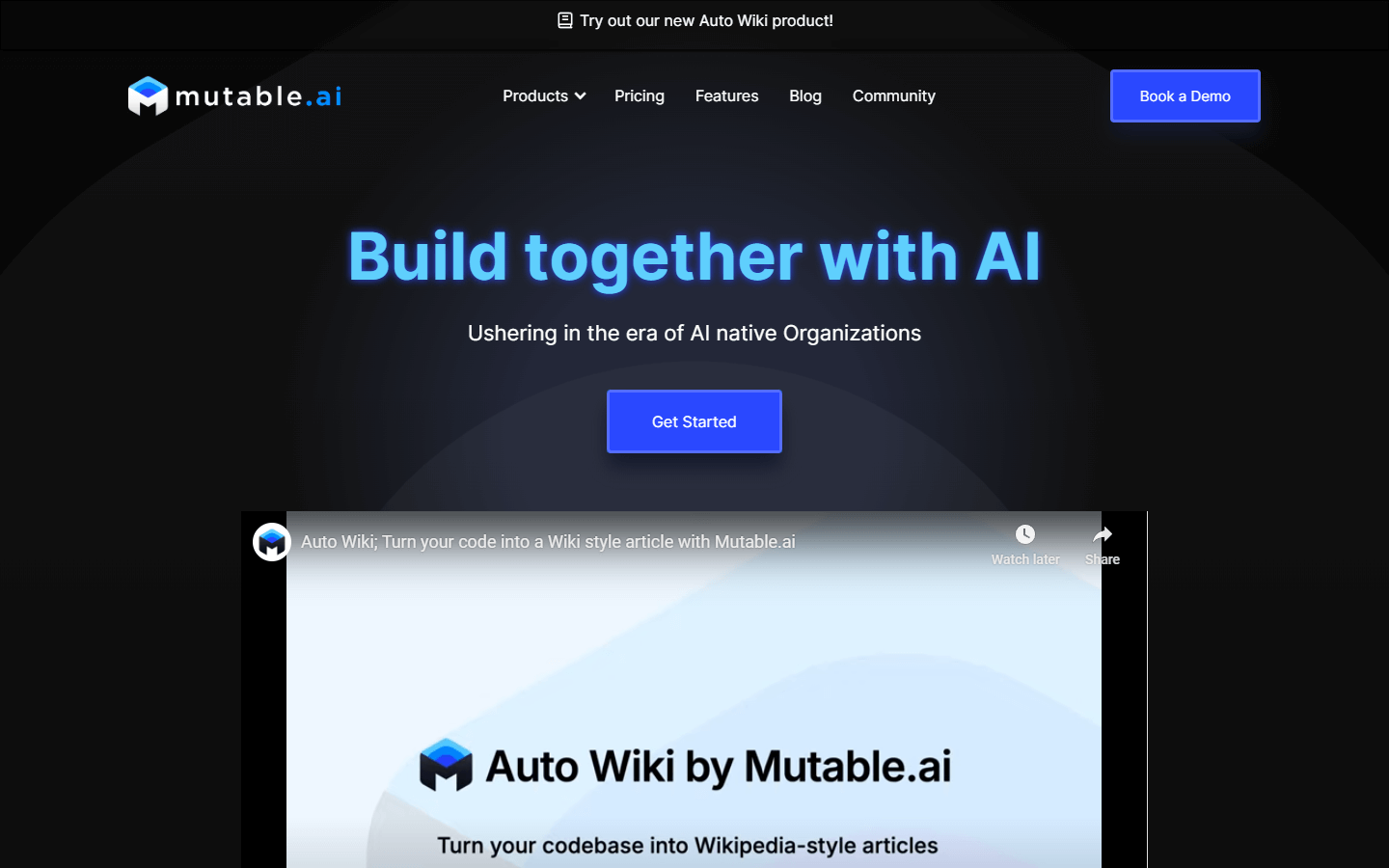
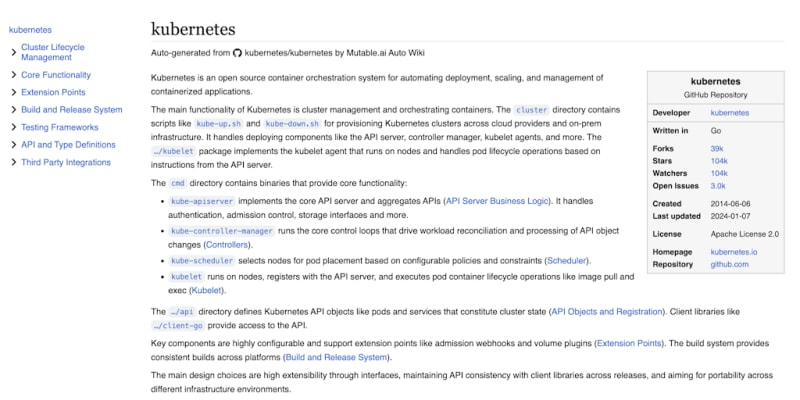
That pivot produced Auto Wiki. Feed it a GitHub repository and it generated a navigable explanation of the system, with pages, diagrams and citations pointing back to actual lines of code. The sales pitch was practical: source code is the only documentation guaranteed to reflect what the software does, but source code is a miserable onboarding manual. Auto Wiki tried to build the missing layer between those facts.
For a developer joining a team, an engineering manager facing an inherited service, or a curious maintainer opening Kubernetes for the first time, the appeal was immediate. MutableAI was less a robot pair programmer than the colleague who had read every file and left legible notes. Today you cannot sensibly buy it. Google acquired the company in November 2024. This is a guide to what worked, what did not, and why the idea outlived the product.
Who was it really for?
MutableAI’s natural customer was not the person starting a weekend to-do app. It was the person asking, “Where does authentication actually happen?” inside a repository large enough to make that question expensive. Auto Wiki was designed for unfamiliar systems, thin internal documentation, public projects with intimidating directory trees, and teams that could not keep prose synchronized with commits.
The workflow also suited software leaders who wanted a shared map rather than another private chat transcript. A wiki can be browsed, searched and linked. MutableAI’s generated pages made the model’s intermediate understanding visible. Instead of asking for an answer and receiving an oracular paragraph, a reader could move from a high-level explanation to the referenced definition in code.
There was a catch for security-minded teams. Private repositories had to be authorized through GitHub. In a Product Hunt exchange, Shams said private data was stored in AWS S3, staff access was logged, two-factor authentication was used, and the team would not inspect customer data without permission. He also said self-hosting was possible by contacting the company. Those statements were useful, but a commenter’s immediate question about where code went was exactly the right instinct.
From eager typist to patient reader
Founder Omar Shams started MutableAI in November 2021, quit his job, and entered Y Combinator’s Winter 2022 batch two weeks later as a solo founder. His background wandered productively through theoretical physics, DeepMind research and machine learning at Apple. The first company version cleaned up Jupyter notebooks. One customer and a seed round followed. Then came the more familiar bundle: AI code generation, code search, suggestions, cloud handoff and editor extensions.
Auto Wiki began as a side idea born from Shams’s own habit of exploring open-source projects. The first result did not charm his team. He shelved it. When he later ran into another repository he wanted to understand, he dusted off the code, improved it for a day, and found the result genuinely useful. That stubborn return matters more than the standard “scratch your own itch” slogan. He scratched, disliked the first answer, and waited until the itch came back.
The company committed fully after a January 2024 launch reached the Hacker News front page. Auto Wiki’s public examples included React, Kubernetes, D3, Bitcoin and Terraform. Later examples stretched to TensorFlow, AutoGPT, llm.c and OpenAI’s Transformer Debugger. MutableAI said it was processing the 1,000 most popular GitHub repositories while charging for private ones.
“It helped me understand the code. So it’s useful to me, it’s probably useful to others.”Omar Shams, recalling the Auto Wiki prototype
How the book report worked
Shams described the core technique as recursive summarization. The system moved from small units of source code toward progressively broader descriptions, eventually producing a human-readable map of the repository. He compared the idea to the renormalization group in physics: start with the microscopic details, repeatedly compress, and arrive at the macroscopic behavior. It is an unusually nerdy metaphor, and a good one.
The MutableAI loop
Read code
Files, definitions and relationships
Build a language map
Successive summaries and citations
Explain and answer
Wiki, diagrams, search and chat
That map did two jobs. It became documentation people could browse, and it became prepared context for the chat model. MutableAI argued that this “homework” produced better answers than fetching a handful of code chunks at question time. The company called it effectively infinite context. The language was cheeky, but the design insight was sober: make the model develop a persistent representation of the system before asking it to reason about the system.
Auto Wiki v2 added Mermaid diagrams, filters, search, manual edits and AI-directed revision. Private access followed the repository’s GitHub permissions. Wikis were refreshed monthly; a PR bot was presented as the mechanism for updating on commits and showing documentation diffs. By v3, the wiki and chat were joined into the “living expert” pitch.
What landed, and what wobbled
| Job | MutableAI approach | Editorial read |
|---|---|---|
| Onboarding | Browsable wiki with architectural summaries | Its clearest use. A shared starting map beats twenty isolated prompts. |
| Verification | Precise citations back to source | Helpful, but citations make checking possible; they do not make prose correct. |
| Freshness | Monthly regeneration and planned PR updates | The right problem, with a tension: regenerated pages may move under active readers. |
| Editing | Manual and AI revision | Reasonable, though Shams later said human editing was not heavily used. |
| Private code | GitHub permissions, hosted storage, enterprise deployment | A procurement conversation, not a casual checkbox. |
The product’s public reception was more curiosity than proof. Its 2024 Product Hunt listing had 114 points but no formal reviews. Commenters liked the time-saving idea while asking about storage, self-hosting, language coverage and why the generated pages did not live as Markdown inside the repository. One user hit a “No wiki found” message before seeing the value. That is a small launch-page complaint with a large product lesson: show the artifact before asking for trust.
MutableAI never named a final model publicly. Auto Wiki v2 announced a “better underlying model,” while the architecture and generated artifacts did most of the differentiation. Claims about a proprietary state-of-the-art model would be invention. What we do know is more useful: the system used LLMs, recursive summaries, GitHub integration, Mermaid diagrams, and a language map that persisted beyond one chat turn.
The honest limitation: generated truth
In a 2025 interview, Shams acknowledged that Auto Wiki could hallucinate. He still found the persistent summary more helpful than having no map, but that answer sets the proper operating rule. Generated documentation is an index, not authority. Follow the citation. Read the function. Run the tests. A confident paragraph about an obsolete module can cost more time than it saves.
The same limitation appeared when Google’s successor arrived. Reporting on Code Wiki noted criticism that generated explanations could be verbose, uneven and unaware that an indexed repository was obsolete. Continuously refreshing documentation solves staleness at one level while creating instability at another. If the whole page regenerates after a commit, a link shared yesterday may tell a different story today.
Still, MutableAI chose the right battlefield. Code is cheap to generate; understanding why existing code behaves as it does remains costly. Autocomplete helps the author in the moment. A repository map helps the next engineer, the reviewer and the person on call at 3 a.m. That social value is why the wiki concept feels more durable than the earlier grab bag of coding features.
The exit, and the afterlife
Alphabet completed its MutableAI acquisition on November 12, 2024, according to acquisition disclosures later tracked in Europe. The deal was reported publicly in March 2025 after Alphabet notified European Commission regulators under Digital Markets Act obligations. Terms were not disclosed. Y Combinator now marks the seven-person company as acquired.
Then, in November 2025, Google introduced Code Wiki in public preview. The product maintains structured documentation for repositories, updates it as code changes, links explanations to files and definitions, draws diagrams, and gives readers a Gemini-powered chat. Shams appeared on the launch byline as a Google Research engineer and has described Code Wiki as a rebuild of Auto Wiki. The resemblance is lineage, not coincidence.
For present-day buyers, compare Google Code Wiki and Cognition’s DeepWiki if the wiki format is what drew you here. For editor-first assistance, look toward GitHub Copilot, Cursor, Sourcegraph Cody, Continue and Tabnine. For dedicated documentation workflows, Mintlify belongs in the conversation. The useful evaluation question is not “Which one knows my whole repo?” Everyone now says that. Ask how its map is built, updated, secured and checked.
MutableAI’s best feature was not an answer. It was the visible homework behind the answer.
Verdict
MutableAI is no longer a product recommendation. It is a compact case study in finding the good company hiding inside the broad company. The early assistant wanted to finish your line, refactor your files, write tests, search code and shuttle work to the cloud. Auto Wiki made one sharper promise: help you read the thing before changing it.
That promise carried the startup to an acquisition and into a Google product. It also left behind a buyer’s checklist for every repo-aware assistant that followed. Does the tool expose its understanding? Can a human trace claims to code? Do updates preserve useful context? Can private data stay under appropriate control? And when the model is wrong, how quickly can you see it?
A startup can vanish while its point survives. MutableAI’s point was that software teams do not merely need a faster typist. They need a reader with a memory, a map and the manners to cite the page.
Follow the paper trail
historical MutableAI website · Y Combinator company profile · Auto Wiki v2 launch · Product Hunt discussion · Open VSX extension listing · MutableAI videos · legacy LinkedIn page
Omar Shams interview transcript · acquisition report · Google Code Wiki announcement · Code Wiki critique