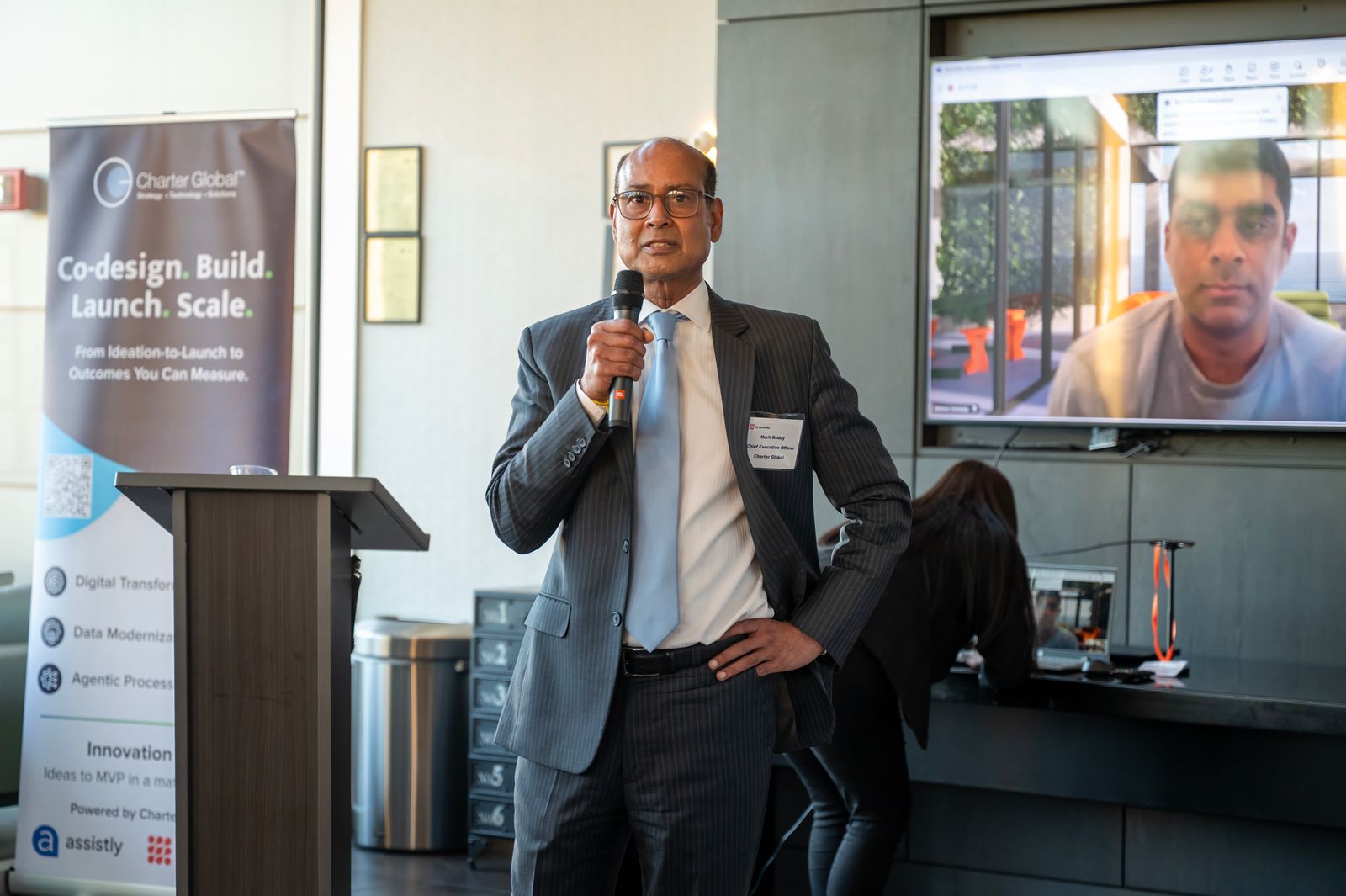
Murli Reddy took the microphone for a cause that required a rather different kind of delivery. In November 2025, the president and CEO of Charter Global performed stand-up comedy for Leap to Shine’s “Laughter Matters” fundraiser. An executive can ordinarily rely on a polite audience. A comedian has to earn the next ten seconds.
The purpose was education: helping children gain access to digital learning. Reddy joined business and community leaders willing to become the entertainment themselves. For someone whose working life has revolved around technology, the assignment was agreeably human. No software could oblige the room to laugh.
“Comedy brings people together,” he said afterward. The observation offers an unexpectedly useful entrance to his career. Reddy has spent more than three decades assembling people around technical problems, first through an Atlanta consulting company founded in 1994, and more recently through an AI venture called Orcaworks. Alongside that work runs a public commitment to education. The microphone brought those interests into the same room.
Before the digital co-worker, two founders
Charter Global began with Murli and Deven Reddy. The account accompanying Reddy’s 2023 interview describes two men out of college who felt conventional jobs were making insufficient use of their abilities. They started with their own labor and no outside investment. It is a suitably unadorned beginning for a business concerned with getting other businesses’ work done.
Georgia’s corporate record dates Charter Global’s formation to July 5, 1994. The date anchors a career that can otherwise disappear beneath the vocabulary of successive technology eras. Long before today’s talk of autonomous agents, Reddy was building a company that would have to keep finding useful work as customers’ systems changed.
There is a particular discipline in that kind of continuity. A consulting business must make itself useful repeatedly, with different teams, different requirements and different expectations. Its founding idea receives a fresh examination whenever a client brings a new problem. Thirty years give a company experience; the next assignment still expects an answer.
A long business, measured in delivered work
By 2016, Charter Global appeared at number 3,488 on the Inc. 5000. Its listing described an IT consultancy with offices in five American states, the United Kingdom and Canada, plus four global software development centers. For Reddy, the recognition attached to an operating company already more than twenty years old.
The company’s capabilities material later described nearly 1,000 consulting professionals and more than 100 completed project implementations, with an Atlanta headquarters and offices in the United States, India and Serbia. These are company-reported measures of scale. They also put some substance behind the word “global” on the door.
The work spans cloud migration, application modernization, data engineering, testing and automation. Such assignments rarely lend themselves to a glamorous photograph. A migrated system is not especially photogenic; a functioning process tends to attract less attention than a broken one. The usefulness lies in whether people can depend on what has been built.
Reddy’s career has unfolded in that practical territory. The business has served customers across sectors including finance, manufacturing, telecommunications, retail and hospitality. Different industries bring different constraints, but the recurring task remains recognizable: understand how an organization operates, then make the technology serve it.
March hires; October brings a launch
In March 2025, Charter Global appointed Rajesh Indurthi as chief technology officer. His remit included the company’s technology direction, new products and modern architecture. Reddy framed the appointment around product development and creating value for customers. It was a hiring decision with a visible next chapter.
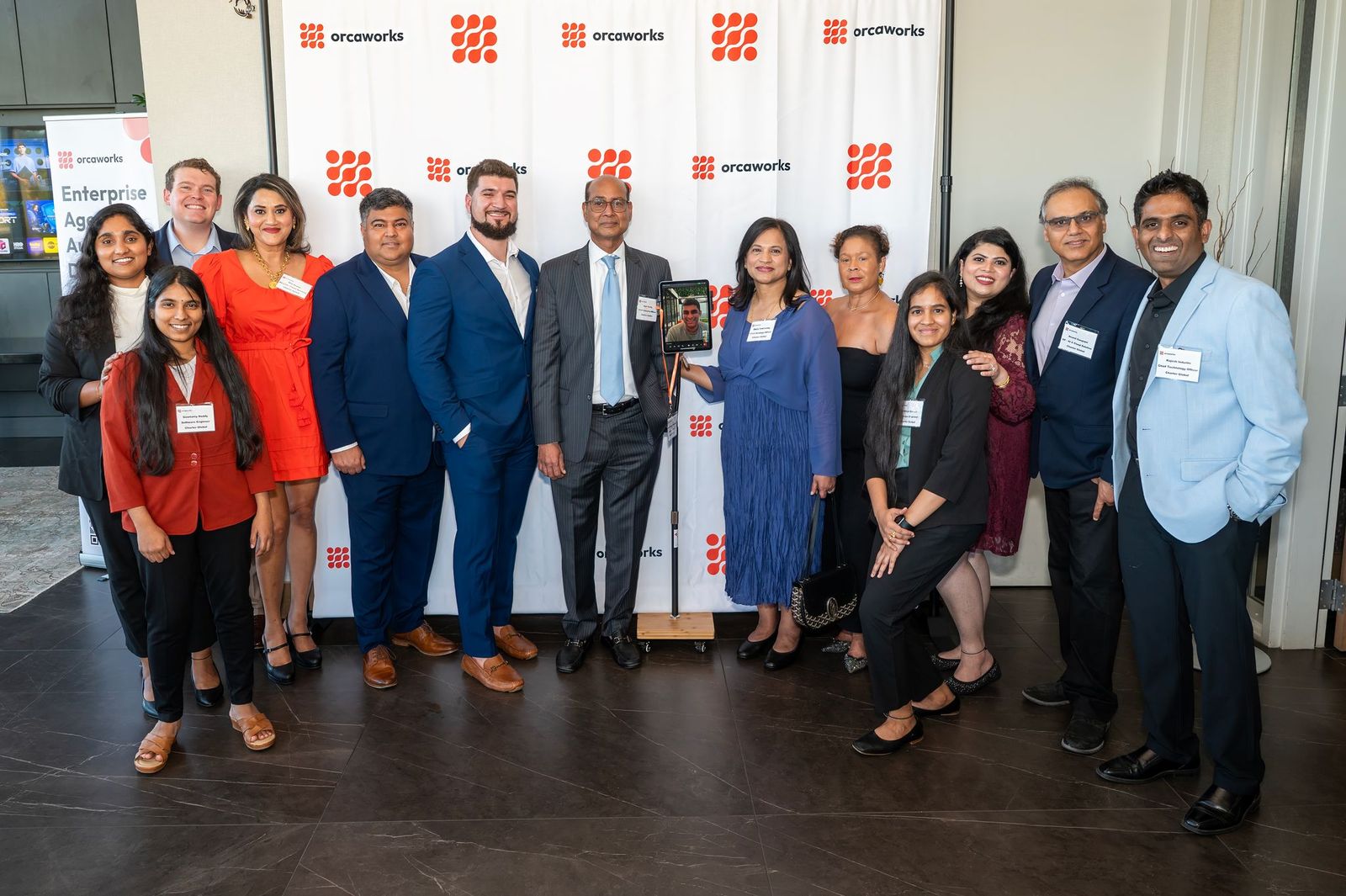
On October 20, 2025, Charter Global announced Orcaworks, co-founded by Reddy, Indurthi and Dr. Abhinav Somaraju. Reddy became CEO of the venture. Indurthi served as its chief information officer, Somaraju as chief AI officer, and Bindu Vemireddy as chief strategy officer. The new venture brought commercial, engineering, AI and strategy responsibilities into a named founding team.
The introduction included a private gathering at Bar Peri in Atlanta, where customers, partners and guests heard the team describe its plans. Neha Negandhi moderated a conversation with Indurthi and Somaraju. Reddy spoke about Charter Global’s passage through client-server computing, cloud services, analytics and intelligent automation.
For a founder still leading the business he helped establish in 1994, it was another beginning inside a long career. The company was extending its services experience into a product venture. That move has an appealing logic: years spent seeing how work gets stuck can supply a fairly extensive list of things worth fixing.
The inbox is part of the business plan
Orcaworks addresses a familiar office predicament: information lives in emails, documents and business systems, while somebody must decide what happens next. Its proposed digital co-workers read that context and act within existing tools. The underlying Orca Lattice platform coordinates and governs those agents.
Reddy’s stated audience includes midsize businesses carrying substantial operational complexity with fewer people and tighter margins. The attraction is easy to understand. An approval delayed in an inbox can become everyone’s problem; the email asking for an update then becomes another item awaiting attention. Administration is exceptionally talented at reproducing itself.
The venture describes a process that begins by defining an outcome with the customer, then mapping connections and workflows, building and testing, and moving into production with measures for comparison. Its announced offering emphasizes customer involvement, visibility into actions and human oversight. Those are product commitments whose importance lies in daily use.
- 01 / DefineAgree on the business outcome.
- 02 / ConnectMap tools, context and decisions.
- 03 / TestBuild flows and examine errors.
- 04 / MeasureCompare results in production.
Reddy’s public LinkedIn activity returns to the question of how AI operates amid enterprise workflows, accountability and governance. In that framing, the demonstration is only an introduction. The real relationship starts when a system must behave sensibly inside a working business, where exceptions have a habit of arriving before lunch.
Give the people doing the work a stake
Reddy’s own account of leadership puts execution close to the center. He argues for keeping long-range aims connected to short-term work, delegating to trusted colleagues and learning from mistakes. There is room for a vision, but also an expectation that somebody will attend to the details.
He describes transparency, recognition and reward as parts of his approach to retaining talent. His emphasis includes promoting people responsible for execution and using performance bonuses and stakeholder roles to create ownership. It is a concrete answer to a familiar managerial question: what happens to the people who actually carry the plan?
“A leader’s role extends beyond achieving financial success; it involves making a meaningful social impact.”
Murli Reddy
His published leadership principles also call for equitable opportunity and reject discrimination. These are the standards he sets out for his company and himself. Read alongside his interest in delegation, they describe an ambition to distribute responsibility and opportunity more widely than the founder’s own desk.
A former direct report, Ron Telleysh, offers a personal view in a public LinkedIn recommendation. He recalls Reddy listening, making considered decisions and mentoring junior associates. The detail about junior colleagues matters: accessibility becomes more tangible when it extends to people with little organizational rank.
Education keeps returning to the conversation
The education thread predates the comedy stage. At an Ekal Vidyalaya cultural event in the Atlanta area in March 2017, Reddy spoke about the responsibility to provide basic education so children could participate in a changing world. The evening’s performers included former Ekal students and teachers, bringing the work of the schools before their supporters.
Eight years later, Leap to Shine gave that interest a different format. Its “Laughter Matters” gala asked executives and community figures to train for stand-up performances. Eleven participants took part, with comedian Zain Sharif helping prepare them. The gathering raised a reported $200,000 for digital education in India; that was the event’s collective result.
The distinction is worth keeping. Reddy was one participant in a shared undertaking. The money supported access to tablets, laptops and learning tools. His company also described support for student sponsorships and girls’ education. The cause gave the evening a purpose beyond testing whether a CEO could survive a punchline.
His community connections continued into 2026. Murli and Bindu Reddy were recognized among the gold sponsors of NRIStories, an Atlanta gathering built around people telling their own life stories. It is a quieter form of participation than taking the stage, but it helps make a stage available to others.
The September 26, 2026 event took place at Bliss Events & Banquet Hall in Suwanee. Seven storytellers addressed an audience gathered around lived experience, with music, dinner and recognition woven into the evening. For Reddy, sponsorship placed him among the people supporting that community gathering, rather than at the center of its stories.
Another beginning, with experience attached
There is a consistent question running through these different settings: what should technology allow people to do? In the business, Reddy is pursuing systems that reduce repetitive work. In education, he has supported access to the tools through which children can learn. The settings differ; the concern with participation recurs.
His career now contains both the established consulting company and the newer AI venture. One supplies a long operating history. The other asks him to build again with a founding team and a product proposition. Experience offers perspective, although customers will still want to know what works on Monday morning.
And then there is the comedy. It is a welcome detail in a career usually described through titles and technical services: a founder willing to become a beginner in public for an educational cause. After decades of professional delivery, Reddy accepted an assignment in which the audience could judge the result immediately. The next laugh, like the next useful product, had to be earned.