At a large American personal injury law firm, the difficulty was deciding where a case should go. More than 80 attorneys worked across multiple offices. Cases arrived continuously. Yet the rules for assigning them lived partly in people’s heads. The firm had accumulated expertise without turning that expertise into a consistent operating system.
- The work: custom software, cloud modernization, data engineering, and enterprise integration.
- The method: small teams that own a defined outcome from discovery through delivery.
- The new bet: turning consulting experience into AI products through i3Labs and Orcaworks.
Charter Global’s account of this engagement describes manual handoffs, inconsistent workflows, and fragmented documentation. Its response brought legal operations, process design, and Orcaworks expertise into one compact team. Discovery and workflow design ran together. Before automating an assignment, someone had to make the assignment rules explicit. That is a useful place to begin understanding this Atlanta engineering company.
01 The business between the boxes
Founded in 1994, Charter Global combines consulting, custom development, and technical staffing. Its engagements are managed locally and executed globally, with U.S. offices and development centers in India. Customers can bring it a new application, a legacy platform, a migration, or a shortage of engineering capacity. The commercial relationship can start at several different doors.
The company works with mid-sized organizations and Fortune 1000 enterprises. Public customer material includes NCR, Allconnect, ADP, MARTA, and Kobie Marketing. Those names cover very different businesses. Their common problem is that software must operate inside an existing organization, with existing data, habits, and obligations. A new interface is only one piece of the job.
Consider its telecommunications migration case. The client managed more than 500 applications in an on-premises Hadoop environment and wanted to move to Azure because of cost inefficiencies and platform limitations. Charter Global describes three-week migrations per application and an approach that preserved the operations team’s support process. The interesting constraint was continuity: the people running the system still needed to recognize their work.

02 Shrink the team. Keep the ownership.
Charter Global calls its compact delivery teams Impact Pods. A typical pod has four to seven practitioners spanning disciplines such as product, engineering, DevOps, and quality assurance. The advertised structure uses four-week sprints and weekly checkpoints. The premise is straightforward: the people defining the problem should remain close to the people building and testing the answer.
“Most delays aren’t technical, they are structural.”
Charter Global · Impact Pods
Its delivery approach begins with users, workflows, constraints, and success criteria, then tests working prototypes against real data. Security and integration enter during the build. This is a practical operating discipline for a buyer to copy. Put the decision-maker, the engineer, and the person responsible for acceptance into the same conversation before expanding the team.
A reading of Charter Global’s delivery method, not a promised project schedule.
03 Ninety days, and a pile of paperwork
Assistly gives that method a tangible shape. The senior-care management platform addresses daily logs, care tasks, incident reporting, and family communication. These are ordinary administrative jobs with consequential details. A caregiver’s update must reach the right person; a record must remain usable later. Paperwork is part of delivering the service.
Charter Global says it took the platform from concept to production in three months. Its case study names React and Locofy for frontend work, GitHub Copilot for API development, Figma-to-code workflows, and AWS microservices. The useful detail is the connected development process: design, implementation, and deployment were arranged to reduce the waiting between them.
Assistly’s reported concept-to-production timeline.
One company case study. Scope matters.
A buyer should read that timeline as a project to examine. Which workflows reached production? Who tested them? What counted as acceptance? A tightly bounded first release can move quickly; an expanding wish list changes the equation. The lesson is to agree on a usable first outcome and put it in front of the people doing the work.
04 The consultant builds a coworker
The next step arrived publicly in October 2025, when Charter Global unveiled Orcaworks and its flagship Orca product in Atlanta. Reporting on the launch connected both Orca and Assistly to i3Labs, the company’s internal innovation hub. Reddy described the offering as “a practical path from pilot to production.” The move extends a services business into reusable software.
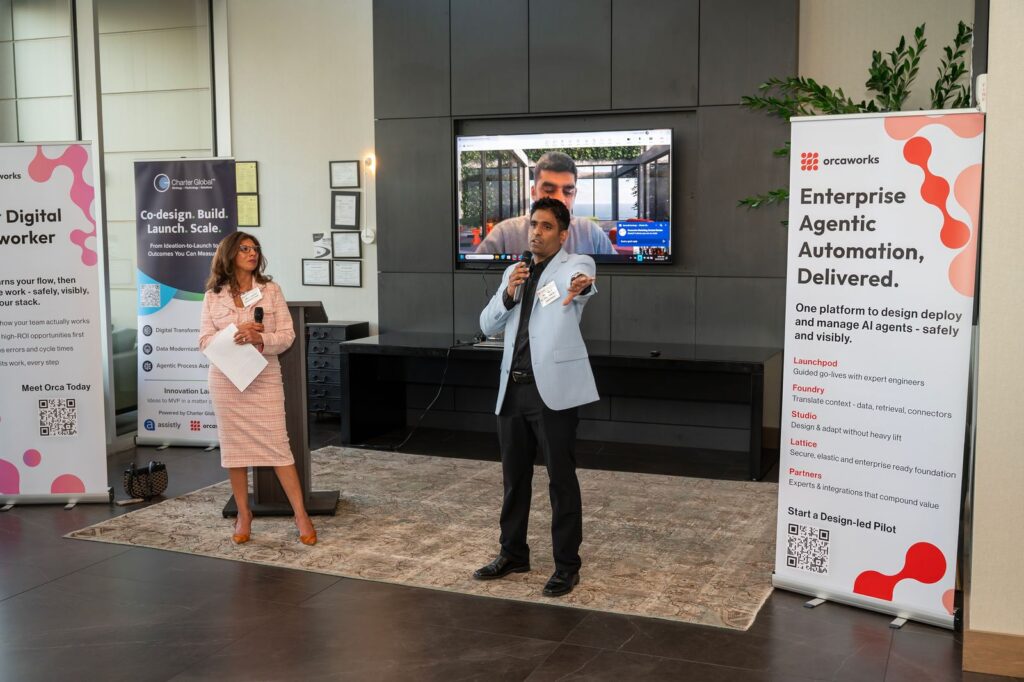
Orcaworks presents Orca as a digital coworker operating across existing business tools. Its platform describes versioned rules, permissioned actions, human approvals, and audit trails. In practical terms, the pitch is to carry work across systems while preserving the business’s authority over what happens. The permissions deserve as much attention as the AI model.
This combination places Charter Global among digital engineering consultancies and systems integrators, with an additional product offering. Buyers can compare it with firms such as EPAM or Persistent, a specialist agency, or their own engineering team. Its distinctive proposition is the combination of technical staffing, delivery teams, and products informed by operational work. That combination still needs to fit the particular assignment.
05 Buy the outcome you can inspect
The business model follows the work: consulting, development, staffing, and ongoing support, alongside platform services. The pod offering includes a fixed monthly pilot with defined scope. For a buyer, the meaningful cost calculation includes internal review time, integration access, testing, and operating responsibility. A contract price alone cannot describe the effort required to make software useful.
The practical boundary is organizational. If nobody owns the routing rule, a faster development team cannot settle it. If production data is inaccessible, a prototype cannot prove much. Start with one workflow, an accountable owner, and an observable result. Add capacity when that result holds up. Charter Global’s most transferable idea is giving the whole problem a team small enough to keep it in view.